
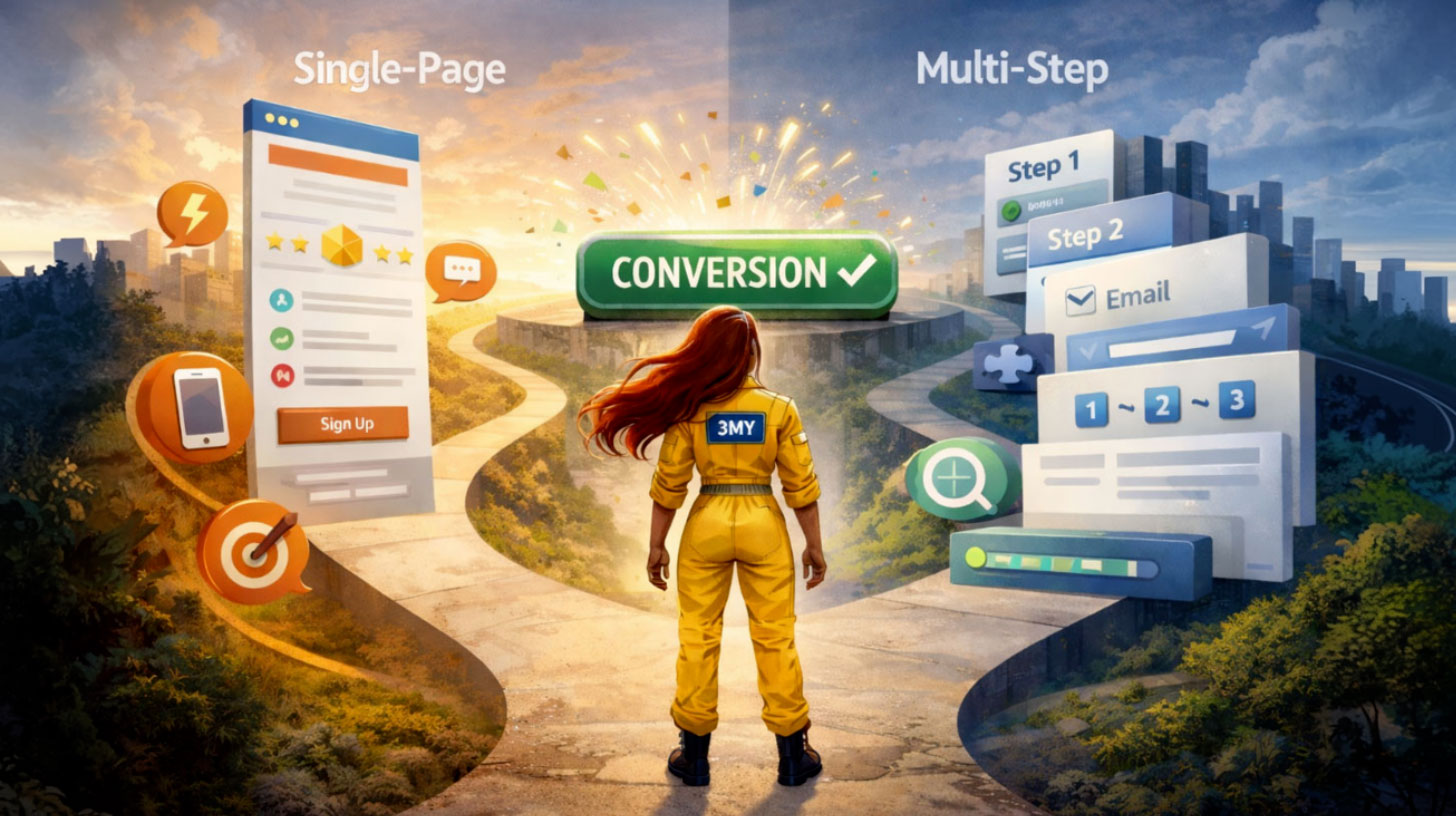
Single-Page vs. Multi-Step Landing Pages: Pros & Cons
Landing page format affects conversion rates more than most marketers realize. Whether you’re generating leads, selling a product, or collecting survey responses, the way you structure the page changes how users behave. The two most widely used formats—single-page and multi-step—offer distinct advantages, depending on the context.
The goal of this article is not to crown one type the universal winner, but to help you understand which format better fits specific goals, audiences, and channels.
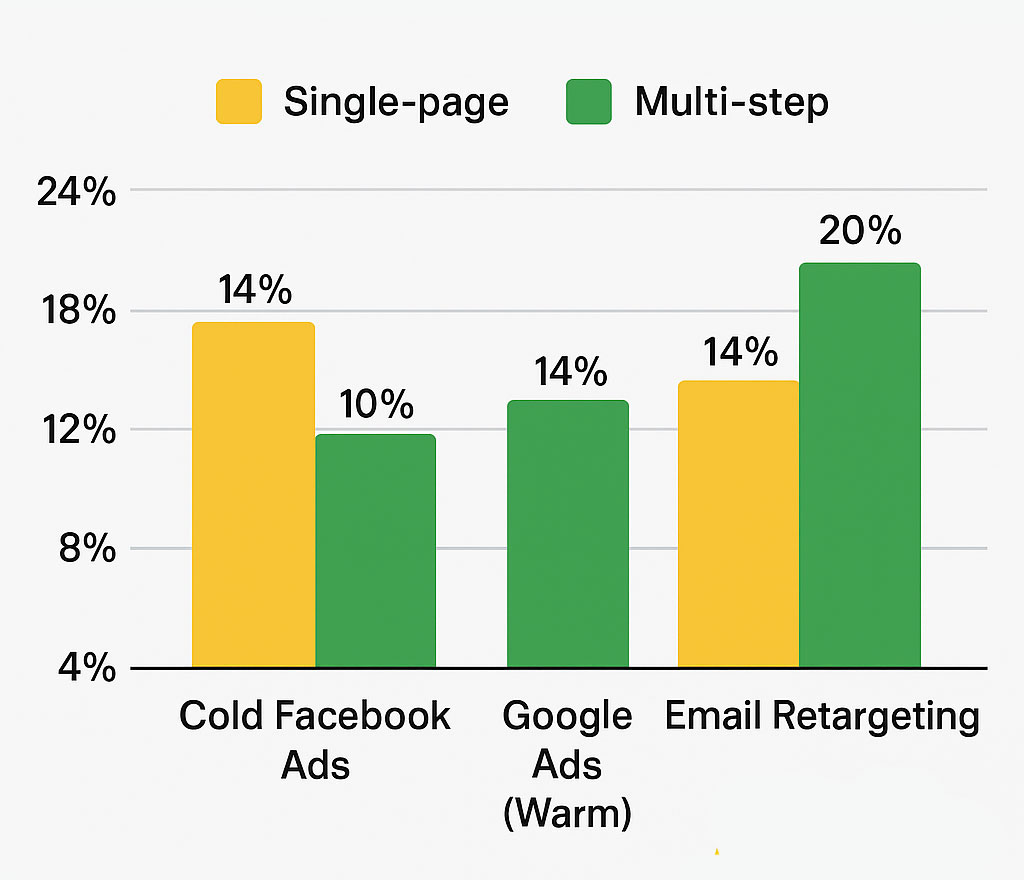
Conversion Rate by Landing Page Type and Traffic Source
This chart compares conversion rates for single-page and multi-step landing pages across key traffic sources. Results are based on A/B testing data from 3MY campaigns. Multi-step pages show higher performance on colder traffic, while single-page performs better on warm and retargeted users.
1. Definitions
Single-page landing page: A standalone page where all copy, benefits, visuals, and forms are presented in one scrollable experience. All information, persuasion triggers, and the form are located in one unified flow, reducing interaction steps and keeping everything immediate.
Multi-step landing page: A multi-phase experience where the user completes one action per screen. This often starts with a micro-commitment (e.g. selecting a service or entering an email) and progresses through 2–5 steps before conversion. Each step is designed to feel small, reducing overwhelm and increasing completion for more complex flows.
2. Pros & Cons Comparison Table
| Format | Pros | Cons |
|---|---|---|
| Single-page | Fast to build, ideal for mobile, low friction | Can feel overwhelming if content is dense |
| Great for simple offers or retargeting | No segmentation or lead qualification | |
| Easy to test variations quickly | Lower-quality leads for complex services | |
| Lower bounce rates when content is structured well | SEO value often limited to one keyword focus | |
| Multi-step | Segments users as they proceed | Longer interaction time can increase drop-off |
| Encourages micro-commitments | Requires more development time and analytics setup | |
| More data per lead, better for personalization | Poorly optimized steps frustrate users | |
| Ideal for qualification-based funnels | Incompatible with fast-decision offers |
3. When to Use Each Type
Single-page is best when:
- The offer is simple (newsletter, freebie, trial)
- You’re running paid traffic with a clear CTA
- You want quick tests and fast iterations
- You’re targeting mobile-first users
- Your funnel is linear and conversion requires no segmentation
- You need to launch fast, with fewer dependencies on back-end logic
Multi-step is best when:
- You need to pre-qualify leads (budget, region, etc.)
- The offer has high friction (consultation, B2B SaaS)
- You want richer user data for nurturing
- You’re running cold traffic that needs warming up
- You want to personalize follow-ups based on earlier answers
- You’re working in regulated industries (finance, health, legal)
4. Examples of Each Format
Single-page use cases:
- “Get your free guide” or checklist campaign
- Simple service inquiries (plumber, yoga trainer, consultant)
- Local events or online webinar signups
- Pre-launch campaigns with one CTA and limited info
Multi-step use cases:
- Service providers with location-specific teams (e.g., real estate, legal services)
- Healthcare forms requiring step-by-step logic and disclaimers
- Financing or credit score tools requiring layered inputs
- E-commerce with personalization quizzes or upsell funnels
- Complex SaaS trial flows asking for use case, team size, or role

5. How 3MY Chooses the Right Approach
At 3MY, we don’t start with layout. We begin with the conversion goal, type of offer, and traffic source. Then we:
- Map the ideal customer journey
- Identify where friction or confusion might occur
- Align form strategy with conversion psychology
If a campaign targets cold traffic from Facebook for a high-touch B2B service, we might build a 3-step funnel to pre-qualify users by region and budget. If it’s a Google Ads campaign promoting a free eBook, a single-page format often performs better.
We A/B test layouts frequently, and leverage tools like:
- Hotjar or Microsoft Clarity (for heatmaps)
- Form analytics for drop-off insights
- GA4 + Tag Manager to monitor conversions at each step
6. Extended Tips for Maximizing Performance
- Start small: Your first field should always feel easy. Use email or multiple-choice before asking for open-ended answers.
- Use logic branching: In multi-step forms, dynamically change questions based on previous answers.
- Minimize distractions: Remove header navigation, footer links, or anything that leads off-page.
- Use proof early: Social proof or testimonials above your CTA increase trust and conversions.
- Add visual progress indicators: People like to know how much is left to complete a form.
- Optimize every screen for mobile: Test step-by-step or scroll interactions with your phone in hand.
- Validate as they type: Don’t let people hit submit and get a wall of red errors.
7. Real Performance Differences in Practice
In multiple tests across service industries, we found:
- Multi-step landing pages reduce bounce rates by 20–35% when traffic is cold and hesitant
- Single-page forms convert 15–25% higher when the offer is clear and urgent (e.g. ebook download)
- Multi-step flows deliver leads with 2x better data quality (full name, phone, budget, region)
- Drop-off rates spike after the third step unless visual cues and auto-fill tools are used
These findings guide how we design landing experiences—not just by theory but by live data.
8. Summary: Which Landing Page Type Is Right for You?
Don’t default to one format. Match structure to:
- The audience’s familiarity with your brand
- The level of commitment you’re asking for
- How much segmentation you need
- The traffic source you’re using (organic, paid search, social, etc.)
Single-page: Best for low-friction offers, mobile-first campaigns, quick iterations.
Multi-step: Best for segmentation, lead qualification, higher-value conversions.
About 3MY
3MY is a conversion-focused digital agency that designs and builds landing pages engineered for real results. From fast-loading single-page builds to data-rich multi-step funnels, we test, optimize, and improve every layer of your lead flow.
We help:
- Define your user journey based on intent and traffic
- Design the right landing page architecture
- Validate form logic with real analytics and behavior data
- Launch and iterate with high-speed A/B testing
Want to build smarter landing pages that perform?