

Too many businesses approach Google Ads as if it were a magic switch. They create a campaign, set a daily budget, and expect results to roll in overnight. But Google Ads doesn’t work on wishful thinking. It’s not magic. It’s a performance system and like any system, its output depends on the quality of its inputs.
When campaigns underperform, it’s rarely because Google failed. The problem usually lies in the strategy: poor keyword targeting, weak ad copy, irrelevant landing pages or a lack of conversion tracking. These small gaps quietly drain budgets and leave businesses frustrated.
If you’re seeing clicks but no conversions, impressions but no growth, it’s time to audit your foundation. This guide outlines the real reasons campaigns fail, what to check, and how to fix them based on what actually moves results.
Let’s break it down.
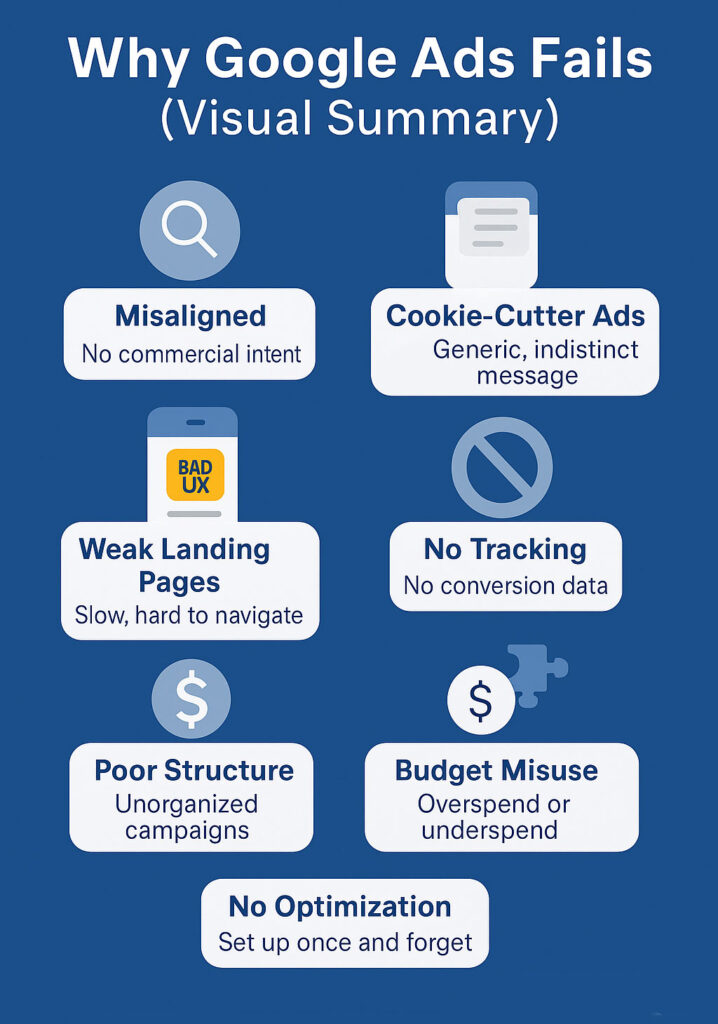
Why Google Ads Fails: Key Issues at a Glance
Misaligned keywords, vague ads, poor landing pages, and missing tracking all contribute to weak campaign performance. Use this visual summary to spot and fix what’s holding your results back.
1. Misaligned Keywords and Intent
Google Ads matches your ads to user searches, but if those search terms aren’t tied to commercial intent, you’re paying for irrelevant clicks.
Common Issues:
- Generic keywords like “CRM” or “email platform”
- No negative keywords (“free”, “jobs”, “tutorial”)
- Lack of keyword-level intent mapping
Quick Fixes:
- Use long-tail, buyer-focused keywords (“CRM for finance teams”)
- Audit and update Search Terms weekly
- Expand negative keyword list continuously

2. Cookie-Cutter Ad Copy
Ads that sound like everyone else’s get buried. Your copy needs to communicate clear value and a good reason to click now.
Questions to Answer:
- Does your headline solve a user problem?
- Is the call-to-action persuasive and context-specific?
- Do you highlight unique benefits, social proof, or guarantees?
Improvement Tips:
- Use structured copy frameworks (problem > benefit > CTA)
- Test multiple headlines and descriptions
- Match messaging to search intent (transactional vs informational)

3. Weak Landing Page Experience
Even the best ad won’t convert unless the landing page delivers. It needs to be fast, relevant, and clear.
Key Checks:
- Page speed < 2 seconds on mobile
- Clear headline that matches the ad
- Visual hierarchy and obvious next step
- Mobile-responsive design
Fix It Fast:
- Simplify layout: one focus, one CTA, minimal clutter
- Ensure consistent messaging between ad and page
- Improve mobile UX — no hidden menus or hard-to-click buttons
4. Zero or Incomplete Conversion Tracking
“No tracking, no optimization.” It’s that simple.
What to Check:
- Are form submissions, phone calls, or purchases tracked?
- Is conversion data imported into Google Ads or Analytics?
- Do campaigns have enough conversions (15–30/month) for smart bidding?
Immediate Actions:
- Install tags via Google Tag Manager
- Test using Tag Assistant
- Link Analytics and Ads for deeper insights
5. Poor Campaign Structure
If your campaigns look like a random mix of keywords and ads, Google sees them as low-relevance and charges you more.
Symptoms:
- Ad groups with 50+ unrelated keywords
- One ad set tied to multiple funnel stages
- No consistent naming conventions
Best Practice:
- Create tightly themed ad groups (1 intent per group)
- Align ad copy and landing pages to each group’s keywords
- Name logically (e.g., [Service] – [Location] – [Intent])
6. Mismanaged Budget Allocation
Budget misalignment sabotages performance — either by underfunding high performers or overspending on low-converting segments.
Signs of Misalignment:
- “Limited by budget” alerts on top-performing campaigns
- Low-intent campaigns consuming most of the budget
- Spending thresholds not aligned with expected CPC
Solution Approach:
Calculate daily budget:
Monthly Conversions × Target CPA ÷ 30.4
- Allocate first to middle and bottom-of-funnel campaigns
- Adjust budgets weekly based on performance
7. No Ongoing Optimization
Google Ads requires regular attention. If you’re not reviewing performance and adapting, your ROI will decline.
Common Failures:
- No weekly traffic and conversion review
- Underperforming ads left active
- No testing of new creatives or keywords
Optimization Strategy:
- Schedule weekly check-ins on campaign health
- Pause low performers; scale high performers
- Use A/B testing for ads, landing pages, budget shifts
What We Do at 3MY
At 3MY, we don’t run Google Ads on autopilot. We manage it as a focused performance system — designed to drive measurable results, not just traffic. Here’s how we approach every campaign.
Intent-led keyword strategy
We go beyond search volume and focus on what people actually want. Every keyword is selected based on commercial intent, funnel stage, and search behavior. This ensures your ads reach people who are ready to take action — not just browsing.
Ad copy that converts
We write with clarity and precision. Our ads speak directly to the user’s need, highlight your unique value, and prompt real clicks. No filler, no buzzwords — just relevant messages that align with what the user searched.
Landing pages built to convert
A click is only valuable if it leads somewhere. That’s why we create landing pages that are fast, mobile-friendly, and focused on a single goal. Every page is designed for clarity, trust, and ease of conversion — no clutter, no confusion.
Full-funnel conversion tracking
We track everything, from form fills and phone calls to micro-interactions like button clicks and scroll depth. This data feeds directly into your campaigns so we can optimize based on actual results — not assumptions.
Ongoing testing and optimization
We don’t wait for performance to dip. Every week, we review what’s working and what’s not. We test new ad variants, update targeting, and adjust budgets to push your ROAS higher with each iteration.
We don’t guess. We measure, improve and repeat.
Is It Time to Reevaluate Your Google Ads?
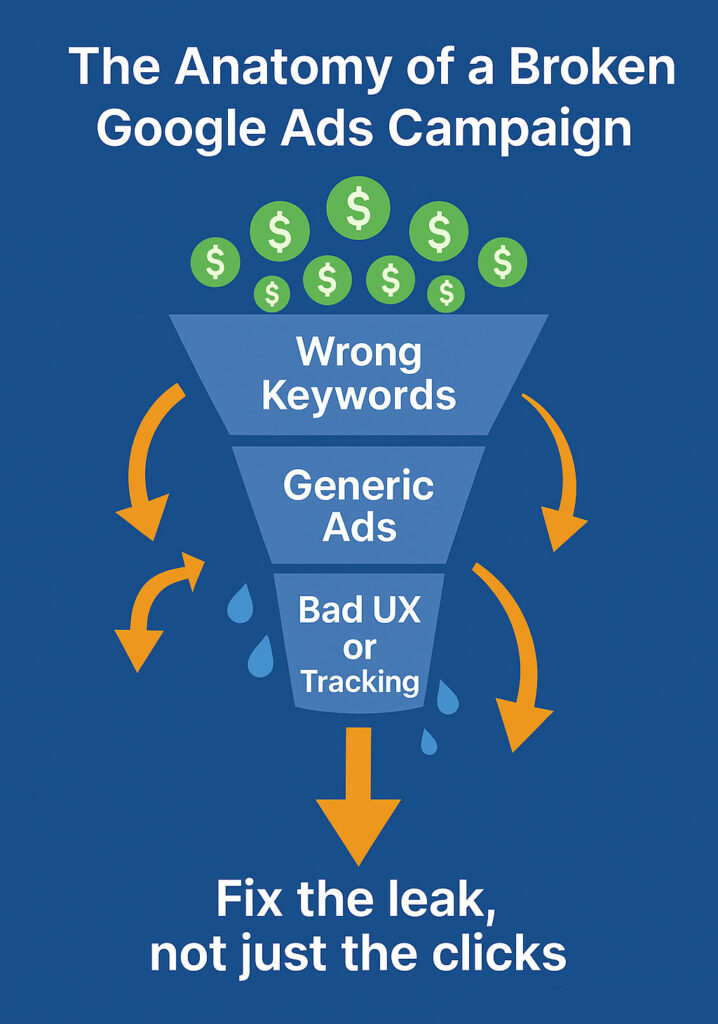
The Anatomy of a Broken Campaign: Where Your Budget Leaks
Wrong keywords, generic ads, and poor landing experiences cause invisible losses at each funnel stage. Fix the funnel – not just the top.
If your campaigns are getting clicks but not turning them into business, something is off. It could be the keywords, the copy, the targeting, the landing page or all of it working against you.
But here’s the good news: everything in Google Ads is measurable and fixable. You just need to know what to look at and what to adjust.
Request a Free Google Ads Audit
We’ll review your setup, identify weak points, and give you a clear roadmap to better results – based on data, not guesswork.
Let’s turn your ad spend into growth.