


Whether you’re running paid search or display campaigns, every click costs money. But not every click becomes a customer – especially if your site loads slowly. If your landing page lags, users bounce, and you lose conversions before they even begin.
In this guide, we’ll break down why site speed is one of the most overlooked drivers of ad performance and how to improve it.
Why Site Speed Is the Hidden Driver of Your Ad Performance
Most advertisers focus on bids, targeting, and ad copy, but forget the most important element: the user’s experience after clicking.
If your website doesn’t load quickly, it won’t matter how compelling your ad was. The user leaves, your spend is wasted, and your campaign metrics suffer.
Slow site speed leads to:
- Higher bounce rates — the longer the page takes, the more visitors give up before it finishes loading
- Mobile abandonment — the figure everyone quotes here (53% of mobile visits abandoned past three seconds) comes from a Google study published in 2016. It is old, and we cite it as a secondary source — but nothing measured since has pointed the other way
- Conversion drop-offs — the loss is gradual, not a cliff: every extra fraction of a second costs you a slice of the people who would have converted
- A weaker landing page experience — speed is part of how Google rates the landing page, and a weak rating shows up as higher CPCs and worse positions. That is not a penalty; it is the auction pricing relevance
Google Ads + Site Speed = A Performance Multiplier
Google uses three main components to calculate your Quality Score:
- Expected click-through rate
- Ad relevance
- Landing page experience — which includes site speed
A higher Quality Score means:
- Lower cost-per-click (CPC)
- Better ad placements
- Higher ROI without increasing your budget
A slow site drags all three components down. Even if your targeting is perfect, if your landing page takes too long to load, users leave before converting — and Google charges you more for less.
What Slows Down Your Site
Here are the most common performance killers we find in client audits:
| Problem | Impact |
|---|---|
| Uncompressed images | Large file sizes delay loading, especially above the fold |
| Third-party scripts & trackers | Add latency and block render |
| No caching or CDN | Forces every asset to reload from scratch |
| Large CSS/JS files | Delays first content paint |
| Poor mobile optimization | Slower devices and networks magnify existing issues |
These issues compound on mobile, where most paid traffic now lands first.
How to Fix It — Fast
Here’s a practical action plan you can apply immediately:
| Area | Fix | Tools |
|---|---|---|
| Speed Audit | Test on mobile & desktop, measure Core Web Vitals | PageSpeed Insights, GTmetrix |
| Image Optimization | Compress, resize, and use WebP or AVIF formats | TinyPNG, CMS plugins |
| Minify & Defer | Reduce CSS/JS size, load scripts asynchronously | WP Rocket, developer tools |
| Browser Caching | Store static files locally for returning users | CMS settings, server config |
| Enable CDN | Distribute assets from edge locations | Cloudflare, BunnyCDN |
| Script Cleanup | Remove or delay third-party scripts and plugins | Tag Manager, audit manually |
These changes don’t require a full redesign — just smart technical adjustments.
Core Web Vitals: Your Technical Baseline
Google’s Core Web Vitals measure the actual user experience and directly affect your Quality Score and organic rankings.
Your targets should be:
- LCP (Largest Contentful Paint): under 2.5 seconds
- INP (Interaction to Next Paint): under 200 ms. INP replaced First Input Delay as a Core Web Vital in March 2024 — if a report still grades you on FID, it is out of date
- CLS (Cumulative Layout Shift): under 0.1
Google counts the target as met when at least 75% of visits clear it. That is the number to aim for, and it carries across everything Google measures — paid search included.
What We Do at 3MY
At 3MY, we treat landing page speed as a strategic asset, not just a checkbox.
Here’s how we handle it:
- Real-device testing — not just lab tools, but real conditions across 4G, 5G, and Wi-Fi
- Full technical audits — covering Web Vitals, server response, and user behavior
- UX + speed optimization — to align your ad message with a fast, relevant landing experience
- Performance benchmarking — so you can see bounce rate, CPC, and conversions improve over time
We don’t stop at the ad click — we make sure the rest of the journey performs just as well.
The ROI of Speed
Investing in speed has one of the highest returns of any campaign improvement.
- Every second you cut is a share of paid clicks that reaches your page instead of bouncing off it — you already bought those clicks
- A stronger landing page experience feeds back into the auction: better positions for the same bid
- Increased Quality Score means you win more auctions, spend less per click, and get more from your budget
In short: better speed = more conversions, lower cost, higher ROI.
How Load Time Impacts Conversions
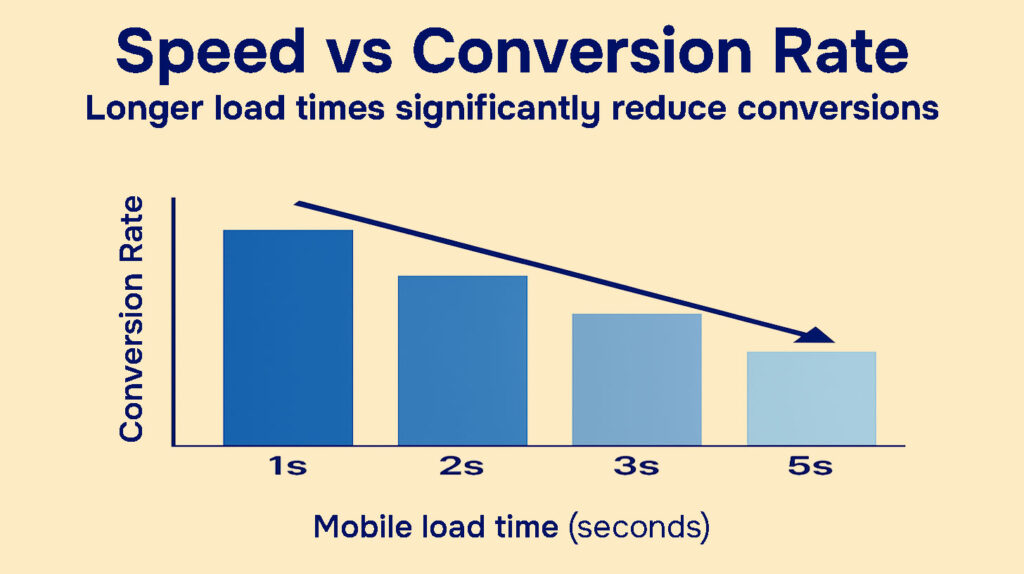
Every second counts. This chart shows how even small delays in site speed dramatically reduce conversion rates and how improving speed boosts every dollar spent on ads.
🏁 Ready to Maximize the Value of Every Click?
Your ads are only as strong as the pages they lead to. Don’t waste budget driving traffic to a site that underperforms.
Request a Free Google Ads Audit
We’ll evaluate your landing experience, uncover speed bottlenecks, and help you turn more clicks into real results.