


Manual vs Automated Bidding (Explained Simply)
When setting up online advertising campaigns, one of the most important decisions is how to manage your bids. The choice between manual bidding and automated bidding can significantly impact your results. While both aim to optimize budget usage and drive performance, they do so in fundamentally different ways.
This guide breaks down how each strategy works, their technical differences, and when it makes sense to use one over the other.
What Is Manual Bidding?
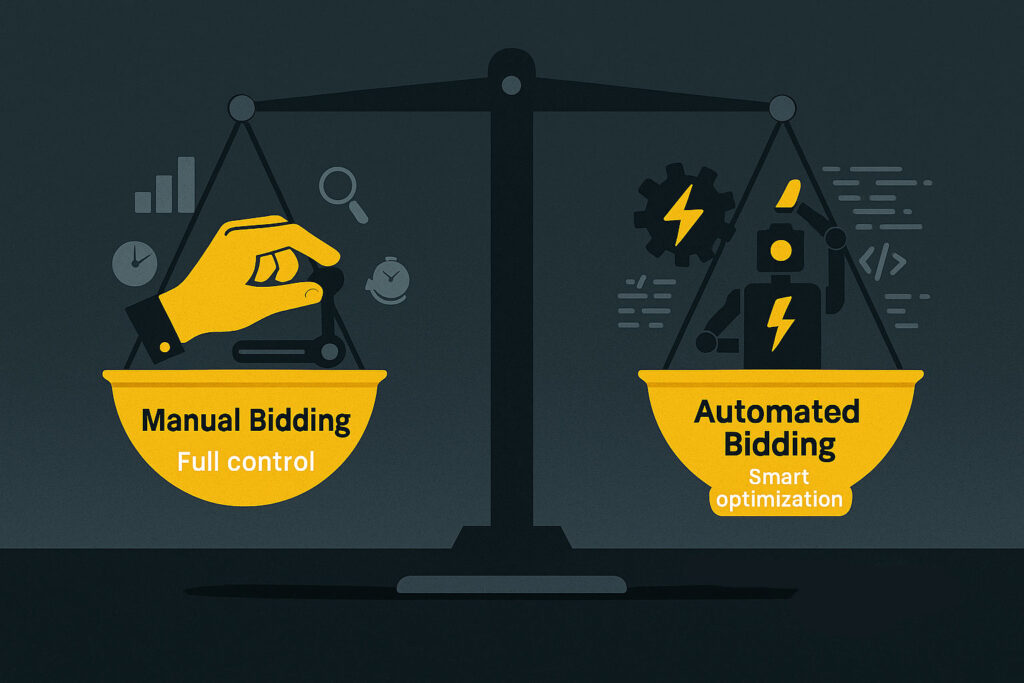
Manual bidding gives advertisers full control over how much they are willing to pay for each click, impression, or action in their campaigns. You decide the maximum cost-per-click (CPC) or cost-per-thousand impressions (CPM) for individual keywords, ad groups, or placements.
How It Works
In this approach, you analyze campaign data and adjust bids manually based on performance metrics. For example, if one keyword consistently generates conversions, you can increase its bid to gain more visibility. Conversely, you can lower bids for underperforming keywords to save budget.
When Manual Bidding Makes Sense
- For smaller campaigns with limited keywords where close attention to detail is possible.
- When testing new markets, audiences, or strategies where granular control is critical.
- For advertisers who want to prioritize specific high-value traffic sources.
Key Advantages
- Full control over bid adjustments for each keyword or audience segment.
- Greater flexibility in testing and optimizing on a micro level.
- Useful for advertisers who have in-depth knowledge of their market and competition.
Key Limitations
- Requires constant monitoring to avoid missed opportunities or overspending.
- Scaling campaigns becomes time-intensive as the number of keywords grows.
- Performance is highly dependent on the advertiser’s expertise and time commitment.
What Is Automated Bidding?
Automated bidding relies on advertising platform algorithms to set bids dynamically. Instead of assigning individual bid amounts, you define your campaign objective—such as maximizing conversions, achieving a target cost-per-action (CPA), or reaching a specific return on ad spend (ROAS). The system then automatically adjusts bids in real-time to meet these goals.
How It Works
Using machine learning, automated bidding analyzes large amounts of data—such as user behavior, device type, location, and time of day — to predict which impressions are most likely to result in clicks or conversions.
When Automated Bidding Makes Sense
- For campaigns with large amounts of historical data to train the algorithm effectively.
- When managing multiple campaigns or accounts where manual adjustments are impractical.
- For advertisers seeking to save time while still optimizing for performance goals.
Key Advantages
- Eliminates the need for constant bid adjustments, saving time and effort.
- Algorithms can factor in hundreds of signals simultaneously, which is impossible manually.
- Allows advertisers to focus on strategy and creative elements instead of technical details.
Key Limitations
- Reduced transparency and control over individual bid decisions.
- A learning phase is required, during which performance may fluctuate.
- Works best with sufficient conversion data; otherwise, optimization may be suboptimal.
Manual vs Automated Bidding: A Side-by-Side Comparison
| Aspect | Manual Bidding | Automated Bidding |
|---|---|---|
| Bid Control | Full control over each keyword or placement. | Platform determines optimal bids in real time. |
| Time Investment | High – requires daily adjustments and monitoring. | Low – minimal manual input once configured. |
| Optimization Speed | Dependent on advertiser’s ability to analyze and react. | Continuous, real-time optimization through algorithms. |
| Data Requirements | Works without large datasets. | Performs best with significant historical data. |
| Best For | Small campaigns, niche targeting, and testing phases. | Large-scale campaigns focused on conversions or ROAS. |
| Learning Curve | Steep for beginners; requires analytical skills. | Easier for beginners; relies on platform expertise. |
Key Technical Differences
To understand why these strategies perform differently, it’s important to look at how they operate on a technical level:
- Bid Decision Process
- Manual bidding uses static rules created by the advertiser.
- Automated bidding dynamically adjusts to each auction based on predictive modeling.
- Adaptability
- Manual bidding requires frequent updates to account for changes in competition, seasonality, or user behavior.
- Automated bidding adapts instantly to changing conditions without human intervention.
- Resource Requirements
- Manual bidding is resource-heavy and better suited for advertisers with time and expertise.
- Automated bidding scales more easily, especially for accounts with thousands of keywords.
Which Should You Choose?
Manual Bidding is ideal if:
- You need precise control over bids for niche or experimental campaigns.
- Your budget is limited, and you want to prioritize specific keywords or placements.
- You have the expertise and time to monitor and adjust campaigns regularly.
Automated Bidding works best if:
- Your campaigns generate sufficient data for machine learning optimization.
- You want to scale performance without spending hours on bid management.
- Your goals focus on maximizing conversions or achieving a target CPA or ROAS.
Why Not Use Both?
Many advertisers adopt a hybrid approach, starting with manual bidding during the testing phase and transitioning to automated bidding once they’ve identified high-performing elements and gathered enough data. This strategy combines control with the efficiency of automation.
Final
Choosing between manual and automated bidding is not about which one is universally better — it’s about selecting the approach that aligns with your campaign size, data availability, and business objectives. Both methods can deliver excellent results when used strategically.
At 3MY, we help businesses implement the right bidding strategies to maximize their ad spend and drive measurable growth.
Need advice on optimizing your campaigns?