


Not every website that showcases products is an online store. Some are catalogs. The distinction isn’t just technical — it shapes your user experience, operations, and sales model. If you’re building or optimizing a site, it’s essential to understand what sets these two formats apart.
This article breaks down the differences between catalog websites and full e-commerce stores, along with the pros, cons, and use cases for each.
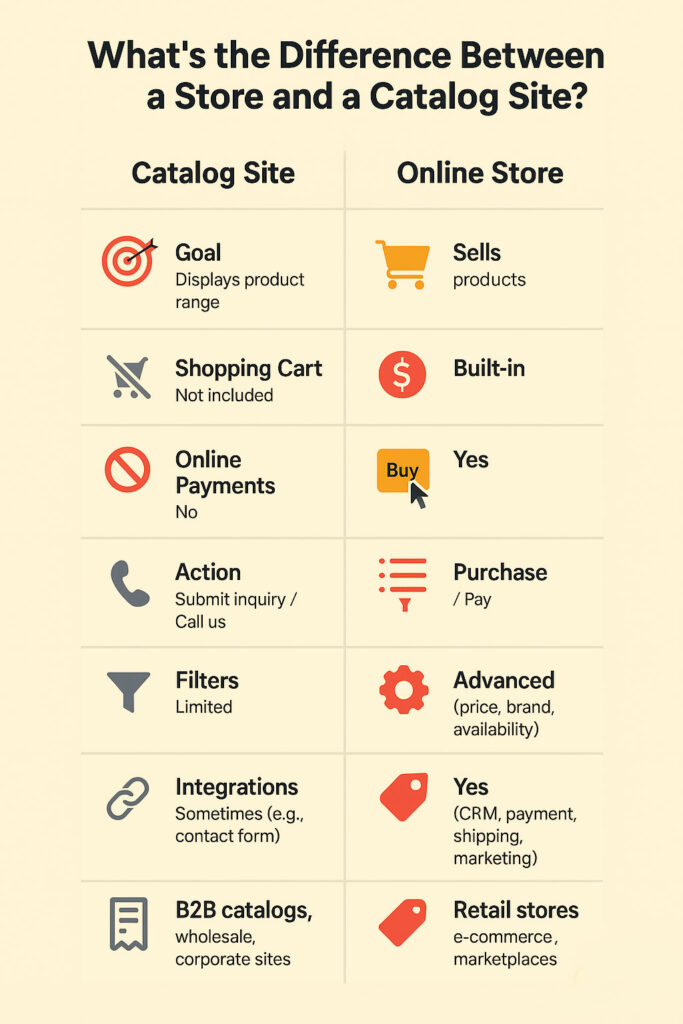
Store vs. Catalog: What’s the Difference?
An e-commerce store enables transactions. A catalog site showcases products without direct checkout.
Use a store to sell. Use a catalog to inform.
1. Core Functionality: How the Site Operates
E-Commerce Store
An e-commerce site is a transaction-ready system designed to handle the entire purchase process end-to-end. Key components include:
- Shopping cart functionality: Users browse, select, and add products to a virtual cart.
- Online checkout: Customers can securely input payment details and complete their order in real time.
- Integrated payment processing: Supports gateways like Stripe, PayPal, Apple Pay, credit/debit cards.
- Live inventory and availability: Quantities update automatically based on stock and demand.
- Instant order confirmation and email notifications.

Catalog Site
A catalog site, by contrast, showcases your products but doesn’t process transactions directly on the website.
- Product listings without checkout: Visitors see descriptions, photos, SKUs, specs, and maybe pricing.
- Manual conversion flow: Instead of buying online, users are encouraged to contact sales via phone, email, or inquiry form.
- Offline sales support: Ideal for B2B models, made-to-order products, or regulated industries.
Key Takeaway:
Use an e-commerce store to generate direct online revenue.
Use a catalog site when your sales process requires qualification, negotiation, or personal interaction.
2. User Experience (UX): How the Site Feels to Use
E-Commerce Store
Optimized for speed, clarity, and conversion:
- Advanced navigation tools: Search bars, filters (by size, brand, category), and sorting options (price, popularity).
- Streamlined checkout: Minimal clicks from product to payment.
- Account creation: Enables repeat customers to log in, track orders, and reorder easily.
- Real-time cart updates and mobile-friendly checkout flow.
Catalog Site
Prioritizes product information and lead generation over instant sales:
- Emphasis on detail: High-res images, datasheets, use-case scenarios, and downloadable PDFs.
- No checkout: Instead, forms like “Request a Quote” or “Contact Sales” dominate CTAs.
- Slower, more editorial feel: Layouts often resemble product brochures or whitepapers, with more static page structures.
Key Takeaway:
Stores are built for frictionless transactions.
Catalogs are built for information depth and pre-sale engagement.

3. Purpose and Strategy: Why You Choose One Over the Other
When to Use an E-Commerce Store:
- Your product pricing is transparent and fixed.
- Customers are comfortable making purchases without human interaction.
- You want to scale marketing with PPC ads that lead directly to product pages.
- Your revenue model depends on volume and efficiency.
When to Use a Catalog Site:
- Your offerings require customization (e.g., industrial machinery, B2B services, modular solutions).
- Pricing varies depending on specs, client profile, or order volume.
- Legal, regulatory, or operational reasons prevent you from accepting online payments.
- Sales involve demos, discovery calls, or distributor negotiation.
Key Takeaway:
Stores support fast-moving sales cycles.
Catalogs support complex, consultative selling.
4. SEO and Content Implications: How Google Sees Each
E-Commerce Store SEO Benefits:
- Structured product data: Helps Google index your items for Shopping Ads and rich snippets.
- Dynamic updates: New products, real-time availability, reviews, and pricing changes keep the site fresh.
- Category-based optimization: SEO-friendly URLs like /shop/laptops/macbook-pro enhance discoverability.
- Transactional keywords: “Buy,” “free shipping,” “discount” align with buyer intent.
Catalog Site SEO Strengths:
- Long-form evergreen content: Guides, datasheets, case studies, and FAQs drive traffic at the top of the funnel.
- Topic authority: Useful for positioning your brand as a thought leader in technical or industrial niches.
- Less keyword competition: Because you’re not always targeting high-conversion commercial terms.
- Lower update frequency: Static product pages remain relevant longer without constant edits.
Key Takeaway:
Stores capture searchers ready to buy.
Catalogs attract those still researching or comparing.
5. Platform and Tech Stack: What Powers the Site
E-Commerce Stores Typically Use:
- Shopify: Fast, scalable, plug-and-play e-commerce platform with rich app integrations.
- WooCommerce (WordPress): Flexible, open-source solution ideal for content-heavy stores.
- Magento / Adobe Commerce: Best for enterprise-level, high-SKU stores needing advanced features.
Catalog Sites Often Use:
- WordPress or Webflow: For CMS flexibility, design control, and content depth.
- Custom CMS: Tailored backends allow dynamic product cataloging without requiring e-commerce plugins.
- Hybrid Models: Some businesses use platforms like Shopify or WooCommerce but disable checkout to run a “catalog-only” experience with quote request flows.
Key Takeaway:
Stores need robust checkout and payment tech.
Catalogs can focus more on content architecture and presentation flexibility.
Which One Do You Need?
Ask yourself:
- Do I want visitors to convert online?
- Is my product price-fixed and ready for instant checkout?
- Can I handle payments and fulfillment automatically?
If yes, you’re likely building a store.
If instead:
- Your products are high-touch, custom-built, or have fluctuating pricing
- You need to vet leads before quoting or selling
Then a catalog site may be the smarter, leaner solution.
Work With 3MY: Build the Right Website for Your Business
At 3MY, we help businesses choose and build the platform that matches their model — whether it’s a sleek e-commerce store or a high-performance catalog site.
Our services include:
- Custom UX/UI for catalogs and online shops
- Platform selection and integration
- Quote request and lead tracking systems
- Conversion rate optimization for both models
Ready to clarify your site strategy?