
If you run a small business, chances are you’re tracking customers across email threads, spreadsheets, or mental notes.
And it works — until it doesn’t.
- A lead goes unanswered.
- A client slips through the cracks.
- Your best employee quits — and takes context with them.
In 2025, your competitors aren’t waiting for leads to get lost. They’re automating follow-ups, tracking every stage, and working from one source of truth: a CRM.
What Happens Without a CRM
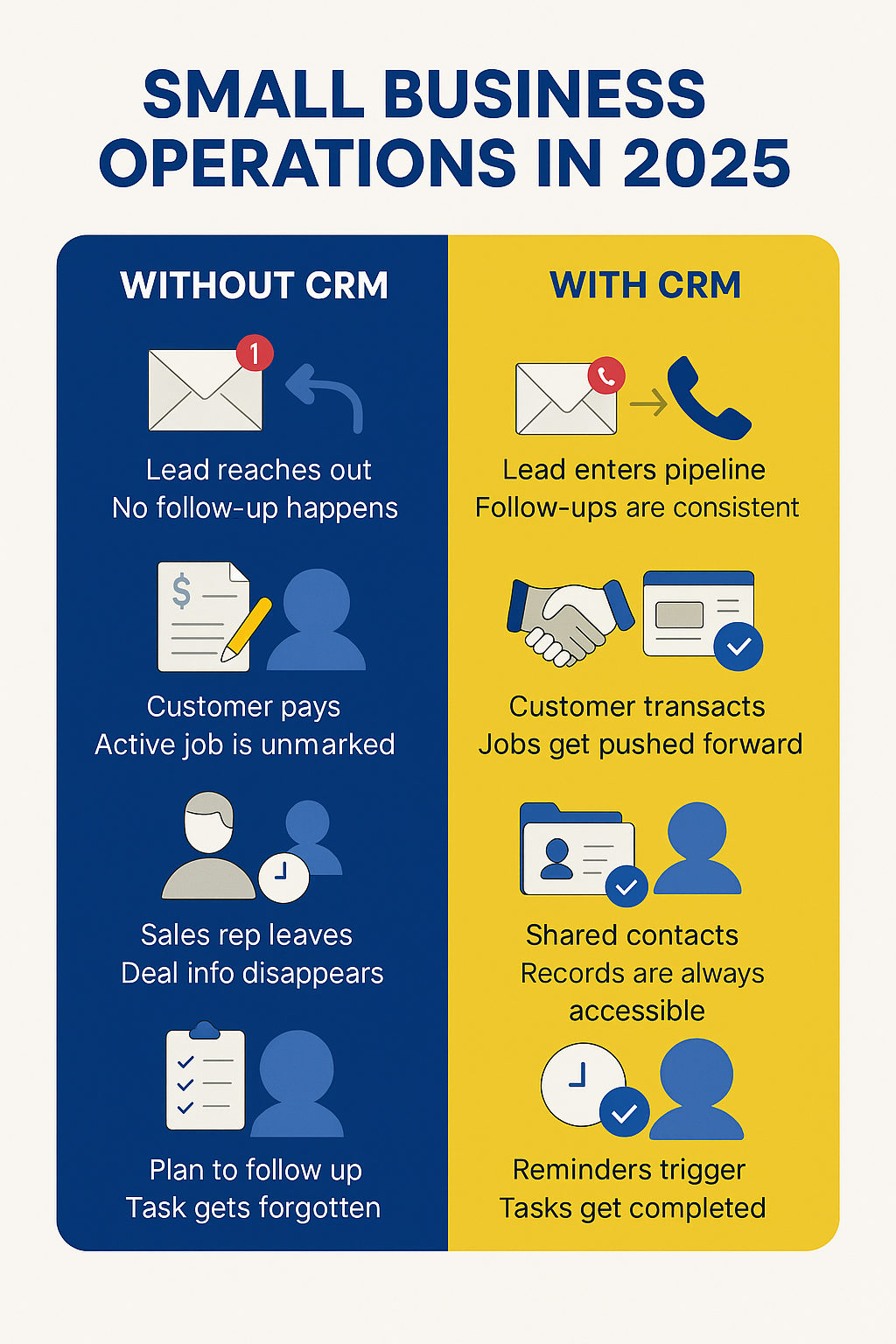
- A new lead reaches out. No one follows up until it’s too late.
- A customer pays. But fulfillment is delayed because no one marked the order as active.
- Your sales manager leaves. Along with deal notes, email history, and customer trust.
- You plan to follow up. Then forget. That deal goes cold.
Every one of these scenarios is silent revenue loss — and entirely avoidable.
What a CRM Actually Solves
| Function | What It Fixes | Why It Matters |
|---|---|---|
| Deal Pipeline | Visualizes every lead stage | Everyone knows what’s active and what needs attention |
| Shared Contact History | Emails, notes, files all in one place | Context stays — even if people leave the team |
| Reminders & Follow-ups | No more forgotten calls or overdue proposals | Close more deals without chasing your own memory |
| Segmentation & Tags | Filter by status, industry, size, or priority | Easy targeting for sales and reactivation campaigns |
| Real-Time Analytics | Track source, funnel, win rate, and deal value | Stop guessing — start making data-driven decisions |
Why CRM Is Critical for Small Teams
In large companies, inefficiencies are absorbed. In small businesses, they’re painful and visible.
When 2–5 people run sales, ops, and service — having a central system means:
- No duplicated work
- No missed steps
- No scattered information
CRM = structure your brain doesn’t need to hold anymore.
It brings clarity, consistency, and repeatability — without adding headcount.
Common Objections — Revisited
“We’re not big enough for a CRM.”
“CRMs are expensive.”
“Too hard to implement.”
What 3MY Does Differently
We don’t sell CRM licenses. We build operational clarity.
We help clients who:
- Lose track of leads and follow-ups
- Rely on spreadsheets or inboxes as a system
- Can’t tell what stage each client is in
- Need visibility without adding more staff
How we help:
- Audit your current sales & delivery process
- Recommend the right CRM (Pipedrive, Bitrix24, HubSpot, etc.)
- Customize fields, pipelines, and automation
- Integrate it with email, forms, site, calendar
- Train your team to actually use it daily
Not Sure If You Need a CRM — or Just a Smarter Setup?
We’ll review your current system (or lack of one), identify gaps, and tell you honestly whether a CRM would help — or if a simpler fix is enough.
No pressure. Just clarity from people who build real systems, not sales decks.