
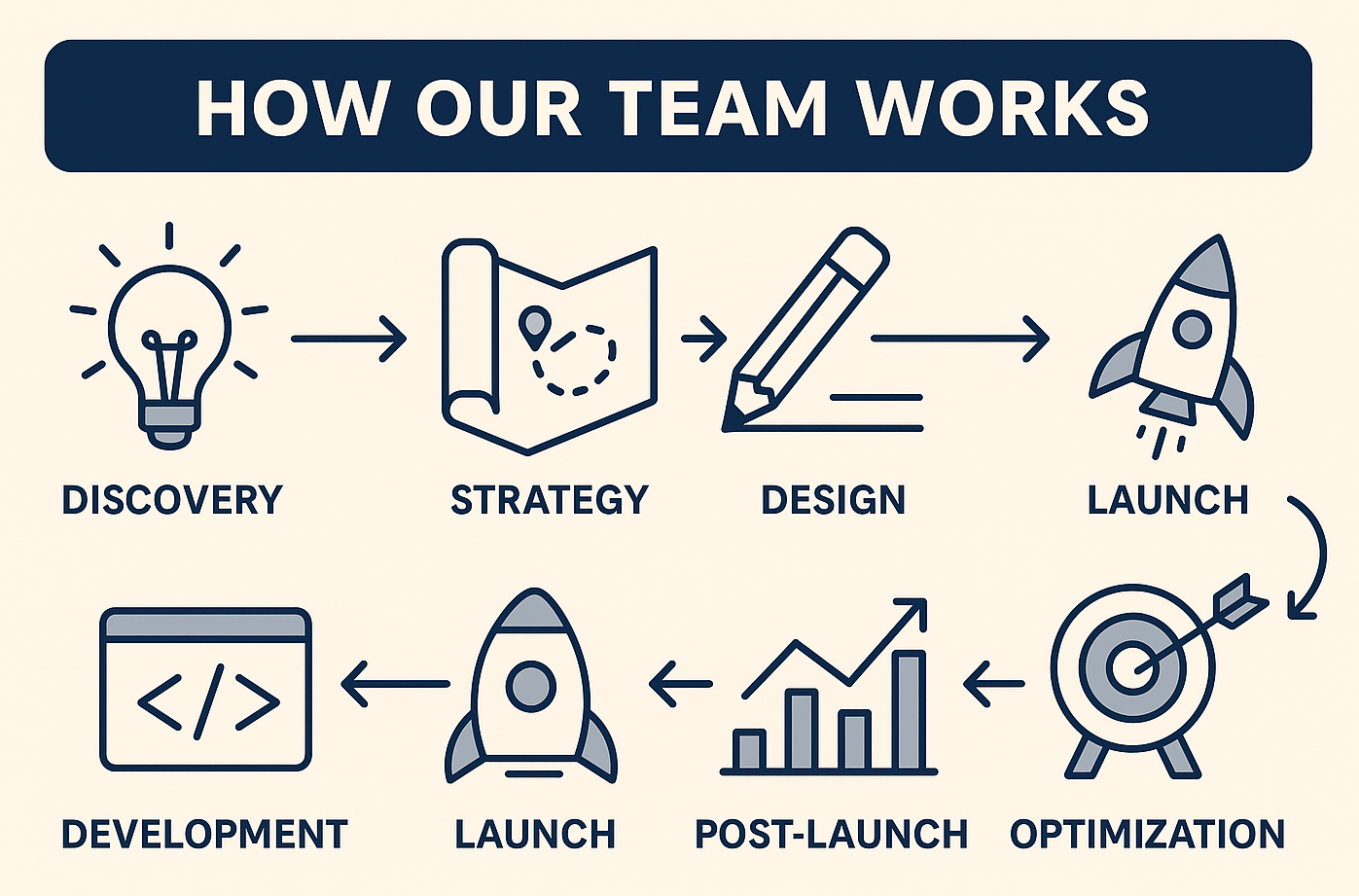
1. Discovery & Alignment: Foundation First
Every project starts with clarity—on both sides.
Our kickoff call focuses on:
- Business goals: What results matter most—leads, conversions, brand lift?
- Audience insight: Who we speak to—and how.
- Current state assessment: Reviewing your site, analytics, and tech stack.
- Criteria & success milestones: What “done” really means.
By establishing mutual expectations early, we avoid scope confusion and stay focused on the outcomes that matter.
2. Research & Strategy: ✓ Insight, ✓ Context, ✓ Plan
Armed with baseline data, we build the strategy:
- Keyword and competitive audit: What your industry and competitors are doing well—and where opportunities lie.
- User journey mapping: Visualizing your prospects’ paths from first touch to sale.
- Content and conversion planning: Deciding which assets—blogs, listings, funnels—drive results.
- Technical baseline: Identifying immediate fixes versus long-term improvements.
Everything we propose directly ties back to your outcomes—no fluff or guesswork.
3. Design & Development: Clean, Fast, Purposeful
We don’t build sites—we build systems:
- UX wireframes to test the flow before launching into design.
- Design sprints guided by your brand—polished, responsive, and conversion-focused.
- Development phase includes mobile-first front-end, speed optimization, and clean code.
- Internal sanity testing ensures technical performance and content accuracy.
Our iteration process keeps you informed and involved—not overwhelmed.
4. Pre-Launch Quality Assurance
Before pushing live, we dive deep:
- Cross-browser and device testing to ensure consistency.
- Load speed testing under real-world conditions.
- SEO, accessibility, analytics setup—we don’t neglect the details that drive performance.
- Your team review and sign-off, followed by a staged rollout.
Launching isn’t finish line—it’s the starting gun.
5. Post-Launch Optimization & Monitoring
Our partnership doesn’t end after launch:
- Site monitoring: speed, uptime, errors, backups.
- Analytics review: traffic patterns, bounce rates, form completions.
- Continuous CRO support: A/B tests, micro UX improvements, content refreshes.
- Scheduled syncs: sharing results, updates, and the next growth moves.
The goal: keep improving—not just maintaining.
6. How We Work — Our Culture of Clarity
- Small, cross-functional teams: 2–4 people per project to avoid delays and miscommunication.
- Straightforward tools: Slack, Figma, Trello—no proprietary systems you’ll never access.
- Weekly check-ins, monthly reviews: Transparent communication—no surprises.
- Documentation-first: We use shared notes and Loom videos, so knowledge stays with you.
- Feedback loop: Your voice shapes each sprint.
At 3MY, we believe clarity beats complexity and consistent delivery builds trust.
Ready to See Us in Action?
We’ll walk you through a sample project workflow, introduce the team, and show you how our process keeps work visible, effective, and stress-free.
No fluff. Just real-world collaboration.