

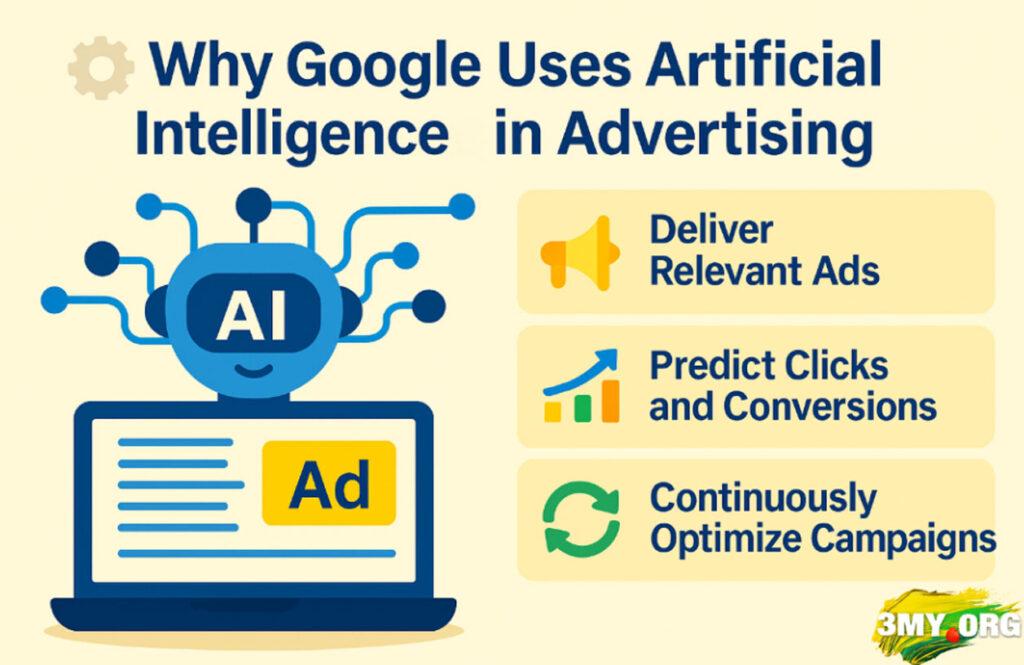
Why Google Uses Artificial Intelligence in Advertising
Google Ads has evolved from a manual, keyword-driven platform into a sophisticated system powered by artificial intelligence (AI). This shift allows Google to analyze billions of data points in real time, understanding patterns and predicting user behavior with remarkable accuracy.
Google’s AI systems are designed to:
- Deliver Relevant Ads: By analyzing search queries, demographics, browsing history, and context, AI ensures that the right ad is shown to the right person at the right time.
- Predict Clicks and Conversions: Using predictive analytics, AI calculates which users are more likely to engage with your ad or complete a desired action, such as filling out a form or making a purchase.
- Continuously Optimize Campaigns: Rather than relying on static settings, Google’s AI dynamically adjusts bids, placements, and ad variations to improve performance.
This automation means advertisers spend less time on routine tasks and more time refining strategy, creative, and messaging. At 3MY, we guide clients in leveraging these AI capabilities effectively without losing control over their campaigns.
How Google AI Works in Ads
1. Smart Bidding
Smart Bidding is one of the most powerful AI-driven features in Google Ads. It uses machine learning to automatically set bids for each auction, considering hundreds of signals like device type, time of day, location, and user intent.
How it helps advertisers:
- Increases efficiency by eliminating guesswork in bid management.
- Adapts in real time to changes in competition or user behavior.
- Allows businesses to optimize for different goals: maximizing conversions, achieving a target cost per acquisition (CPA), or hitting a desired return on ad spend (ROAS).
Example: A campaign using Smart Bidding can lower bids for users unlikely to convert while raising bids for high-value prospects.
2. Responsive Search Ads
Google’s AI can create highly relevant ads by dynamically testing and combining different headlines and descriptions you provide. Instead of manually crafting one version of an ad, you supply multiple variations, and Google determines which combinations perform best.
Benefits:
- Personalized messaging tailored to each user’s search intent.
- Higher click-through rates (CTR) due to more relevant ad copy.
- Saves time by automating the process of ad optimization.
How it works:
- You enter up to 15 headlines and 4 descriptions.
- AI tests millions of combinations to find top performers.
3. Audience Targeting and Insights
AI doesn’t just rely on keywords anymore—it helps advertisers reach people based on behavior, interests, and intent. Google analyzes users’ online activities and segments them into audience groups.
Key features:
- Similar Audiences: Finds new users similar to your best customers.
- In-Market Audiences: Targets people actively researching and comparing products/services.
- Detailed Demographics: Allows refined targeting by life events, parental status, and more.
Result: Advertisers can deliver messages that resonate with users more likely to convert.

4. Performance Max Campaigns
This campaign type gives Google’s AI full control over placements across Search, Display, YouTube, and more. Instead of managing separate campaigns, advertisers upload creative assets, and AI decides how to distribute budget for the best ROI.
Advantages:
- AI identifies high-performing channels and allocates spend automatically.
- Offers granular reporting insights to refine creative and messaging.
- Ideal for businesses seeking broad reach with minimal manual intervention.
Advantages of Google AI in Advertising
| AI Capability | Benefits for Advertisers |
|---|---|
| Smart Bidding | Achieve more conversions at optimized costs |
| Automated Creative Testing | Continuously improve ad performance without manual effort |
| Predictive Audience Targeting | Focus budget on users most likely to convert |
| Real-Time Optimization | Adjust campaigns dynamically to market and user behavior |
AI helps businesses move beyond simple targeting and manual testing, enabling highly efficient campaigns that scale with minimal resources.
What Moving a Campaign to Google’s AI Looks Like
A typical move looks like this: a retail account goes from manual bidding and static ads to Smart Bidding combined with responsive search ads.
What that involves:
- Setting a clear conversion goal so the bidding model has something real to optimize toward.
- Supplying enough distinct headlines and descriptions for the system to have something worth testing.
- Turning on audience signals so in-market shoppers are recognized rather than guessed at.
What changes after that:
- Bidding decisions stop being a weekly manual chore and start reacting to each auction.
- The learning period comes first: results are unstable for a few weeks before the model settles.
- The work shifts from adjusting bids to feeding the system better conversion data and better creative.
None of this is automatic. Automation rewards accounts with clean conversion tracking and enough volume to learn from — and punishes the ones without it.
How 3MY Helps You Leverage Google AI
While Google’s AI is powerful, it isn’t a magic button. Success depends on:
- Providing high-quality inputs (creative assets, conversion data, audience signals).
- Interpreting AI insights to guide long-term strategy.
- Combining automation with human oversight to prevent wasted spend.
At 3MY, we:
- Build AI-powered campaigns aligned with your business objectives.
- Fine-tune targeting and bidding strategies to maximize ROI.
- Continuously monitor, test, and refine to ensure performance keeps improving.
Ready to Harness Google’s AI for Your Business?
Let 3MY help you design campaigns that combine human creativity with Google AI’s precision. Together, we’ll drive better results and smarter ad spend.