


You already know you need help. Traffic is coming in, the form isn’t filling up, and a dozen conversion rate optimization agencies are bidding on the same search you just ran. What their landing pages rarely tell you is how they get paid, what happens when a test doesn’t move the number, or what you’re left holding if the relationship ends. Ask about those three before you sign anything and you’ll learn more than any case-study page will tell you. If you’re not yet sure the problem is an agency’s to solve at all, start with what’s actually fixable on a site that has traffic but no leads, laid out in what to fix first when traffic is high but leads aren’t.
How Conversion Rate Optimization Services Get Paid — and Where the Conflict Sits
Every pricing model has a place it can go wrong, and the sales page never mentions it.
Retainers. Aggregated third-party pricing surveys — compiled from agency sites, not published rate cards — put these as the most common shape for ongoing work — usually a 6 to 12 month commitment, running anywhere from around $2,000 a month for a newer shop to $10,000–$35,000+ a month for agencies with a decade of case studies behind them. The conflict here is obvious once you say it out loud: a retainer renews whether or not anything changed last month.
Hourly billing. The same surveys put experienced consultants at roughly $100–$300+ an hour, freelancers anywhere from $40 to $300. Here the conflict shifts from “did it work” to “how long did it take.”
Performance-based pricing — a cut of the lift — sounds like it removes the conflict, which is why it’s popular in pitches. In practice, experienced agencies avoid a pure version of it: conversion moves for reasons that have nothing to do with them, from a slow season to an unannounced platform update. Whoever gets credit for the swing also gets to define what caused it — not a fight worth having with the person you’re paying. Most “performance-based” pricing is a hybrid anyway: a smaller base fee plus a bonus.
Project or per-test pricing — a fixed fee for defined work, like rebuilding a checkout flow — is the cleanest of the four, because the scope is written down before the invoice is.
None of these is a red flag by itself. What matters is whether the agency can explain which one they’re on, and why, without flinching.

Six Questions That Break a Weak Conversion Rate Optimization Company
A strong agency answers these in one sentence each. A weak one changes the subject.
- How do you measure a lead, and what counts as a conversion? A form submit, a phone call, an email that skips the form entirely — if the answer is only “the form,” ask what happens to everything else. Google’s own definition of a key event is a reasonable place to check their answer against.
- What do you do if the test doesn’t show a difference? This separates people who ran an experiment from people who ran a slide deck.
- Who created the accounts, and who owns access to them? Part of this has a documented answer; part depends entirely on what you wrote down.
- What do we get if we leave? A finished page, or a PDF describing one?
- Do you edit the site, or do you write a report about the site? Two very different jobs, priced very differently.
- Whose code is this when the contract ends? If the answer is vague, assume it’s theirs.
What Happens When the Test Doesn’t Show a Difference
This is the question most proposals never get asked, and it’s the one worth asking first.
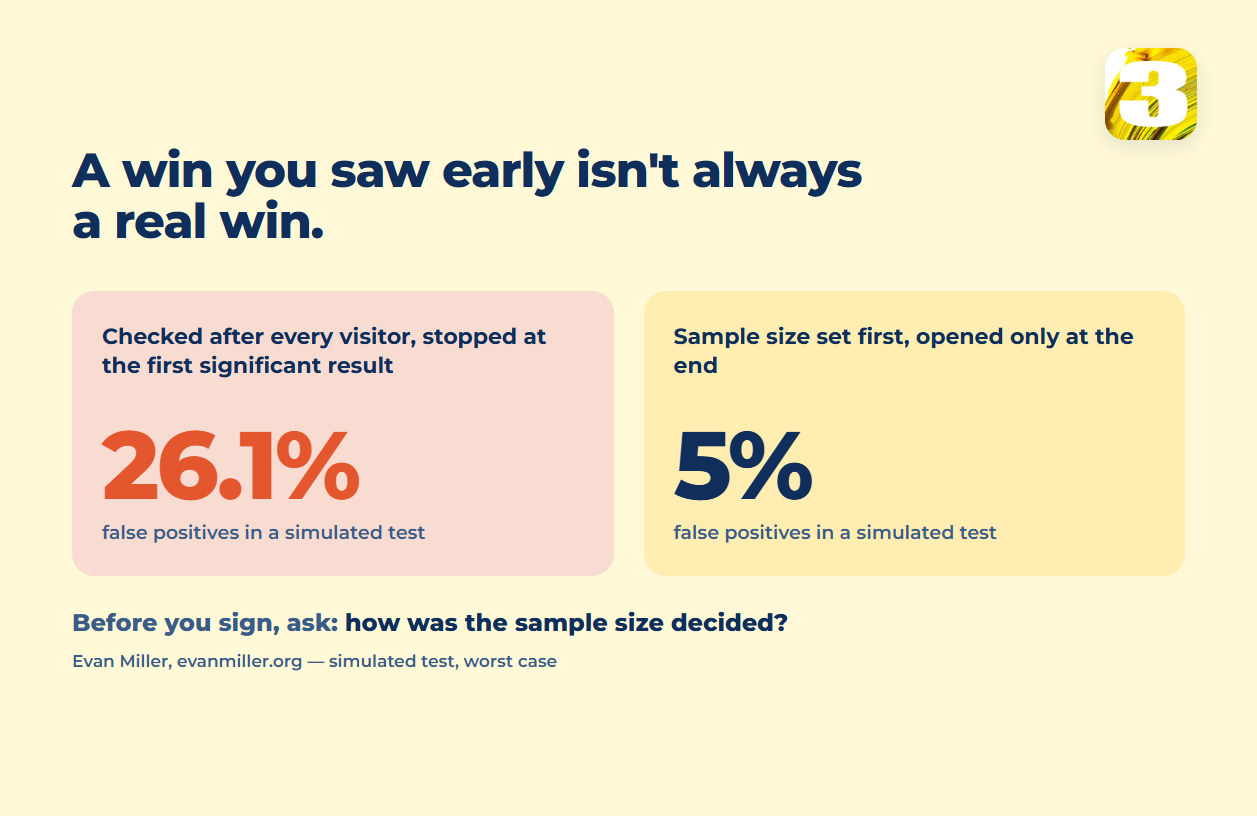
A/B testing has a quiet failure mode: checking the result too often. Stop a test the moment you see a “significant” result and you’re no longer running a 5% false-positive rate — you gave yourself many chances at a lucky reading instead of one. Evan Miller’s widely cited breakdown, “How Not To Run An A/B Test”, puts a number on the extreme case: in a simulated test checked after every single observation, stopping as soon as p<0.05 pushed the real false-positive rate to 26.1% — five times what the test claimed. Check daily instead and the real rate lands somewhere between the two, depending on how long the test runs — which is exactly why the sample size gets fixed in advance. His fix is blunt: set it before the test starts, and don’t look at “chance of beating original” until it’s over.
So “our test showed a 12% lift” is not, by itself, information. Ask how the sample size was decided — before the test, or after someone liked what they saw.
Who Owns the Data When the Contract Ends
Google built ad account access so the client keeps a lever. Its own documentation on manager accounts states it plainly: “The client account still owns its data and has the ability to remove ownership access by unlinking.” An agency that links an account it didn’t create doesn’t get ownership by default, and you can unlink a manager at any time.
What that doesn’t cover is the other direction — an owning manager account can pass ownership to a different manager. So the real question is who opened the account. One created by the agency, under the agency’s manager, is a different starting position from one you opened and gave them access to.
Ask in writing which accounts they created, and that the ad accounts stay registered to your business. Google’s documented protections cover manager accounts in Ads; for analytics properties, the answer is whatever you wrote down. Reluctance here is itself the answer.
Our own position, since it belongs in the same paragraph: if a client leaves us for another agency, we hand over what they paid for — the pages, the tracking, the copy, the code. That sentence is worth putting in writing before you sign with anyone, us included.
A Report or a Fix: What You’re Actually Buying
A recognizable part of this market sells the audit, not the fix. You get a document — screenshots, a heatmap or two, a list of recommendations — and then rebuilding the page lands back on your desk, or on whoever built the site originally and now has to interpret someone else’s homework. What those heatmaps do and don’t show you is worth reading if a proposal leans heavily on one, and it’s unpacked in what a heatmap actually shows.
We build sites, so diagnosis and rebuild are one job rather than two purchases from vendors who don’t talk to each other. It also means copywriting and SEO preparation are part of the price of the site — the SEO work covering the landing pages and the homepage, where search traffic actually lands, rather than the policy, terms and thank-you pages. Ask any conversion rate optimization services vendor whether new page copy is included or billed separately after the audit; most bill it separately.
And be careful with any pitch built around “the average conversion rate for your industry.” That number moves depending on who’s measuring it and how, which makes it a weak yardstick for judging whether your redesign worked — the reasons it moves are set out in why published conversion benchmarks disagree.
When a Specialist Agency Is the Better Choice
We’d be a poor fit for a good share of the people reading this. If you’re staying on a platform someone else maintains, a specialist working inside it will move faster than anyone proposing a rebuild. If you already have a developer and what’s missing is testing discipline — hypotheses, sample sizes, a queue of experiments month after month — that’s a dedicated practice, not what a build studio does. And if your traffic is high enough that a fraction of a percent is real money, continuous testing beats rebuilding, because you can afford to learn slowly.
The reverse is the honest version of our pitch: if a page can’t be fixed without changing how it’s built, a testing programme will spend months proving it.
Two red flags, whoever you hire: a guaranteed percentage — nobody can promise a specific lift, and the promise tells you how the rest of the conversation will go; and no named owner — ask who does the work, not who runs the sales call.
What This Costs, and What’s Included
We’re not a conversion rate optimization agency in the sense of selling standalone audits — we’re a studio that builds and rebuilds the site itself. We manage advertising accounts across industries as different as law firms, a medical clinic, a fencing manufacturer, and an event company, we’re a Google Partner and Meta Certified, and we run our own lead-tracking plugin, which is how we can tell a form submission from a call from a message that never touched the form at all — the kind of detail a generic analytics setup misses by default.
A site of up to eight pages, with copywriting and SEO preparation included, runs $1,900. An online store runs $3,900. Both typically ship in 10 business days, on the condition that materials and feedback come back on schedule — a project waiting two weeks on a client takes two weeks longer, and that part isn’t on us. How site cost breaks down covers what’s included at each size, and the same work seen from the build side is our website development. Ongoing work after launch isn’t priced off a card — we quote it after looking at the actual site.
If you’re evaluating agencies right now, send us the site instead of another proposal. We’ll tell you what we’d fix, in what order, and what it would cost — no audit fee to find that out.