


The honest answer is that it depends entirely on which of four roads you take, and each one prices out differently enough that lumping them into one “average” number would mislead you more than help you. Here’s what the numbers actually look like before you read another word about why a website matters:
| Route | What you’re paying for | Real numbers |
| Build it yourself on a website builder | A monthly subscription, for as long as the site exists | Squarespace $19–$99/month, Wix $17–$159/month (billed annually) |
| Self-hosted WordPress, DIY | Hosting plus your own time (or someone else’s, paid separately) | Hosting alone: $11–$35/month depending on the host |
| Hire a freelancer | A project quote, usually hourly or per page | No reliable published range exists — ask for a written scope, not a number over email |
| Agency or custom shop | A fixed project fee or a scoped package | Ours: $1,900 fixed for a site up to 8 pages; online stores from $3,900 |
That’s the whole shape of the decision. The rest of this article is about what sits inside each of those numbers, what a price tag never tells you, and why two quotes for what sounds like “the same website” can land $10,000 apart.
The Four Roads, and What Each One Actually Buys You
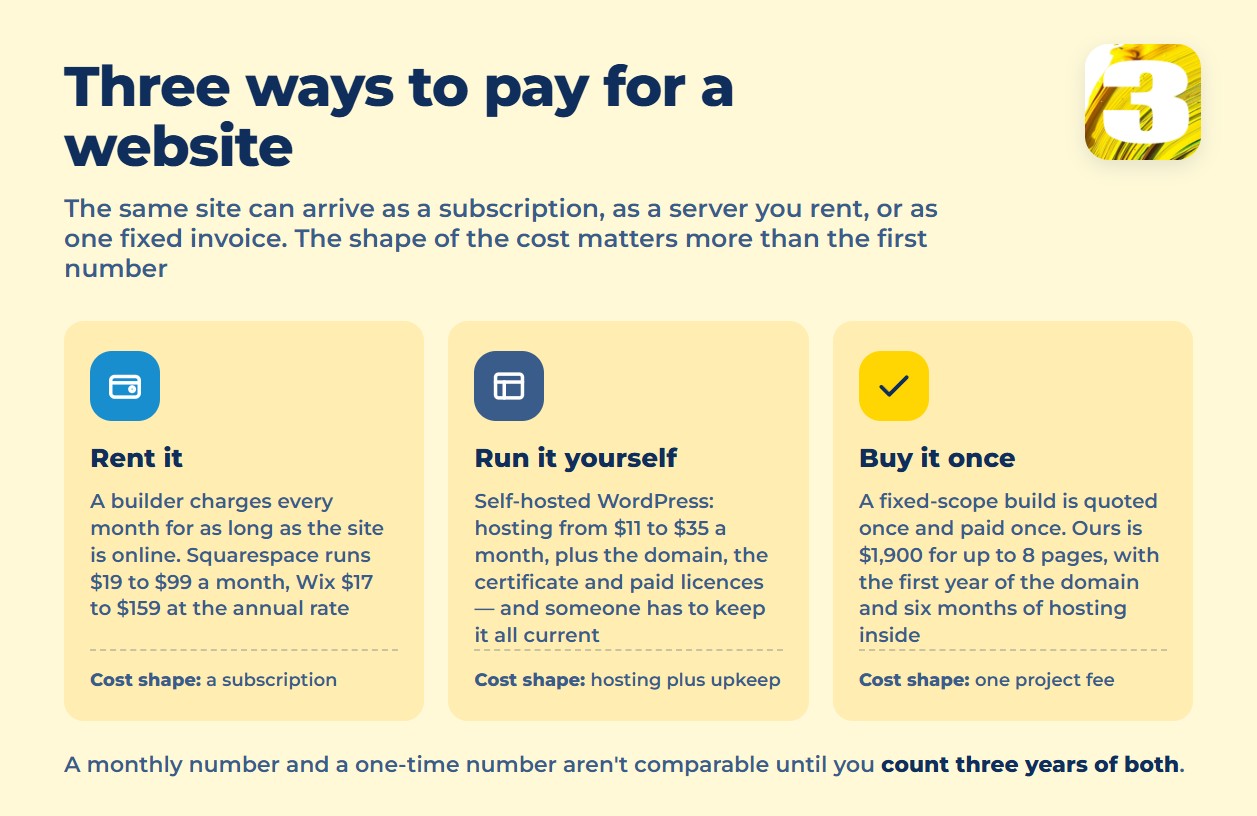
A website builder hands you a subscription and a drag-and-drop editor. You’re not paying for a website — you’re renting one, month after month, on the vendor’s infrastructure. Squarespace’s plans run Basic $19, Core $29, Plus $49, and Advanced $99 a month. Wix’s plans run Light $17, Core $29, Business $39, and Business Elite $159 a month, all at the annual-billing rate — pay monthly instead and the numbers go up.
Self-hosted WordPress means you own the software outright, but you’re renting the server it lives on, and you’re on the hook for keeping it patched and backed up yourself, or paying someone to do that. Hosting alone runs from roughly $11 to $35 a month before you’ve added a theme, a page builder, or a single hour of build time.
A freelancer quotes per project, usually. There’s no dependable published benchmark for what that quote should be — more on that below.
An agency or a custom shop — what we do — either scopes a fixed package or estimates by the hour. Ours is fixed at $1,900 for a site up to 8 pages. An online store instead of a brochure site starts at $3,900 — that one moves with the size of your catalog and how you take payment, so we quote it against your actual products rather than pretending one number fits every store. For a brochure site, though, $1,900 is the one number in this whole topic you can hold onto.
Building It Yourself: What the Subscription Actually Covers
The builder route is the cheapest way to get something live this week, and it stays cheap as long as your needs stay inside the plan you picked. The catch shows up over time, not on day one — our three-year cost breakdown for Squarespace walks through what the monthly number turns into once you add the domain renewal, transaction fees, and a couple of paid add-ons most people don’t budget for at signup.
Self-hosted WordPress is a different trade. You’re not locked into one vendor’s editor, and you can move your files to another host any time — but “self-hosted” means exactly that. SiteGround’s WordPress hosting starts on a discounted first term and then renews at $17.99 a month for one site with 10 GB of storage. Cloudways starts at $11 a month for 2 GB of RAM and unlimited sites on a single server. Kinsta charges $35 a month for one site, 10 GB of storage, and 20 GB of monthly traffic, with backups, staging, and security monitoring built into that price. Domain and SSL are separate line items at all three — none of them bundle a “free forever” domain into the hosting fee.
On top of hosting, a self-built WordPress site usually needs paid software. A page builder license like Bricks runs $79 to $249 a year depending on tier, or $599 once for a lifetime license. A caching plugin like WP Rocket runs $59 to $299 a year. None of that is optional if you want the site to look finished and load fast — it’s just rarely mentioned in the “$11 a month” headline.
Curious what you’d actually be choosing between if you went this route versus hiring someone? Wix vs. WordPress: who fixes it, and who owns what covers the parts of that decision that have nothing to do with price.

Hiring Someone: The Range Nobody Can Actually Prove
Search for “how much does a website cost from a freelancer” or “from an agency” and you’ll land on ranges like $2,000–$10,000 or $3,000–$15,000, repeated across roundup after roundup. We checked. None of them trace back to a primary source with a disclosed methodology — no survey, no invoice sample, no stated number of respondents. They’re estimates copied from one blog post to the next, and by the time a figure has been through five rewrites, nobody can tell you where the first version came from. We’re not going to add another guess to that pile.
What does exist is a 2025 survey of 406 small-business owners in the US, run by Clutch, that discloses its methodology honestly — but it doesn’t publish dollar figures for what a website should cost either. What it does report is that 16% of small businesses skip building a website at all because of the price, down from 26% when the same question was asked in 2018. That’s a real, sourced number about hesitation, not a price list — and it’s the only figure in this space we’re willing to repeat, because we can see where it came from.
So if a published, defensible dollar range for freelancer and agency pricing doesn’t exist, what do you do with a quote in your inbox? Ask what’s actually in it — which is exactly what the rest of this article is for.
What $1,900 Actually Buys, Said Out Loud
Most of what you’ll find when you search this question is other people’s guesses about what things cost. Here’s a number we can say plainly, because it’s ours: $1,900 for a website up to 8 pages, fixed, not an estimate that grows once work starts. That price includes:
- Adaptive design that works on a phone, a tablet, and a desktop
- Contact and lead forms
- A blog, built on a CMS you can update yourself
- A logo, with up to 3 concepts to choose from if you don’t already have one
- SEO setup: meta tags and an XML sitemap
- A domain for one year, plus 6 months of hosting
- The copy for every page, written on our side — not a template you fill in yourself
- Analytics and Search Console connected and reporting
- Google Maps integration
- One month of support after launch, with training so you’re not stuck if something needs a small change
Need an online store instead of a brochure site — product pages, a cart, checkout — that starts at $3,900. That line is the real border between “a website” and “a store”: a store needs inventory management, payment processing, and usually more pages than 8, so the scope and the price both step up together.
If your project doesn’t fit either box — more pages, a booking system, a member area — the pricing logic still starts from the same place: a scope written down before work starts, not a number that grows as you go. That’s what we mean by custom website development built around what your business actually needs, and it’s also the difference between paying for a template and paying for something built from scratch for your business specifically.
What That Price Doesn’t Cover — And What to Ask Every Vendor
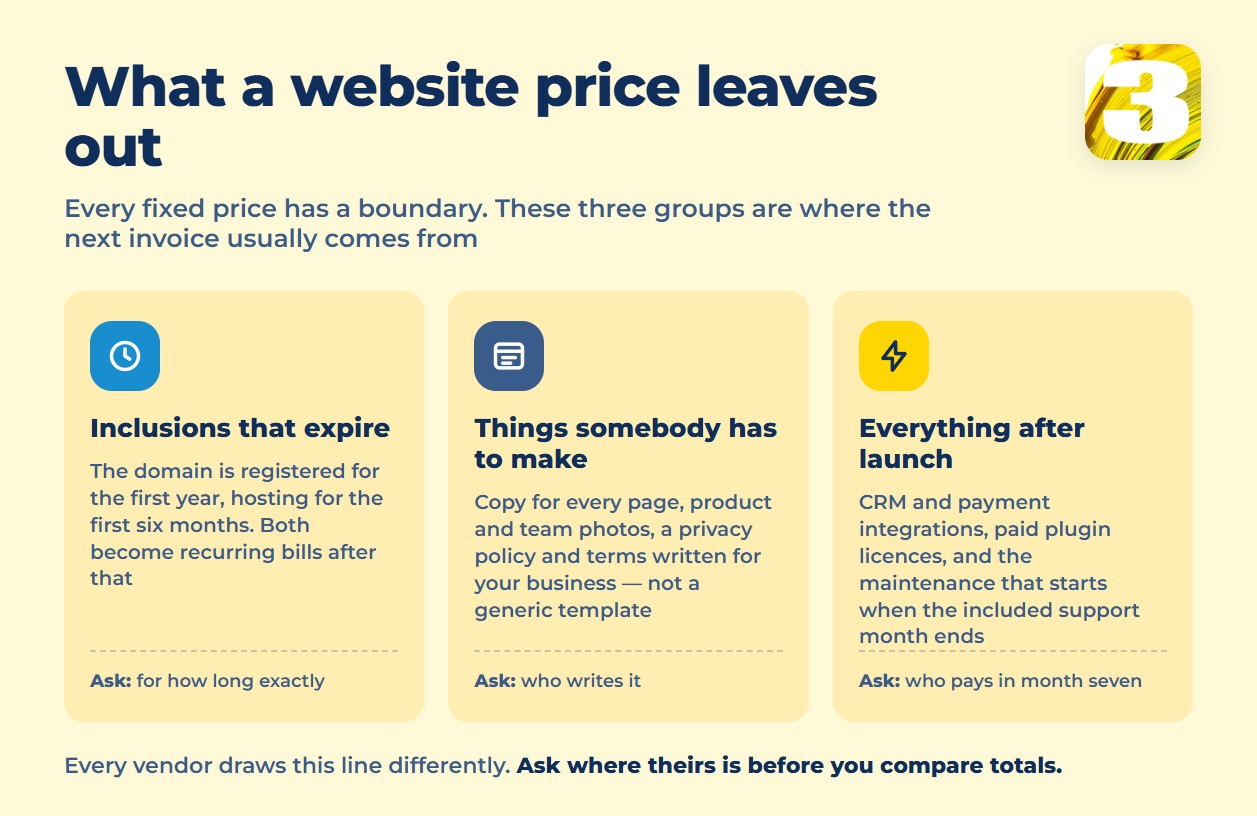
Every fixed price has a boundary, and the boundary is exactly where the next surprise bill comes from if nobody names it upfront. Here’s ours, item by item:
- The domain after year one. Registration is included for the first 12 months; renewal after that is a yearly cost you’ll pay to whoever holds the registration.
- Hosting after month six. The included hosting covers the first 6 months; after that, hosting becomes a recurring bill — self-hosted WordPress plans run roughly $11–$35 a month depending on the host, as covered above.
- Email. A website doesn’t include a mailbox at your domain — that’s a separate service.
- Paid plugins and licenses beyond the base build. A page builder upgrade, a premium form plugin, a caching license like WP Rocket at $59–$299 a year — these depend on what your specific site ends up needing.
- Content and photography. Product photos, team headshots, and stock imagery licensed for your use aren’t automatically part of a build.
- Legal pages. A privacy policy or terms of service written for your specific business, not a generic template.
- CRM and payment integrations. Connecting the site to your existing sales tools or a specific payment processor is its own line item once your setup gets particular.
- Ongoing maintenance. What happens to the site in month seven, after the included support runs out, is its own question — our breakdown of what website maintenance actually includes covers it in full.
Here’s the part that matters more than any single line above: every vendor draws this list differently. One agency’s “full-service” quote includes copywriting and stock photos; another’s identical-sounding quote assumes you’re supplying both. Neither is wrong — but if you don’t ask which is which before you sign, you’ll find out the hard way, mid-project, when a line item you assumed was covered turns out not to be.
Why Two Quotes for “The Same Website” Land $10,000 Apart
This is the part almost nobody explains, and it’s usually the real reason one number looks nothing like another for a project that sounds identical on paper.
Fixed scope versus hourly. A fixed quote prices a defined list of pages and features once, upfront. An hourly estimate prices a guess at how long the work will take — and estimates are frequently wrong in the direction of “more,” not less, once real content and real feedback show up.
Revision rounds. A quote that includes two rounds of design revisions costs less than one that includes unlimited rounds, because unlimited revisions are unlimited hours on somebody’s calendar. Ask how many rounds are built in before you compare two numbers as if they mean the same thing.
Who writes the copy. A vendor writing every page from scratch is doing work a client-supplied draft skips entirely. This single line item alone can be a difference of thousands of dollars between two otherwise similar quotes.
Who sets up analytics and tracking. Connecting Analytics, Search Console, and conversion tracking properly takes real time. Some quotes fold it in; some treat it as an add-on once the site is live.
Who pays for changes after launch. A quote that includes a defined support window — ours is one month, with training — costs differently than one where every post-launch fix is billed separately from day one.
Line up two quotes side by side on these five points before you compare the total at the bottom. A $2,000 quote with no revisions, no copywriting, and no post-launch support is not cheaper than a $4,000 quote that includes all three — it’s just a different, smaller list of work wearing a lower number.
If timing matters as much as price for you — you’re working toward an opening date or a launch window — how long a website build actually takes is worth reading next, since scope and schedule are tied together the same way scope and price are.

Send Us What You’re Building
If you’ve got a project in mind, send us what it needs to do and we’ll tell you, in writing, exactly what’s included at $1,900 (or from $3,900 for a store) — and just as importantly, what isn’t, and what that specific gap would cost to close in your case. The whole number in writing before you commit, not a figure that quietly grows once work has started.