

In early-stage conversations, business owners often say:
It sounds efficient. Clean. Minimal. But in practice, “just a landing page” almost never performs well on its own — not for SEO, not for ads, not for conversions.
This article breaks down why relying on a single landing page is a weak digital strategy — and what modern websites need instead.
What Is a Landing Page (Technically)?
A landing page is a single-purpose, standalone page designed to capture leads or conversions. Often used in ads or email funnels, it’s stripped of navigation and distractions.
Landing pages work well when:
- You drive targeted, ready-to-convert traffic (usually from paid ads)
- You have a single offer and a narrow audience
- You already have awareness elsewhere (email list, social proof, SEO)
But outside those conditions? A lone landing page falls short.
Why a Single Page Usually Fails
1. No SEO Visibility
It is worth being precise here, because the shorthand version of this argument is simply wrong. Google says its ranking systems are designed to work page by page, with site-wide signals contributing to how each page is understood. So a single page can rank. The problem is arithmetic rather than policy: one page can only answer one question well, and the people you want are asking a dozen.
- One page = minimal keyword coverage
- No supporting content = no topical depth
- No blog or structure = no internal links or content clusters
Even the best-optimized landing page can’t compete with:
- A site that answers adjacent questions
- A site with authority built over time
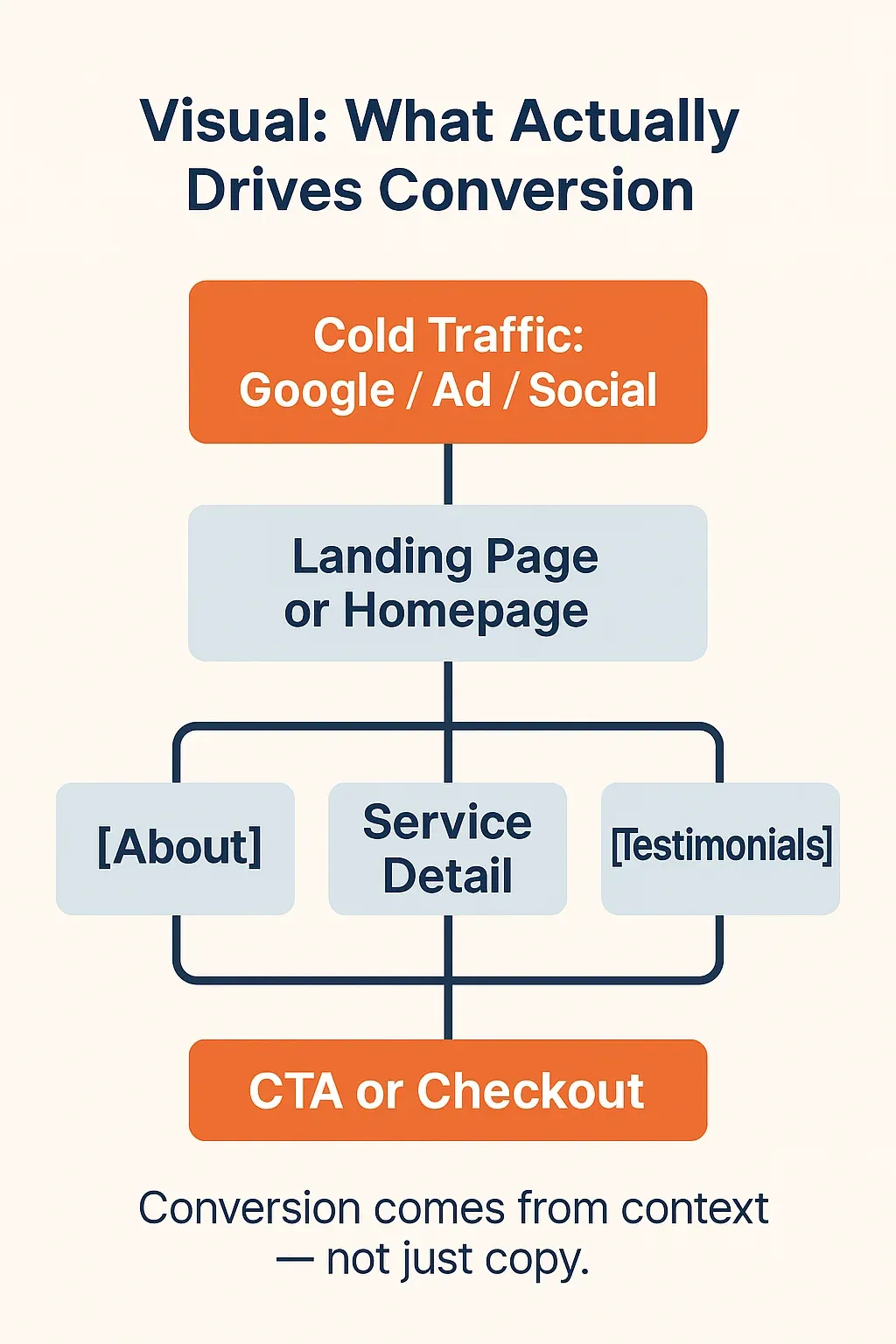
2. Lack of Context for Cold Traffic
If your ad lands a user on a page that says “Buy now,” but they don’t know you — they bounce.
- No About page to build trust
- No service breakdown to show details
- No testimonials, process, or FAQ
Cold traffic needs warm-up. A landing page can’t carry that load alone.
3. No Content for Retargeting, Email, or AI Assistants
You can’t:
- Retarget based on scroll depth or behavior if there’s no behavior to track
- Feed AI assistants a real answer if there is no page that answers anything in depth — or attach structured data describing services you never wrote a page for
- Capture top-of-funnel search traffic without blog content
Modern marketing is full-funnel. A single page can’t feed the top.
4. Low Conversion Without Supporting Pages
Even warm leads want:
- Details
- Proof
- Alternatives
Conversion rates increase when users:
- Visit 2–3 pages
- Skim a blog or read a case study
- See other product tiers or paths
One honest caveat on that: it is a correlation, not a lever. People who were already close to buying are also the people who read three pages before writing to you. Adding pages does not create intent — it stops you from losing the visitors who wanted to check something before they committed.
One page? Feels like a squeeze. Especially for high-ticket services.
What You Need Instead
| Element | Purpose |
|---|---|
| Homepage | Explain who you are, what you do, and for whom |
| Services/Product Page | Deep dive into your offer and its value |
| About Page | Build trust and connection |
| Blog/Resource Page | Feed SEO, email, and chatbot content |
| Contact Page | Make outreach frictionless |
If you run ads or have landing pages, they should plug into this ecosystem — not replace it.
What About Microsites?
Microsites can work — if they’re structured. For example:
- A one-product brand with a homepage, checkout, and support page
- A lead gen funnel with a landing page + blog + confirmation content
- An event promo site with info, schedule, and signup
Still not just one page.
Final Word
A single page is almost never enough. It puts too much pressure on one touchpoint and ignores how people actually explore, compare, and decide.
If you’re just starting out, a simple 5-page site can outperform a fancy landing page in every way — traffic, trust, and conversions.
To put a number on it, since most articles on this subject carefully avoid doing so: we build a site of up to eight pages for $1,900, and the writing is inside that price. The text for every page, the structure, the images, the meta titles — ours to produce, not a separate quote and not a template you fill in yourself. That last part is where most “cheap” builds actually stall: the design was finished in a week and the content took four months, because nobody had agreed who was writing it.
The build itself takes ten working days, with one condition worth stating plainly rather than in a footnote: it holds if the material arrives on time and approvals come back on time. A project that sits two weeks waiting for a decision moves the date by two weeks, and no agency has ever found a way around that.
Need help building that minimal-but-complete foundation? We can help.