


A lot of advice treats anything under $500 as suspect. We price SEO for a one-page site at $489, so we have a stake in that question — which is why the test below doesn’t depend on the price at all. What decides whether a low-cost package is a fair deal or an empty one isn’t the number on the invoice. It’s how much of your site that number is scoped to cover, and whether the person selling it tells you so plainly before you pay.
If you want the fuller picture first, our piece on how much SEO costs goes through why SEO for an existing site, SEO for a store, and SEO delivered as articles, and SEO built into a new site are four different purchases with four different prices. This piece stays narrower: what a genuinely affordable package can do, what it can’t, and how to tell a small scope apart from a bad one before you sign anything.
Low-Cost SEO Services: What the Price Is Scaled To
Low-cost SEO services can get cheap two different ways, and only one of them is honest. The honest way is scope: fewer pages means less research, less writing, less restructuring, so the price comes down with the workload. The dishonest way is doing a thinner version of the same workload and not mentioning it — treating five pages like one while still billing for five. The first should show up in the price list before you ask. The second usually only shows up after you’ve paid. Either way, the fundamentals don’t change with the size of the package — they’re the same ones Google’s SEO Starter Guide walks through for any site.
That’s how our two lowest tiers split (the full list is on our SEO services and prices page): $489 covers SEO for a one-page site; $1,489 covers a site of five pages. Both are one-time, and both are priced for one language — a second language adds 30%. You pay once for the work on those pages; nothing renews monthly.
If a low-cost package promises unlimited pages, ongoing monthly work, and a rock-bottom one-time price all at once, at least one of those claims doesn’t match how pricing like this works — scope, frequency, and price move together, not separately.
The Difference Between a Small Scope and a Bad Deal
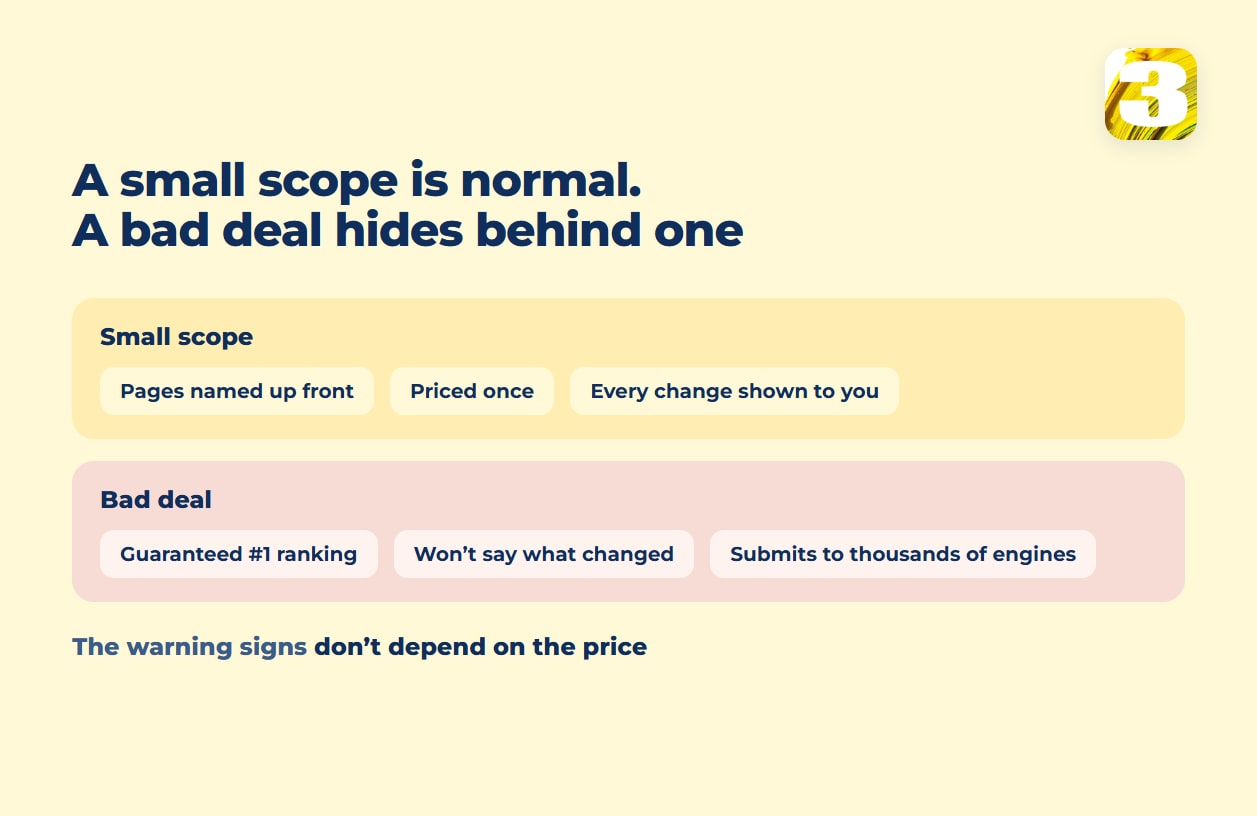
A small scope is normal. A bad deal hides behind one. Google’s own guidance for site owners weighing outside help, Do You Need an SEO?, is direct about it: “No one can guarantee a #1 ranking on Google. Beware of SEOs that claim to guarantee rankings, allege a ‘special relationship’ with Google, or advertise a ‘priority submit’ to Google.” The same page tells site owners to avoid anyone who talks about “link popularity schemes or submitting your site to thousands of search engines,” which Google calls “typically useless exercises that don’t affect your ranking in the results of the major search engines—at least, not in a way you would likely consider to be positive.” None of that becomes more legitimate attached to a bigger price, and none of it becomes less legitimate attached to a smaller one.
The same page suggests questions worth asking before you sign, and one of them does more work than the rest: “How can I expect to communicate with you? Will you share with me all the changes you make to my site, and provide detailed information about your recommendations and the reasoning behind them?” A seller who answers with specifics — which pages, which lines, which tags — is describing a real project. If you want to see what a thorough technical pass checks, item by item, our technical SEO audit checklist is the kind of list we’d expect a seller to hand you, not keep to themselves.
What a Small Package Should List in Writing
Before you sign anything, ask the seller to name the page elements Google’s Starter Guide covers, and get a straight answer on each. Which title tag is changing, and to what? What will the meta description say, and does it describe this page specifically, not a template? How are the headings organized — does the structure make sense to a reader, not just a search engine? Which pages will link to this one, and with what anchor text, given that Google finds most pages through links from pages it already knows? Does every image get real alt text, or only some of them? A seller who can walk through those five items for the pages you’re paying for is describing a real edit. A seller who answers all of it with “we handle that” is asking for trust instead of offering a specification.
SEO Packages for Small Business: What They Should Promise
An SEO package for a small business, at the affordable end, should promise exactly what it’s scoped to: work on the pages you’re paying for — not pages beyond that scope, not the blog you haven’t written yet, not next month’s rankings. Whether that scope fits where your business is right now is a separate question, worth asking before you pay rather than after.

One more branch worth naming: if you haven’t built the site yet, this calculation changes entirely. Our $1,900 website package, for a site of up to 8 pages, already has SEO built into the landing pages and homepage it delivers — keyword research, page copy written for those keywords, meta tags, and internal linking, all included rather than billed separately — so there’s nothing extra to buy for the pages that need to rank at launch. See what that includes if that’s closer to where you are.
What Ours Doesn’t Include
Here’s what $489 and $1,489 leave out. Pages past five aren’t folded in — each one adds $300. Both prices are for one language; a second language is a 30% addition, not something folded in. They don’t cover a store — a Shopify or WooCommerce catalog is a separate package, starting at $2,489, because a catalog is a different job than a handful of pages. They don’t cover ongoing content either: SEO articles are billed on their own, starting at $89 for one article a week in one language. And no package — ours or anyone else’s — comes with a ranking guarantee, for the reason Google states above.
If you’re not sure which scope fits, a free audit shows where your pages stand, what’s broken, which searches you’re missing, and what to fix first — including a straight answer if nothing needs fixing.