


In this article
- A Translated Keyword Isn’t the Keyword People Search
- Multilingual SEO vs. International SEO
- Google Detects Language From the Words, Not the Tag
- Multilingual SEO Keyword Research, Once Per Language
- Multilingual SEO Beyond the Body Text: Titles and URLs
- What This Looks Like on a Real Site
- How to Research Keywords in a Second Language
- Before We Translate a Word
You translate the page, publish the French version, and traffic on it sits near zero for months. Nothing is broken — the plugin did exactly what it promised. The problem sits one step earlier: a page ranks for the words on it, and a direct translation of your English keyword is often not the phrasing people in that language actually type into Google — or not the one that brings customers. That gap between a translated keyword and a searched keyword is the first thing multilingual SEO has to solve, and translation software doesn’t solve it.
A Translated Keyword Isn’t the Keyword People Search
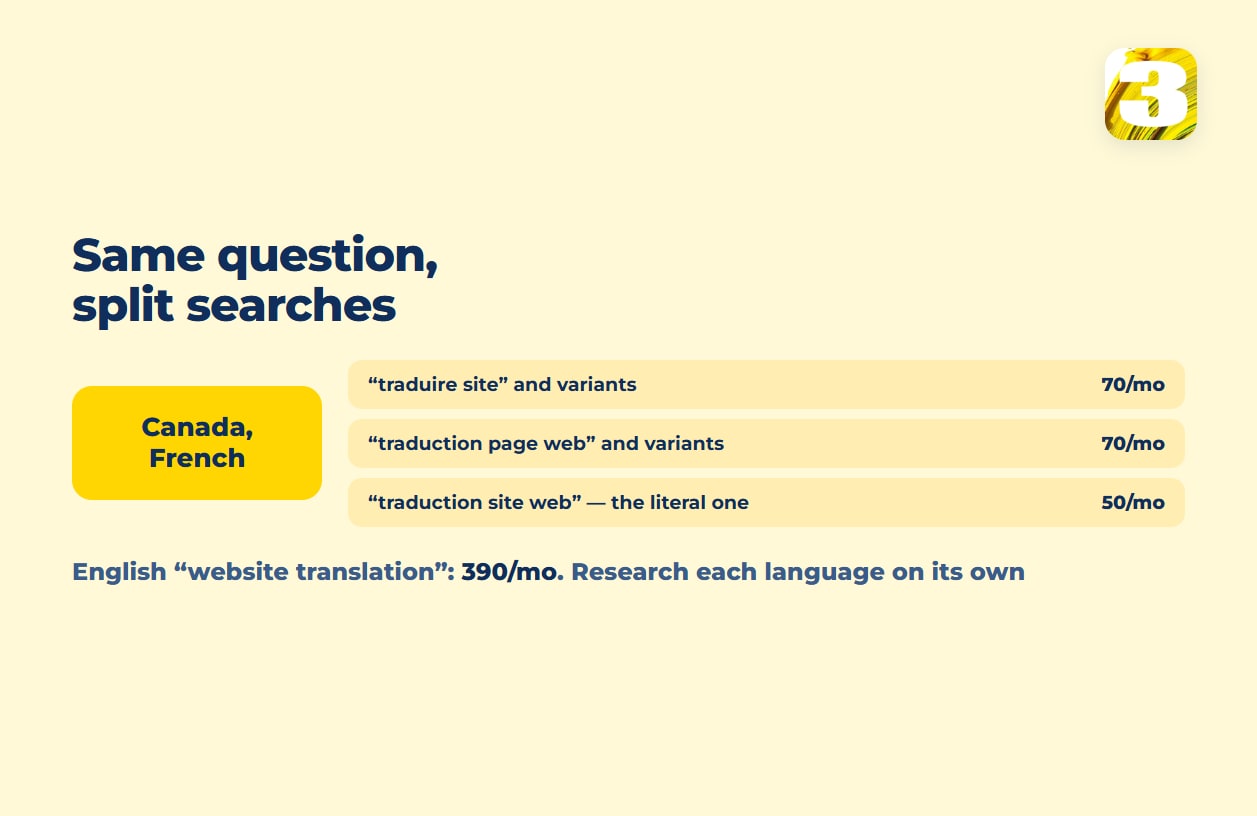
We measured it in Google Keyword Planner on September 25, 2026, one market at a time. In Canada, English “website translation” gets about 390 searches a month. Its literal French translation, “traduction site web,” gets about 50 — but that’s not the whole French side of the same question. Planner splits the French searches into several separate groups, and the three biggest groups about translating a site each have their own volume and their own bids: “traduction site web” at 50, “traduire site” and its variants at 70, “traduction page web” and its variants at another 70.
The volumes alone are close. The bids are where the groups part ways: the top-of-page bid reaches about $12 a click for “traduction site web,” about $8 for “traduire site,” and about $2 for “traduction page web” — a sign that the last group is likely mostly people looking for a quick way to translate a page they’re reading, not a business looking to translate its site.
Here, the literal translation happened to land on the most commercial group — yet it still misses “traduire site,” the second phrasing with real bids, while the “page web” phrasing, just as big, would likely bring the wrong visitors. Neither of those things shows up in the English list. The real argument for researching each language separately isn’t that French has “fewer searches” — it’s that the same question splits into phrasings with different volume and different intent, and a translated keyword is a guess at which one, not a match.
Multilingual SEO vs. International SEO
The two get treated as one job, and they’re not. Multilingual SEO is about language: serving the right words to a French speaker, a Spanish speaker, an English speaker, wherever they are. International SEO is about geography: serving the right country version, currency, and shipping terms to a visitor in Canada versus one in the US.
A site can need one without the other. A US-only store selling in English and Spanish needs multilingual SEO — Spanish accounts for 61.1% of US residents who speak a language other than English at home, per the Census Bureau. A company selling the same product, in English only, in Canada and the US needs international SEO. A site with English and French in Canada plus Spanish and English in the US needs both — separate keyword research per language, separate signals per market. Mixing them up usually means solving the wrong problem — adding a country version when the gap is language, or translating a page when the gap is the market.

Google Detects Language From the Words, Not the Tag
Hreflang tags help Google show the right language version of a page to the right searcher. Neither hreflang nor the HTML lang attribute is how Google works out what language a page is written in. Google says this directly, on its page about localized versions: “Google doesn’t use hreflang or the HTML lang attribute to detect the language of a page; instead, we use algorithms to determine the language.”
In practice: the tag tells Google which version to show to whom — not what the page is about or whether it deserves to rank. A thin, keyword-poor French translation is still detected as French; it just has little to rank for.
A translation isn’t treated as a copy of the English page either — the same Google page says: “Localized versions of a page are only considered duplicates if the main content of the page remains untranslated.” So the French page’s canonical tag shouldn’t point to the English original; Google’s advice is to “specify a canonical page in the same language.” Getting the tag itself right — en-CA, fr-CA, es-US, the return-link rule, x-default — is a separate, narrower question, covered in our hreflang guide for Canada and the US.
Multilingual SEO Keyword Research, Once Per Language
This is why translating a page and researching a page are different jobs, and why the second one runs separately for each language instead of once in English with a translation pass tacked on at the end. On our own SEO service page, the price covers one language — English or French — and a second language is priced at +30%, because it’s a second research pass, not a copy of the first.
Keyword research is also easy to miss in a quote, since it isn’t a deliverable the way a translated page is — the full cost of a second language is in what a multilingual website really costs.
Multilingual SEO Beyond the Body Text: Titles and URLs
Keyword research only pays off if it reaches the places Google reads first. On each language version, the page title, meta description, URL slug, headings, and image alt text should carry that language’s phrasing — a French page at /fr/website-translation/ with an English title tag is only half translated as far as search is concerned.
Each language also needs its own address. Google’s guide to multi-regional and multilingual sites says it “recommends using different URLs for each language version of a page rather than using cookies or browser settings to adjust the content language on the page,” and adds: “Avoid automatically redirecting users from one language version of a site to a different language version of a site.” It lists three workable structures — a country domain, a subdomain (fr.example.com), or a subfolder (example.com/fr/) — and advises against URL parameters. On 3my.org, French lives in a subfolder, /fr/.
What This Looks Like on a Real Site
On one of our client sites, a bilingual curtain and window-treatment studio, the English and French versions were written separately, each around its own keyword set — not one translated from the other. Contact tracking by traffic source went in at the same time, so each call or form fill shows which channel it came from — ads, organic search, or social — instead of being guessed at. See the case on our site.
How to Research Keywords in a Second Language
- In Keyword Planner, set both the location and the language — Canada + French, or United States + Spanish. One without the other mixes markets.
- Seed it with how a native speaker would ask, not with your translated English list.
- Read the groups, not the rows. Phrases that show identical volume and bids are one group — don’t add them up. Different bids usually mean different intent.
- Search the top phrases in that language and see what already ranks: service pages, guides, or directories.
- Give each group a page or a section, and write the copy around it.
- If the translated page already exists, open the Performance report in Google Search Console, filter by that page, and look at which queries it already shows up for — that’s the phrasing Google already connects it with.
Before We Translate a Word
Before a page goes into a second language, we run keyword research in that language first and find where the real search volume and the buying intent sit. If you’re comparing multilingual SEO agencies, ask what each quote includes: keyword research in every language, or a translated English list. The free audit is the smaller first step: speed, mobile layout, indexing errors, pages competing with each other, a quick keyword check, and a plain order of what to fix first.