

If your Facebook ads targeting still looks like it did a few years ago — pick some interests, exclude a few others, launch — you’re not looking at the current setup. Most write-ups on this point at 2022 and stop there, which is the least useful part of the story: the changes that actually took controls away from advertisers happened in 2025, Meta published the dates for all of them, and one of those dates has already gone by with consequences for anyone who didn’t act on it.
Here’s what changed and when, in order, and where the remaining lever sits.
What Meta Actually Removed From Facebook Ads Targeting, and When
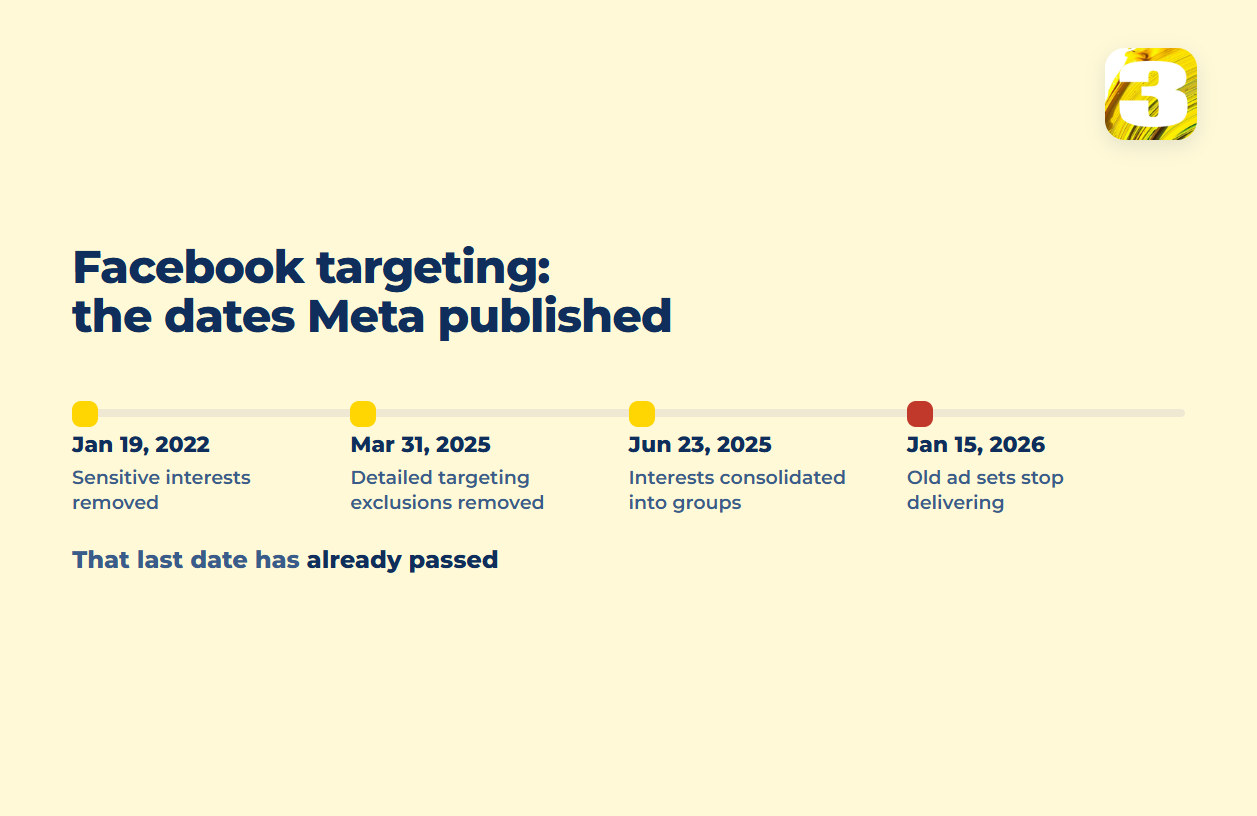
On January 19, 2022, Meta removed a defined set of detailed targeting options — in its own words, “Detailed Targeting options that relate to topics people may perceive as sensitive,” covering causes, organizations, and public figures tied to health, race, political beliefs, religion, and sexual orientation. Meta’s stated reason: it had “heard concerns from experts that targeting options like these could be used in ways that lead to negative experiences for people in underrepresented groups.”
That one is narrower than most recaps make it sound — a named list of sensitive categories, not detailed targeting in general. If your campaigns never touched those categories, the 2022 change took nothing from your setup.
We run these accounts as Meta-certified specialists across industries — attorneys, a clinic, a fencing manufacturer, and an event company — and several of the “missing” options clients ask about turn out to be options nobody ever removed. The ones that were removed came later, and they have dates.

Detailed Targeting Exclusions Are Gone, and Meta Dated It
Meta’s Updates to Detailed Targeting page states that it began removing the ability to use detailed targeting exclusions on March 31, 2025 in Ads Manager, and on June 10, 2025 for boosted posts. Not deprecated with a grace period: the page says exclusions were removed from active existing campaigns starting on that March date, and that you can no longer duplicate an ad set or use a saved audience until any detailed targeting exclusions come out of it.
The justification on the same page is the rare case where the platform publishes a number: “A recent advertiser test showed that the median cost per conversion was 22.6% lower when not using detailed targeting exclusions vs when using detailed targeting exclusions.” That’s Meta’s figure from Meta’s own test, not an independent result — but it tells you which way the platform believes the evidence points.
What still works with real precision is a Custom Audience — a customer list you upload, or an audience Meta builds from your own site visitors and engagement. That moves the real work upstream: it used to sit inside Ads Manager, spent on finding the right interest combination, and now it sits wherever your customer data lives, spent on keeping that list accurate. A list that’s six months stale, missing last quarter’s customers, quietly protects or targets the wrong group, and nothing in Ads Manager will flag it. If someone else is running this account, it’s worth knowing what happens to that audience data and the pixel behind it once the relationship ends — what actually stays yours when an agency leaves covers what actually stays yours.
A full breakdown of which audiences to exclude and why — returning customers, converted leads, past applicants — lives at retargeting: who to exclude, and the narrower case of keeping ads off people who already bought is answered there too. Both are a separate question from what’s covered here.
Advantage+ Treats Your Picks as a Starting Point, Not a Boundary
For campaigns running Advantage+ audience, Meta describes it plainly: it “combines your customer knowledge with AI to reach the most relevant audience,” and it “takes your usual audience selections, such as a customer list, a gender, or an interest and expands beyond them.” Read literally, your selection stops being a boundary and becomes a starting point — the system is built to go past it.
What stays fixed, by Meta’s own account, no matter how far Advantage+ audience reaches: minimum age, location, language, and exclusions built from your own Custom Audiences. Those four hold regardless of what else moves.
The Deadline That Already Passed
There’s a third change on that same page, and it has a date that’s now behind us. Starting June 23, 2025, Meta began consolidating interest options — combining related interests into new groupings, so that specific picks a campaign was built on stopped existing as separate choices. Campaigns created before that date were allowed to keep running on the old selections, but only until January 15, 2026. After that, Meta’s wording is blunt: they “will stop delivering if the impacted options have not been removed or replaced.”
That deadline has passed. If an ad set built before mid-2025 has been quiet since January and nobody could explain why, this is the first thing to check — not the creative, not the budget. Ads Manager flags affected ad sets and saved audiences with warning banners, which is easy to miss on an account nobody logs into weekly.
Meta adds on the same page that it doesn’t expect the consolidation to affect advertisers using Advantage+ detailed targeting, where interest picks work as a suggestion rather than a filter — the platform saying, fairly directly, which setup it has built for.
Special Ad Category: Where Facebook Targeting Rules Get Stricter, Not Looser
None of the above applies once a campaign falls under Special Ad Category — housing, employment, credit, or, since January 14, 2025, financial products and services. Meta’s framing: “It’s against Meta’s policies to discriminate by wrongfully reaching or excluding specific groups of people,” and the rules here exist to make that unlikely by design, not by review after the fact.
The obligation isn’t new: US advertisers have had to declare it for new and edited campaigns since December 4, 2019, and in Canada the requirement dates to December 3, 2020 for credit, employment, or housing offers. Inside a declared campaign, age locks at 18–65+, gender narrows to “all,” location needs a minimum radius with no exclusions allowed, lookalike and saved audiences disappear, and behavioral and demographic targeting are off the table. Meta requires the advertiser to self-identify, and running such ads without approved targeting options puts the campaign outside policy. If your business touches any of those four areas, check this before touching anything else covered above.
What’s Actually Left in Your Hands
Put the changes next to each other and a pattern shows up. Age, location, language, and your own exclusion lists are still your call. Interest picks aren’t gone, but the ability to exclude by interest is, and on campaigns running Advantage+ audience the picks that remain work as a hint the algorithm can move past. Inside Special Ad Category, most of that flexibility disappears by rule, before the algorithm gets a say at all.
The practical result: when the system decides who sees an ad within the boundaries you set, the lever that still moves the outcome is the quality of the signal you send back about who actually converts — not which interest box got checked. That’s a Conversions API question as much as a targeting one, and it’s what what breaks when you turn Conversions API on gets into.
None of this changes what a campaign costs to run well — see what Facebook and Instagram ads cost for that side. What it changes is where the setup work goes: less time picking interests, more on the account itself and the data feeding it.
For a second opinion on your own setup, send the campaign structure — objectives, audiences, and which exclusion lists are attached to what. We’ll tell you which settings are still doing something, which ad sets are sitting on options that stopped delivering in January, and whether anything should have been declared under Special Ad Category and wasn’t.