


Search this question and every result gives you the same three numbers: an average cost per click, an average cost per thousand impressions, and a table broken down by industry. Somewhere near the bottom, most of them recommend starting with $5 a day — a number nobody names a source for. None of it tells you whether $5 a day is enough to learn anything, or whether your particular business needs ten times that just to get a single usable data point.
That’s the real question behind what Facebook and Instagram ads cost: not what the market pays on average, but what your account needs to spend before Meta’s own system can even function properly. Those are two different questions, and only one of them has a real answer that doesn’t depend on guessing.
This article works through that second question — the one with an actual floor, set by Meta itself rather than by an agency’s rule of thumb. Then it walks the math forward from an impression to a paying customer, lays out the three separate bills that make up a Meta budget, and shows you how to check your own numbers against Meta’s own tools in about five minutes.
Why There’s No Price List in the First Place
Meta doesn’t publish prices because there isn’t one price to publish. Every time your ad could be shown to someone, it enters a live auction: “every time there’s a chance to show your ad to someone in your audience across Meta platforms like Facebook, Instagram and Messenger, it enters an ad auction.” What you pay depends on who else wants that same person’s attention at that same moment.
Bid size isn’t the deciding factor, either. Meta says plainly that “unlike traditional auctions that pick a winner based on the highest bid, Meta’s auction system looks at a number of factors equally to determine which ad is displayed.” One of those factors is ad quality, and Meta is specific about what drags it down: “ad quality is determined from several sources, including assessments of low-quality attributes in the ad, such as withholding information, sensationalized language and engagement bait.” A vague, clickbait-y ad doesn’t just perform worse — it costs more to run, for the exact same audience, than a plain and honest one. That’s from Meta’s own explanation of the auction, not from an agency trying to sell you better copywriting.
This is also why two businesses in the same city, selling the same kind of thing, can see their cost per result differ by two or three times. It isn’t that one of them found a secret setting. It’s that the auction is scoring the whole ad — creative, landing page, audience fit — not just the number typed into the budget field.
The Real Minimum Isn’t “$5 a Day” — It’s a Number of Results
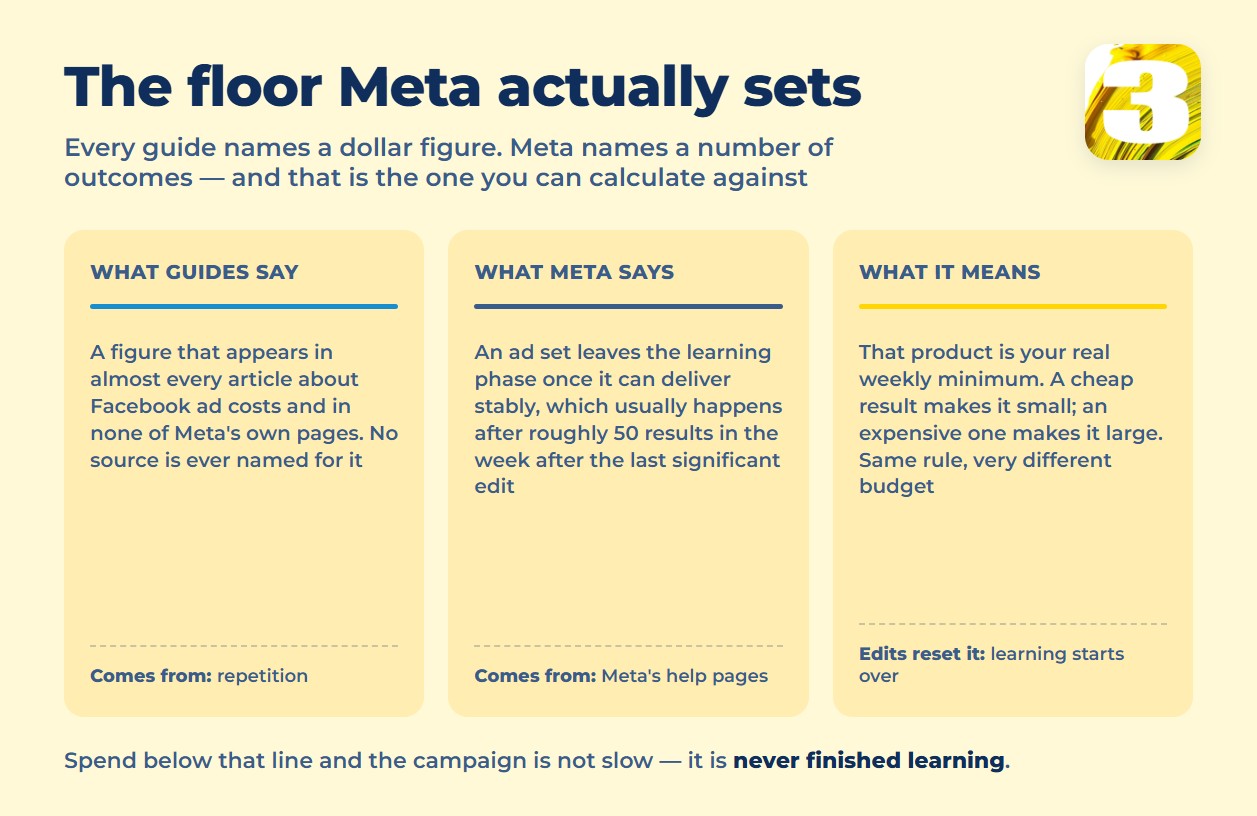
Nearly every guide to Facebook ad costs recommends a starting daily budget somewhere between one and five dollars. That figure doesn’t come from Meta. Look for an official minimum daily budget on Meta’s own pages — the auction page, or the Marketing API’s own documentation on campaign budgets — and you won’t find one. The dollar figures that circulate are agency folklore, repeated often enough to sound official.
What Meta does state, clearly and repeatedly, is something more useful: a new ad set needs to earn its way out of a “learning phase” before it performs the way it’s going to perform long-term. Meta describes it directly: “the learning phase is the period when the delivery system still needs to learn about how an ad set may deliver and perform.” And it gives you the actual exit condition: “ad sets exit the learning phase as soon as they can deliver stably. This usually occurs after about 50 results in the week after the ad set’s last significant edit.”
That single line is the real floor on your budget. Not a dollar figure — a number of outcomes. If your ad set needs about 50 results in a week to leave the learning phase, then your minimum useful weekly budget is 50 times whatever a single result costs you. A business whose result costs $2 can run a meaningful test on $100 a week. A business whose result costs $80 needs $4,000 in the same week just to reach the same starting line. Same platform, same learning-phase rule, wildly different minimum.
Say your result — a completed lead form, for this example — costs $12. Fifty of those in a week is $600. That’s not a recommendation, it’s arithmetic:
| What you need | Example input | Running total |
| Results to exit the learning phase | about 50 per week | — |
| Cost per result (example only) | $12 | 50 × $12 |
| Minimum weekly budget for this example | — | $600 |
| Minimum monthly equivalent | — | about $2,600 |
Below that line, you’re not necessarily wasting money — you’re just spending too slowly for Meta’s delivery system to learn what it needs to learn. A campaign that never exits the learning phase keeps getting reshuffled every time it’s touched, because Meta also advises against editing an ad set while it’s still in this stage: any significant edit resets the clock. So a business that keeps “improving” a struggling ad every few days may be the reason it never stabilizes at all.

What One Customer Actually Costs
The $12 result from the example above isn’t the end of the calculation — it’s the middle of it. A “result” in Meta’s own language usually means a lead, a purchase, or another action you told the platform to optimize for. What you actually care about is the customer at the far end of that lead, and that takes one more step of arithmetic that almost nobody runs.
Say that same $12 lead converts to a paying customer one time in six. Follow the number all the way through:
| Step | Example input | Running total |
| Cost per lead (example only) | $12 | — |
| Lead-to-sale rate | 1 in 6 leads closes | 6 leads → 1 customer |
| Cost per customer | — | $72 |
Nobody quoting an average cost-per-click could have told you that $72. It depends entirely on your landing page and your sales process, not on Meta’s auction. Which is exactly why average CPC is the most useless number in advertising — you don’t pay for clicks, you pay for customers, and a click price alone can’t tell you what one of those costs.
Three Bills, Not One
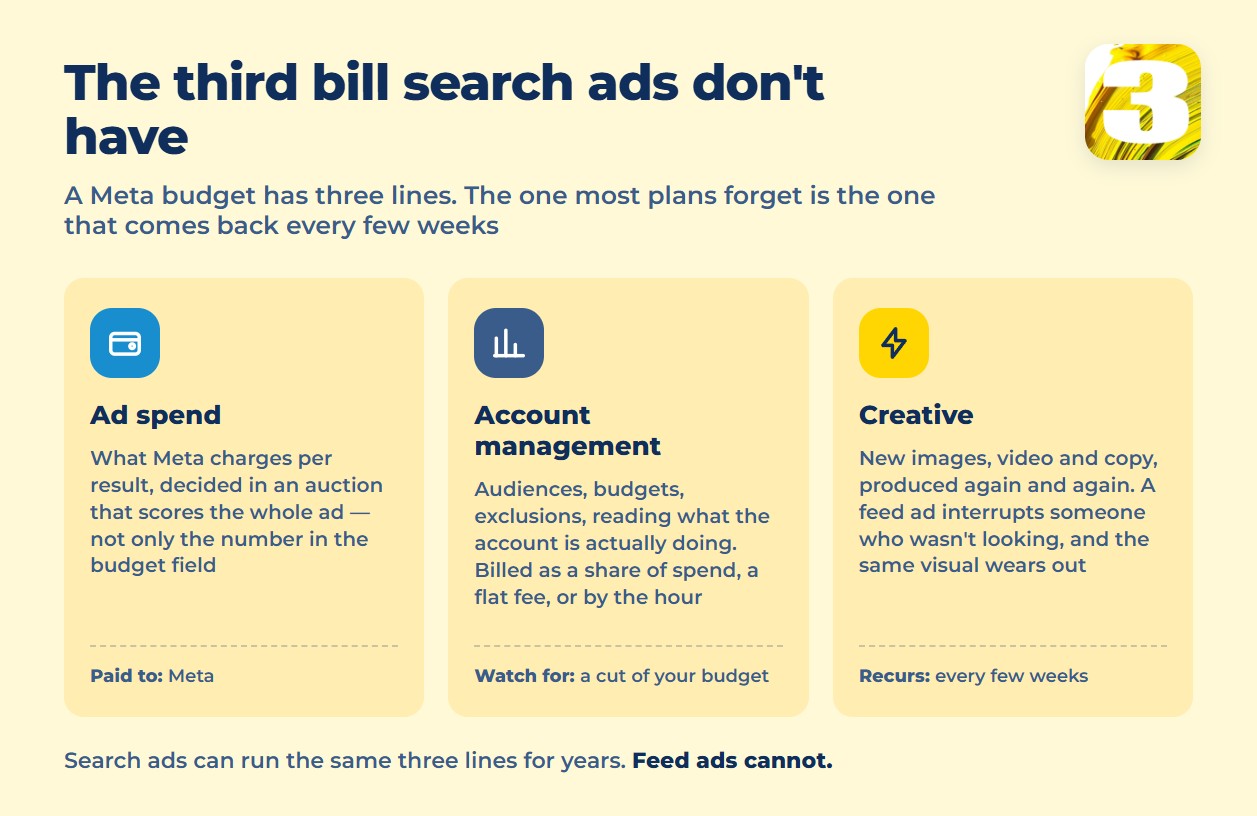
Ask what running Facebook ads costs and most answers only price the first of three separate line items.
| Line item | What it actually pays for |
| Ad spend | What Meta charges per result, governed by the auction and the learning-phase minimum above |
| Account management | Audience building, bid and budget decisions, reading the reports, reacting to what the account is actually doing |
| Creative | New images, video, and copy — produced on an ongoing basis, not once |
The third line is the one search engines don’t have, and it’s the one most Meta budgets underestimate. A search ad can run the same three lines of text for years because the person searching is already looking for you. A Facebook or Instagram ad interrupts someone who wasn’t looking for anything, and the same visual wears out. Creative burnout — the same ad shown to the same audience enough times that performance drops — isn’t an occasional problem to fix once. It’s a recurring cost, built into the platform, for as long as the campaign runs.
Skip that third line and a $600-a-week plan quietly becomes a $600 media budget with nobody producing the next round of creative before the current one goes stale. The account doesn’t fail loudly. It just gets a little more expensive every few weeks, for a reason the invoice never mentions.
Getting Your Own Number in Five Minutes
You don’t need a market survey to find your own starting figure — Meta already has one built into the ad platform you’re using. Inside Ads Manager, the forecasting panel attached to any new ad set estimates a result range for your budget, your geography, and your audience — before you spend a dollar. That number, not a national average, is the one to multiply against the 50-results rule above.
Pair that with a quick look at Meta’s public Ad Library, where anyone can search by page or keyword and see which ads a competitor in your market is currently running — and for how long. An ad that’s been live for months is a decent sign it’s making its money back; one that vanished after a week usually wasn’t.
Two things are worth checking before you trust either number. First, check whether what Meta counts as a result is the event you actually think it is. A form submission missing half its fields, or an event firing twice because two different tools are tracking it, will throw off every calculation above it. how to check the pixel is really counting Second, whether the audience behind that forecast is a cold audience or a warm one aimed at people who already know you — the same budget produces a very different result cost depending on which one it’s talking to. There’s a separate piece on who to exclude from a retargeting audience.
None of that math is worth much, either, if the lead that comes out the other end can’t be traced back to the campaign that produced it. The same blind spot that hides phone calls in a Google Ads report shows up just as easily on the Meta side — a landing page that isn’t tracking calls hides exactly the leads a service business cares about most, regardless of which platform sent the click. And tracking in general matters for exactly this reason: without it, every number in this article is a guess dressed up as arithmetic.
What Other Advertisers Pay for Facebook and Instagram Ads
If you want a number from outside your own account, the closest thing to real data comes from WordStream, whose recent report on US campaigns put the median cost per click at $0.70 for traffic-goal campaigns and $1.92 for lead-goal campaigns.
Two things to hold onto before that number does any work for you. It’s a US-only sample, so a Canadian account can land well above or below it and still be perfectly normal. And a two-and-a-half-times spread between traffic campaigns and lead campaigns, on the same platform, is the whole argument of this article in miniature: an average click price doesn’t answer the question you actually asked. It tells you what strangers paid, not what your funnel will cost you.
Who Gets Paid More When You Spend More?
Here’s the part of a Meta ads quote that almost nobody puts in writing: how the person managing the account gets paid, and what that arrangement makes them want.
Charge a percentage of ad spend and there’s exactly one outcome that raises the bill without raising anyone’s results: a bigger budget. If a campaign genuinely isn’t working, the fix that helps the client — spending less until the funnel is fixed — is the same move that cuts the manager’s invoice. That’s not a scandal. It’s just the one commercial model where the manager’s income and the client’s spend move in the same direction no matter what the account is actually doing.
We manage Facebook and Instagram accounts on a flat fee instead, with no commission tied to how much you spend on ads — the same conflict of interest, and the same fix, that applies on the Google Ads side of an account. We won’t put a number in this article, because the honest one depends on how many campaigns and audiences an account is actually running.
There’s a second place the numbers quietly disagree, and it isn’t about billing at all: what Ads Manager reports as a result and what your CRM records as a sale often use different rules for what even counts as a conversion in the first place. why two platforms claim the same sale The label attached to that lead when it lands in your CRM — whether it reads “facebook,” “Facebook,” or something else entirely — depends on how the link that brought it there was tagged before anyone clicked it. Worth reading next: the naming convention that keeps UTM tags readable.

What This Actually Comes Down To
There’s no honest single price for a Facebook or Instagram ad, and every guide that gives you one is quoting a stranger’s average, not your business. What Meta does give you, in its own words, is a real floor: roughly 50 results a week to exit the learning phase, multiplied by whatever a result costs in your category. From there, the math is yours to run — result to customer, spend to profit — using your own conversion rates instead of someone else’s median.
Send us your category, your current spend, and what a closed customer is worth to you, and we’ll run that math against your own account instead of a market average.