


Ten working days or less. That’s our published timeline for a fixed-scope site of up to 8 pages, and for a good share of projects it lands in as little as one week. Most agencies won’t give you a number at all — you’ll see “it depends,” a range that spans “a few weeks to a few months,” or a list of phases with no dates attached. That’s not dishonesty so much as an admission: without a fixed scope, nobody can tell you how long anything takes, because the scope is still moving.
The number holds on one condition, and we’d rather say it up front than discover it together in week three: it assumes the pieces only you can supply arrive when we ask for them, and that approvals come back. A design that sits waiting two weeks for a yes moves the launch by two weeks — the build was never the slow part.
We can name a number because the scope doesn’t move. Here’s what actually holds that timeline together, what depends on you instead of us, and what to have ready before the clock starts.
Why 10 Days Is a Real Number, Not a Guess
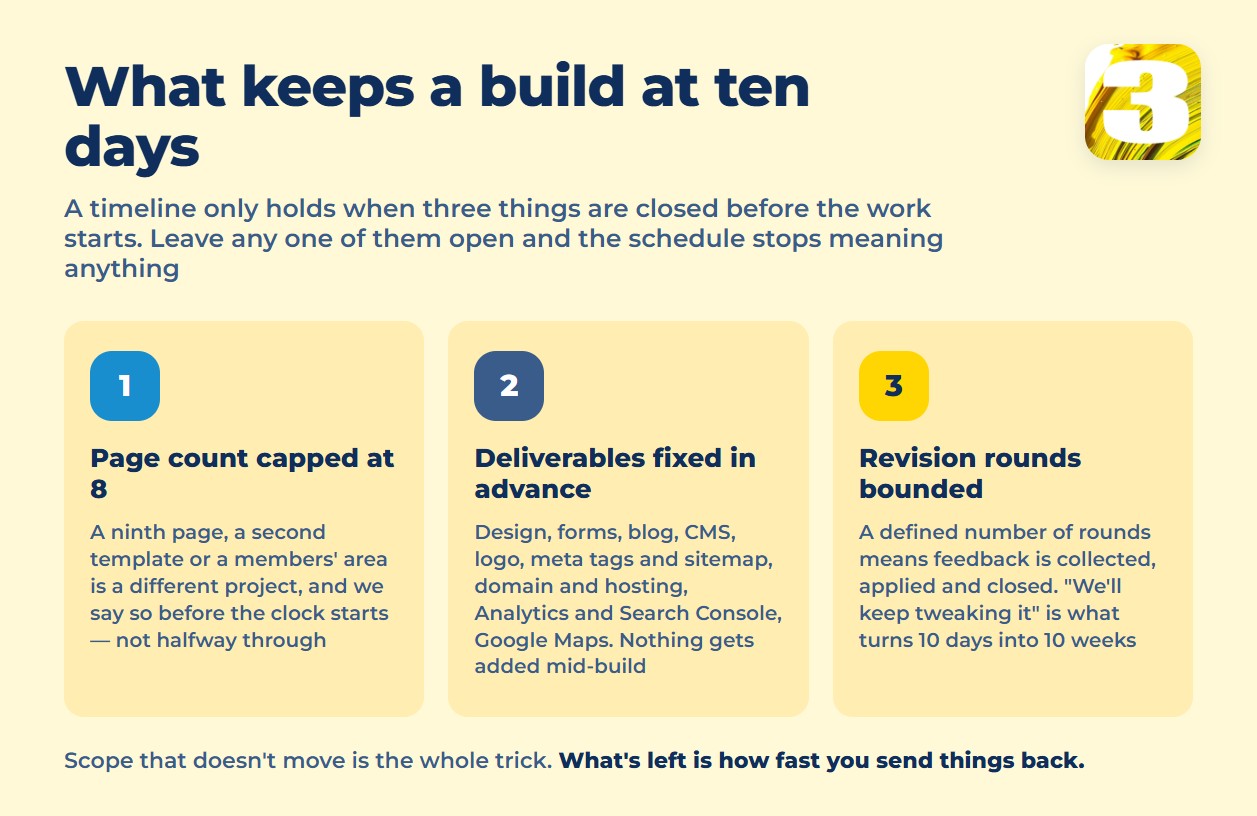
A build stretches out for one of three reasons: the page count keeps growing, the list of what’s included keeps changing, or the revision rounds never end. Our timeline holds because none of those three is open-ended.
The page count is capped at 8. That’s not a marketing limit — it’s the ceiling that keeps a build inside a single, predictable pass through design and development instead of a shifting to-do list. A ninth page, a second template, or a members’ area moves the project into different territory, and we say so before the clock starts, not after.
The deliverable list is fixed in advance. Responsive design, forms, blog setup, CMS access, a logo (up to three concepts), basic SEO — metadata and an XML sitemap — plus your domain, hosting, Analytics and Search Console access, and Google Maps integration. Nothing gets added mid-build that wasn’t agreed on day one, which is the part that usually blows up other people’s estimates.
Revisions are bounded, not unlimited. An open-ended “we’ll keep tweaking it” clause sounds generous and is exactly what turns a 10-day build into a 10-week one. A defined number of revision rounds means feedback gets collected, applied, and closed — not trickled in for a month.
None of that removes the human part of the cost equation — a fixed price and a fixed timeline come from the same source: agreeing on scope before work starts, not during it.
What Actually Slows a Website Down
Once scope is locked, the biggest variable left is you — not because clients are difficult, but because a build can only move as fast as the pieces only you can supply.
- Text and photos. Design work can start on placeholder content, but a page can’t ship without the real thing. Waiting on copy or images is the single most common reason a 10-day build runs long.
- Sign-off from more than one person. A build with one decision-maker moves in a straight line. A build that needs a partner, a marketing manager, and an owner to all approve the same homepage moves in whatever order those three people happen to check their email.
- Access to the domain and email. If nobody remembers the registrar login, or the domain is parked at a different provider than the one paying the bill, that single missing password can stall launch by days — after the site itself is finished.
- Legal pages. A privacy policy and terms of service are quick to add once someone writes them, and slow when nobody has.
- Payment processor details. Selling online means an approved merchant account or payment gateway, and that approval sits outside our timeline entirely — some processors take days to verify a new business.
- Turnaround on revisions. A bounded number of rounds only saves time if each round comes back promptly. A revision that sits unopened for a week adds a week, no matter how fast the build itself was.
What to Prepare Before You Start
The projects that hit 10 days almost always start with the same short list already in hand. The ones that don’t, usually start without it.
- Final or near-final text for every page — even a rough draft beats a placeholder
- Photos and any logo files you already own
- One person with final approval authority, named up front
- Domain registrar login, or access transferred to us
- Business email already set up, or a decision on what to use
- Privacy policy and terms of service, drafted or at least outlined
- Payment processor account, if the site will take payments
- Any must-have integrations named on day one, not discovered mid-build

What “10 Working Days” Doesn’t Include
The build finishing on time isn’t the same as the site being finished with everything a new site needs. Three things sit outside that 10-day window on purpose, because they’re not part of building the site — they start after it exists.
Indexing. A finished site isn’t visible in Google search results the moment it goes live. Search engines have to find and crawl the new pages first, which is a separate process from launch — see Google’s own guidance on asking Google to recrawl your URLs for how that works and what a realistic wait looks like.
Analytics configuration beyond the basics. Analytics and Search Console access come with the build, but goal tracking, conversion events, and custom reporting are a follow-on step, not a launch-day checkbox.
Blog content. The CMS and blog structure are ready on day one. Filling it with articles is ongoing work, not a launch deliverable — see our breakdown of what website maintenance covers for where that line actually falls.
Two more things worth knowing about, even though they rarely add delay: proving you own the domain (Google’s guide to verifying site ownership via a DNS record shows the mechanics), and the SSL certificate that secures the domain, which Let’s Encrypt explains is usually issued automatically once DNS is pointed correctly — not something you request separately.
Have a Date in Mind?
If you have an opening, a launch event, or a season you’re building toward, the fastest way to find out if 10 days gets you there is to tell us the date. Send us your target launch and we’ll send back a short checklist of exactly what we need from your side to hit it — the same list above, tailored to your project.