


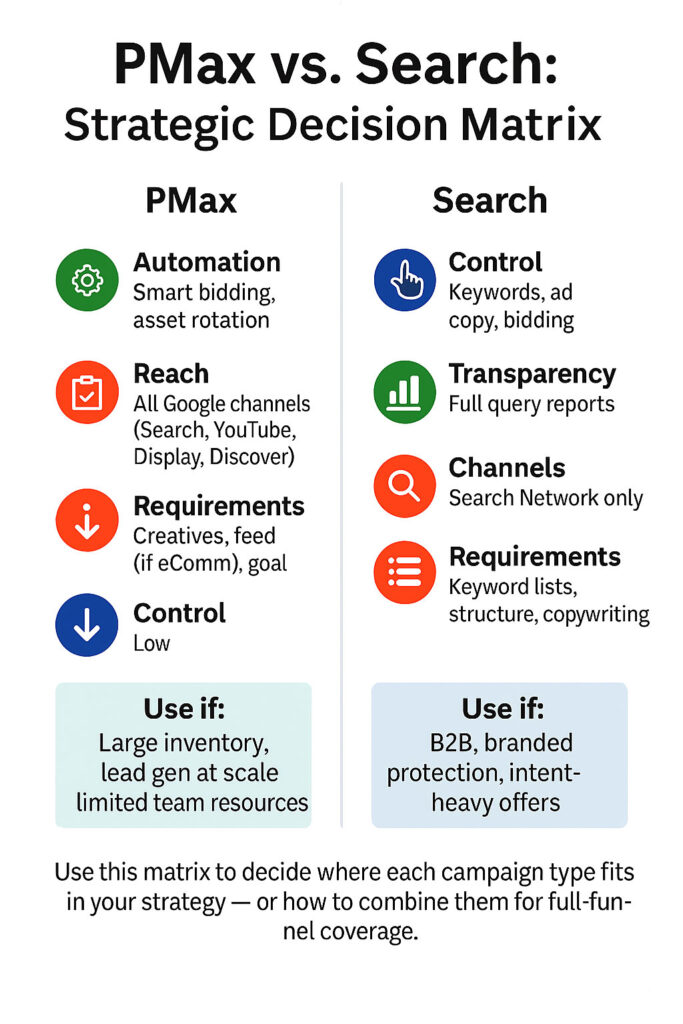
Performance Max (PMax) and traditional Search campaigns serve distinct purposes in Google Ads. One prioritizes automation and reach across Google’s ecosystem; the other provides granular, intent-based control. Understanding when and how to use each is critical to a modern paid media strategy.
What Performance Max Actually Does
PMax campaigns distribute ads across Google’s full inventory — Search, Display, YouTube, Discover, Gmail, and Maps — from a single setup. Advertisers provide:
- Creative assets (images, headlines, videos, descriptions)
- Optional audience signals
- Product or service feed (for eCommerce)
Google’s system then determines:
- Ad placements
- Creative combinations
- Bidding strategy
- Targeting (based on signals and intent)
Key Traits:
- No keyword bidding — though campaign-level negative keywords and brand exclusions are available
- Automated creative and bidding
- Multi-surface delivery
What Search Campaigns Still Own
Search campaigns are built around explicit keyword targeting. Advertisers choose what queries to show for, craft specific ads, and control bidding rules.
Strengths:
- Full control over keywords and match types
- Transparent search term reporting
- Intent-focused targeting
- Ideal for high-precision verticals: B2B, services, brand defense
Side-by-Side Comparison
| Attribute | Performance Max | Search Campaigns |
|---|---|---|
| Setup | Asset-based, fast setup | Manual keywords + structure |
| Reach | All Google networks | Search Network only |
| Control | Low | High |
| Creative | Auto-generated from assets | Fully custom per ad group |
| Targeting | Signal-based | Keyword-driven |
| Reporting | Asset group, channel and search terms | Query and placement-level |
| Best for | eCommerce, lead gen, discovery | Branded, high-ROI, B2B |
Common Misconception: PMax = Smarter Search
Performance Max is not a replacement for Search. It’s a distinct campaign type designed to find conversions across surfaces — not to respond to specific user queries. If you replace branded Search with PMax, expect higher CPAs and less clarity.
Example:
A pattern we see often in B2B: a team moves form-fill campaigns from Search to Performance Max, cost per lead climbs, and nobody can say exactly why, because there is no query list to look at. The usual fix is to keep the proven exact-match Search campaigns for the queries that already convert and score the leads in the CRM, so bidding optimises on real pipeline instead of raw form submissions.
One thing worth knowing before you split budgets. When a Performance Max campaign and another campaign in the same account could both serve, the campaign with the higher Ad Rank wins. The single exception is a Search campaign whose keyword exactly matches the query — that one is preferred over Performance Max regardless. So the popular claim that “PMax always eats your Search traffic” is not how the auction resolves.
Hybrid Models: Best of Both Worlds
1. Intent + Discovery
- Use Search for proven keywords
- Layer PMax to explore new demand
- Use brand exclusions in PMax so it doesn’t bid against your own branded Search campaign
2. Catalogs + Strategy
- Run PMax with product feed for broad coverage
- Use Search for high-margin, seasonal, or promo items
3. Local Services
- Search for intent-rich queries (“clinic near me”)
- PMax for remarketing, YouTube, Maps visibility
Keeping PMax in Check
To avoid waste, implement governance:
- Provide strong audience signals (site visitors, CRM lists)
- Use conversion value rules
- Exclude weak geo-locations and app placements
- Separate campaigns by product or service category
- Add negative keywords and brand exclusions at campaign level — that is the only keyword-shaped control Performance Max gives you
Measurement: What Changes
With PMax, some visibility is lost:
- No keyword-level bidding, and search terms arrive as themes rather than a full query list
- Limited control over placements or device splits
- Reporting is thinner than in Search, but no longer a black box: channel-level and asset-group reporting are both there
But you gain:
- Broad reach and channel coverage
- Auto-tested asset combinations
- Summary-level performance by audience or creative
Control Tips:
- Segment asset groups clearly
- Track with GA4 and consistent UTM parameters
- Import offline conversions (CRM/sales)
Strategic Matrix: When to Use What
| Scenario | Recommended Type |
|---|---|
| Branded traffic | Search (Exact Match) |
| Product catalog promotion | PMax with Merchant Feed |
| Lead capture via forms | Search + PMax Blend |
| Discovering new audiences | Performance Max |
| Precise control over bidding | Search Campaigns |
Final Takeaway
Search campaigns remain unmatched in transparency and control. PMax delivers scalability and automation across Google’s full ecosystem. The best strategies blend both — anchoring on intent, scaling with automation.
You don’t choose between them. You architect the system.
Work with 3MY: Build the Right Campaign Architecture from Day One
At 3MY, we don’t just run ads — we build Google Ads systems tailored to your business model, customer journey, and growth goals.
We specialize in:
- eCommerce brands with product catalogs
- B2B companies with CRM-integrated funnels
- Local businesses using form or call tracking
- DTC and service providers across verticals
Every engagement includes:
- Strategic separation of PMax and Search
- Feed integration and audience rules
- Custom conversion tracking
- Ongoing optimization + detailed reporting