


A minimum advertised price (MAP) policy is a document a brand publishes and enforces on its own: it names the lowest price a reseller may show in a public ad for a product. Not the price the reseller charges — the price the reseller advertises. A retailer can still ring up a lower number at checkout; MAP only governs what’s printed, emailed, or posted where a shopper can see it before they buy.
That distinction is where most confusion starts, and it runs deeper than one sentence can settle — MAP, MSRP and the price at checkout are three different numbers with three different owners, and we pull them apart in MAP vs. MSRP. What matters here is narrower: a brand that mixes them up either writes a policy that doesn’t do what it thinks, or goes after a dealer for something the policy never covered.
If you’re a brand watching your products get advertised below what you’d like across a handful of resellers, the fix starts with a document, not a piece of software.

What Belongs in the Policy Itself
A MAP policy that holds up in practice covers a short, specific list of items, not vague language about “fair pricing.” Looking at how established manufacturers structure theirs — the Sherwin-Williams Consumer Brands Group policy for its Minwax, Purdy, and Cabot lines is posted publicly and worth reading in full — the recurring pieces are:
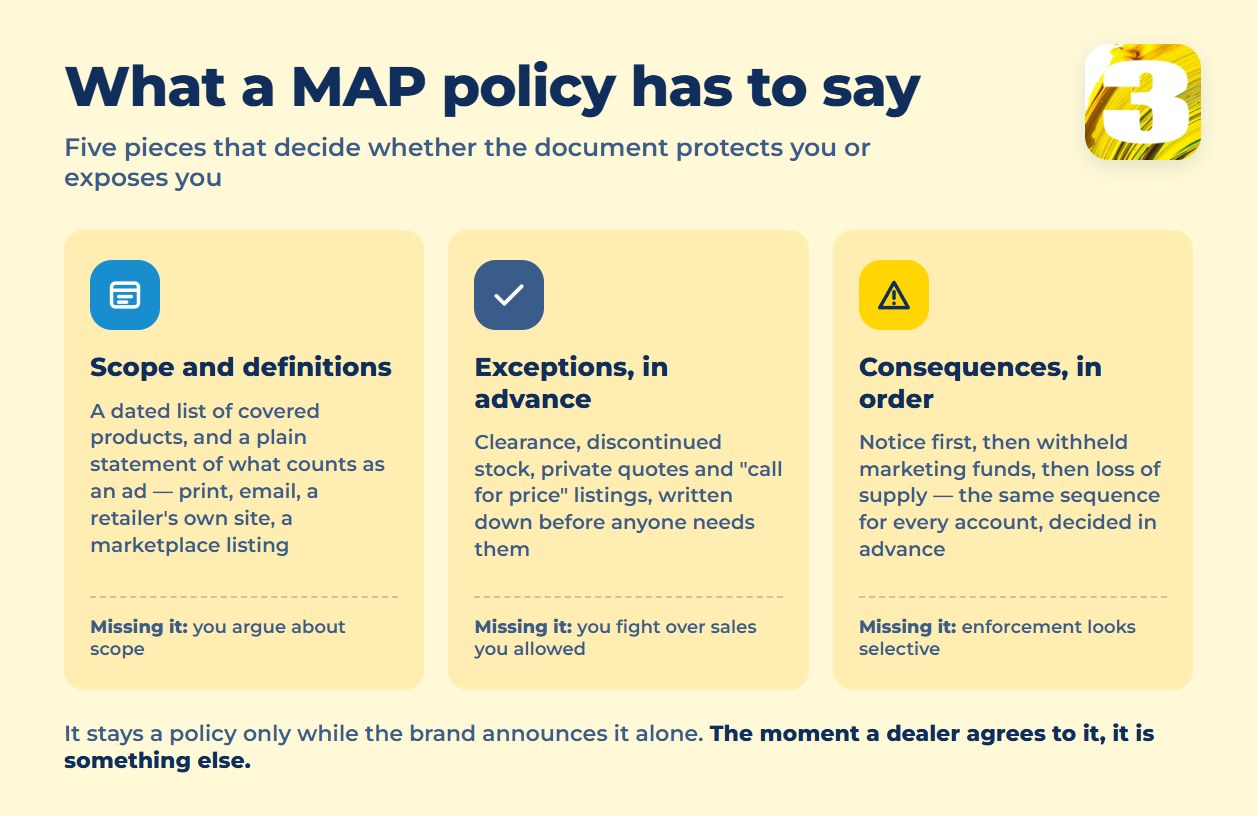
- Which products it covers, published as a dated list, not “everything we sell.” Products get added and dropped over time.
- What counts as “advertising.” Print, broadcast, email, a retailer’s own site, social posts, and third-party marketplace listings all count. In-store price tags typically don’t, and neither does the number a shopper sees only after adding an item to their cart.
- Exceptions. Clearance or discontinued inventory, prices quoted privately for a bid or contract, and “call for price” listings are standard carve-outs — a policy that forgets these ends up fighting resellers over pricing it never meant to restrict.
- How a change is announced. A dated notice, published where every reseller can see it, with an effective date. Not a phone call to one dealer.
- Consequences, and the order they’re applied in. TrackStreet’s documentation describes the ladder most policies follow: a written notice first, then withheld marketing funds and reduced allocation, then loss of reseller status. The point of writing this down in advance is that it removes discretion in the moment — everyone gets the same sequence.
If you sell direct as well as through resellers, decide upfront whether your own storefront is covered by the same floor — a common gap when an e-commerce site launches after the MAP policy was written for wholesale only.
Why the Policy Has to Stay One-Sided
This is the part that determines whether a MAP policy protects you or exposes you: it has to be something the brand announces and enforces alone, never something a dealer agrees to.
In the US, this rests on a long-standing distinction. A manufacturer can unilaterally announce a minimum advertised price and stop selling to resellers who ignore it. The moment a dealer signs something, agrees to a number in a contract, or you ask for their “confirmation” that they’ll comply, you’ve moved from a unilateral policy toward an agreement on price — and that is judged very differently. The FTC’s guidance on manufacturer-imposed requirements sets out both halves, including the case where the FTC challenged the MAP policies of five large music distributors because the policies reached too far — covering in-store advertising and ads the retailer paid for itself. In Canada, price maintenance is addressed directly in section 76 of the Competition Act, where the Competition Bureau discusses MAP and MSRP as common practices — with the same emphasis on whether a supplier’s influence over price is a unilateral policy or something closer to a threat or an agreement.
This isn’t legal advice, and neither page is a substitute for a lawyer reviewing your actual policy in your actual market. It’s a pointer to the primary sources, because a MAP policy is one of the few marketing documents where getting the legal framing wrong has real consequences.
Three Mistakes That Turn a MAP Policy Into a Problem
- The price ends up in a contract. A dealer agreement with a pricing clause, a signed acknowledgment with numbers in it, an email that says “please confirm you’ll hold to this” — any of these can turn a one-sided policy into a two-sided price agreement. The Sherwin-Williams policy says it outright: the document is the company’s unilateral policy, and no reseller is asked to agree to it. That sentence is doing legal work, not filler.
- “Clear your discount with us first.” Asking a dealer to check in before running a sale, or accepting their assurance that they’ll comply, looks cooperative and is exactly the kind of coordination that moves unilateral conduct toward something else. The policy is announced and enforced, not negotiated.
- Selective enforcement. Sending a warning to a small independent seller while letting a large account run the same ad unpunished does two things at once: it weakens your position, because consistency is part of what makes the approach defensible, and it tells every dealer watching that the policy is optional if you’re big enough. Once that message gets out, compliance collapses from the top down.
What Monitoring Adds Once the Policy Exists
A policy without evidence is a letter you can’t send. Once the rules are written down, the practical problem becomes proving a specific violation on a specific day: which listing, at what price, on which page, and when. “I saw it last week” doesn’t hold up as well as a dated screenshot with a timestamp and the seller’s name attached — and a one-off during an approved clearance period looks nothing like a pattern repeated across months.
That’s the gap between having a policy and being able to act on it, and it’s what ongoing price monitoring is for: dated records you can point to when a reseller disputes the notice, rather than a screenshot taken once you’d already noticed a problem. What those tools cost, and which tier actually turns MAP tracking on, is a breakdown of its own. It matters most on marketplaces, where listings and prices change several times a day and the seller behind a listing isn’t always who you think.
Write the policy first. Decide what counts as an ad, what’s exempt, and what happens on a first and second violation. Only after that does monitoring have something to enforce — and when it does, the build is priced once rather than monthly: $800 for a single connected workflow, $1,500 for a set of up to three.