


Publicly, not much most of the time. Named starting prices for tools that track competitor prices and MAP violations run from $0 a month to about $800 a month, depending on catalog size and whether Minimum Advertised Price tracking is switched on. Where a vendor names an enterprise floor instead of a plan, it starts an order of magnitude higher — MetricsCart from $1,000 a month, Intelligence Node from $5,000. That’s the range you can actually see. It’s not the whole picture, because most of the market won’t show you a number at all.
We checked the pricing pages of fourteen vendors that show up for “MAP monitoring software” and “price monitoring tool” — not review sites, not affiliate roundups, the vendors’ own tariff pages. Five publish a full price list. Three publish part of one — a floor, a “starting at,” a FAQ line with a dollar figure buried in it. Six show nothing but a “Contact Sales” button, and in two cases the pricing page itself doesn’t exist. That split is the first thing worth knowing before you talk to anyone: half this market is built to be quoted, not bought.

What These Tools Actually Cost
Every number below is copied from the vendor’s own pricing page, checked in August 2026. Read the last column first — it’s usually where the catch lives, whether that’s a SKU cap, a feature that only unlocks on a higher tier, or the word “unpublished.”
One note on how to read it. “Publishes price” means a number you can see without talking to anyone: a plan page with dollars on it. “Partially” means a floor, a “starting at,” or a figure buried in an FAQ — enough to know whether you’re in the right order of magnitude, not enough to budget from. “No” means the page exists to book a call.
| Vendor | Publishes price? | Price | What’s included |
| Prisync | Yes | $99–$799/mo (Professional $99, Premium $199, Platinum $399) | Professional — up to 100 products, unlimited competitors, updates 3×/day; Premium — up to 1,000 products, Dynamic Pricing, Marketplace Tracking; Platinum — up to 5,000 products. 14-day trial, no card |
| Pricefy | Yes | $0–$499/mo (−25% billed annually) | Free — 50 SKU, 5 competitors, 1 update/day; Starter $49 ($37 annual) — 100 SKU; Pro $99 ($74) — 2,000 SKU; Business $189 ($142) — 15,000 SKU, MAP/MSRP Monitoring turns on here; Enterprise $499 ($374) — 25,000 SKU |
| Priceva | Yes | $0–$199/mo; Enterprise custom | Starter, free — 6,200 checks/mo, 20 products, 20 competitors; Business $99 — 35,000 checks, 30 competitors, extra check $0.0029, extra competitor $2.50; Pro $199 — 100,000 checks, 40 competitors, extra check $0.002 |
| PageCrawl | Yes | $0–$83.25/mo | Free — 6 pages, 220 checks/mo, up to 60-min frequency; Standard $13.33 — 200 pages, 30,000 checks, up to 15 min; Enterprise $25 — 500 pages, 100,000 checks, up to 5 min; Ultimate $83.25 — 1,000 pages, up to 2 min |
| Price2Spy | Partially | Starter/Basic — no published price; Premium — “PRICE UPON REQUEST” | Starter — up to 10 competitors, daily alerts; Basic — adds marketplaces and MAP monitoring; Premium — API access, up to 8 checks/day, 3 users |
| MetricsCart | Partially | Starter $300/mo; Enterprise from $1,000/mo | Starter — up to 50 SKU, 3 sources, 1 module. Model is described as “usage-based”: price scales with modules and volume. “No Annual Contracts” |
| Intelligence Node | Partially | minimum project “$5k per month” | FAQ, quoted directly: “The minimum project size starts at $5k per month and price variations depend on multiple factors like SKUs, no. of competitor websites, modules” |
| Skuuudle | Budget range only | “budgets from €10,000 to £100,000 to $1,000,000” | “We tailor our packages to your requirements based on how many websites and products you wish to track, and how often” |
| Wiser | No | — | Only “Contact Sales” |
| TrackStreet | No | — | No /pricing/ page exists (404); every path leads to “Book a Demo” |
| Dealavo | No | — | Only a free 7-day trial |
| Netrivals | No | — | Absorbed into Lengow; the pricing page is gone, redirected to “Book a demo” |
| Competera | No | — | /pricing redirects straight to a request form |
| 42Signals | No | — | Page is titled “Pricing Plans” but shows no sums; every tier caps at “Upto 200 SKUs” |
Six of fourteen won’t tell you a number until you’ve booked a call. That’s not automatically a red flag — some of these genuinely price by scope, the way an agency does — but it does mean you can’t shortlist them the way you’d shortlist anything else with a price tag. You have to talk to a salesperson before you know if you’re even in budget.
What You’re Actually Paying For
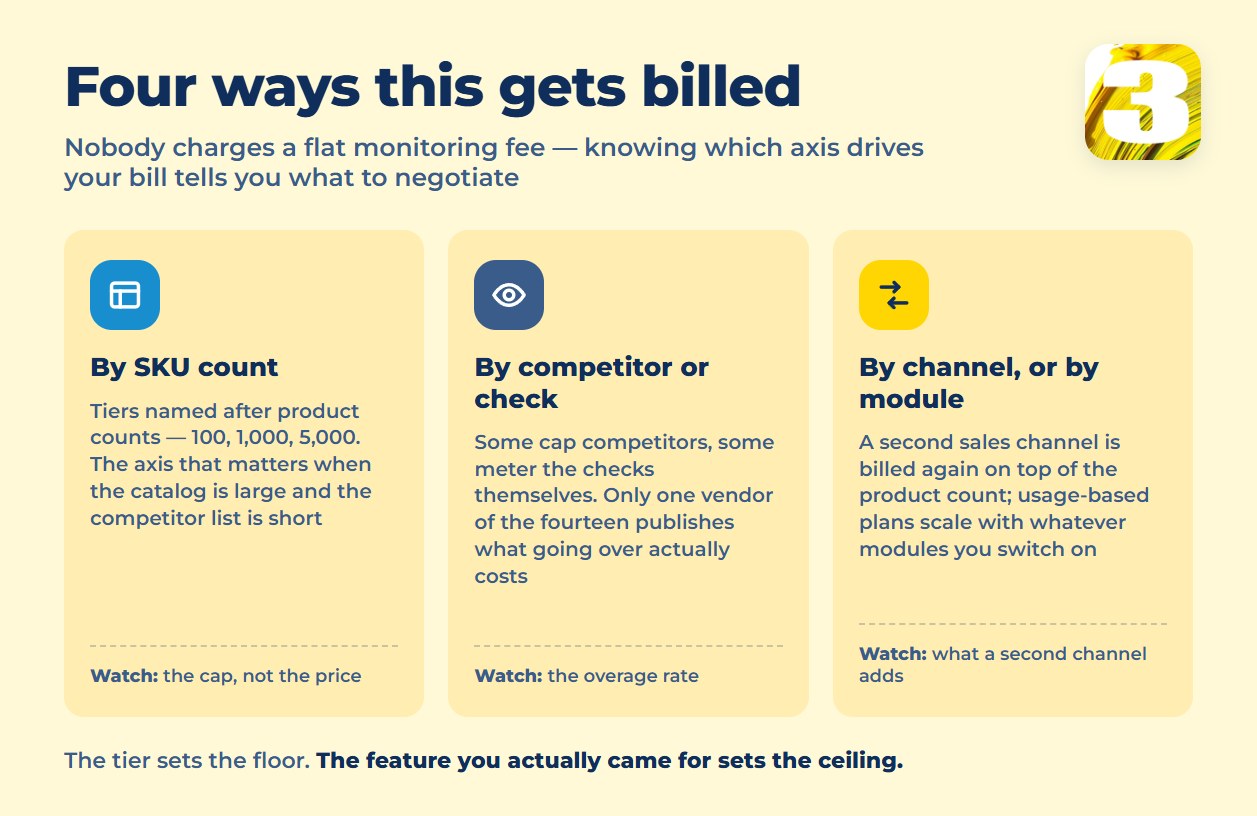
Nobody charges a flat “monitoring fee.” Every vendor above bills on some mix of four things, and knowing which one drives your bill tells you what to negotiate on.
By SKU count. Prisync’s tiers are named by product count — “Up to 100/1,000/5,000 Products.” Pricefy runs the same way, from 50 SKU on the free tier to 25,000 on Enterprise. This is the axis that matters most if your catalog is large but your competitor list is short.
By competitor or source. Price2Spy’s entry tier caps at “Up to 10 competitors.” Priceva scales from 20 competitors on its free tier to 40 on Pro, and unlike everyone else, names an actual overage rate, quoted on its page as “Extra competitor activation: $2.50”.
By number of checks. Priceva also meters the checks themselves — 6,200 a month free, 35,000 on Business, 100,000 on Pro — with overage priced at $0.0029 a check on Business and $0.002 on Pro. PageCrawl runs the same logic in page terms: 220 checks free, up to 100,000 on Enterprise.
A tool that only reads prices and a tool that rewrites your own are two different products, and the difference decides which axis you should even be comparing — we split them apart in price monitoring vs. repricing.
By sales channel. Prisync has a separate model here: “$199 per month, Up to 100 Products, Prices are Updated Daily, 1 Sales Channel Included.” Add a second channel and you’re paying for it again, on top of the product count.
Priceva is the only one of the fourteen that publishes what an overage actually costs, so it’s worth running the math once. Say a shop tracks 30 competitors across a mid-sized catalog and racks up 45,000 price checks in a month — 10,000 over the Business plan’s 35,000-check allowance. That’s 10,000 × $0.0029 = $29 on top of the $99 base, for $128 total. Every other vendor on this list either doesn’t meter checks at all or doesn’t say what going over costs — which means the overage exists, you just find out about it on next month’s invoice.
How the Bill Grows: Three Catalog Sizes
Run the published tiers against three catalog sizes and the price doesn’t climb evenly — it jumps in steps, and the steps are set by features, not by SKU count alone.
Small catalog, no MAP needed (roughly 50–100 SKUs, a handful of competitors). Priceva’s Starter tier is free at up to 20 products and 20 competitors. Pricefy’s Free tier covers 50 SKU and 5 competitors. Prisync’s cheapest paid tier, Professional, is $99/month for up to 100 products with unlimited competitors and three checks a day. Range: $0–$99/month, before MAP enters the conversation.
Medium catalog, MAP or marketplace tracking turned on (1,000–2,000 SKUs). This is where the price jumps, and it’s the feature doing it, not the SKU count. Prisync’s Premium tier is $199/month for up to 1,000 products and adds Marketplace Tracking. Pricefy’s Business tier is $189/month ($142 billed annually) and is the cheapest Pricefy plan with MAP/MSRP Monitoring switched on — even though that tier is built for 15,000 SKU, far more than a 1,000-SKU catalog needs. Range: $189–$199/month — roughly double the first scenario, entirely because of the MAP and marketplace features.
Larger catalog, marketplaces at scale (5,000+ SKUs). Prisync Platinum covers up to 5,000 products at $399/month. Pricefy Enterprise covers up to 25,000 SKU at $499/month ($374 billed annually). Range: $399–$499/month.
The pattern across all three: catalog size sets the floor, but MAP and marketplace tracking set the ceiling. A small catalog that needs MAP monitoring pays medium-catalog prices, because the vendors that offer MAP tracking only turn it on above a certain tier — not above a certain SKU count.
What You Only Find Out Once You’re Inside a Tier
Three things every vendor’s marketing page glosses over, and every vendor’s tariff page eventually admits.
Update frequency is tied to the tier, not the product. PageCrawl states this outright: checks run every 60 minutes on Free, every 15 on Standard, every 5 on Enterprise, every 2 on Ultimate. Prisync does the same thing with a twist — the per-URL model checks 3 times a day at $99 for 100 products, while the channel-based plan costs $199 for the same 100 products and refreshes only “Daily.” Twice the price, a third of the freshness.
Marketplaces aren’t tracked on every plan. Prisync’s Marketplace Tracking is a Premium-tier feature, starting at $199/month — it isn’t available on Professional at $99. Price2Spy is explicit about the same gate: marketplace tracking and MAP monitoring both start at the Basic tier, not the entry tier.
MAP monitoring itself is usually an add-on, not a base feature. Pricefy only turns on MAP/MSRP Monitoring at Business, $189/month. Price2Spy only turns it on at Basic — its entry tier, priced but with no public number, doesn’t include it. If MAP compliance is the actual reason you’re shopping for this software, the entry-level price on the landing page usually isn’t the price you’ll pay.

What the Software Doesn’t Do
Every one of these tools does the same core job: it checks a price, flags a mismatch, and tells someone. None of them enforce anything. Proof and enforcement are two different jobs, and the vendors that document their process the most thoroughly say so themselves.
TrackStreet’s own documentation lays out the enforcement ladder explicitly: notify the violator, escalate, then apply consequences — withheld marketing funds, reduced allocation, loss of reseller status. The same documentation makes a legal point worth repeating: a MAP policy has to be unilateral, a statement from the manufacturer, not a two-way agreement negotiated with resellers. That framing matters enough that we wrote a separate piece on what a MAP policy has to contain before any software is involved.
MetricsCart draws the line even more plainly in its own materials: the software monitors, catches a violation with a screenshot and a timestamp, and hands over an email template. What happens next — deciding whether to escalate, actually holding back a shipment, filing a complaint through a marketplace’s seller portal — is work a person does, not the software.
That split holds across every tool in the table above, published price or not. Buying the subscription buys you the evidence. It doesn’t buy you the phone call, the account rep, or the decision to cut off a reseller. If your business sells through Amazon and you’re trying to understand how Amazon itself treats a manufacturer’s MAP policy, that’s not something any of these vendor pages settle — check Amazon’s own seller documentation directly rather than take a vendor’s word for it.
Three Ways to Actually Do This
Subscribe to one of the tools above. For most catalogs this is the fastest path: named self-serve prices from $0 to about $800 a month depending on SKU count and whether MAP is included, plus custom-scoped quotes from vendors like Intelligence Node and Skuuudle if your catalog or competitor list is large enough. You get regular updates, a support team, and a bill that scales with your business — for as long as you keep paying it.
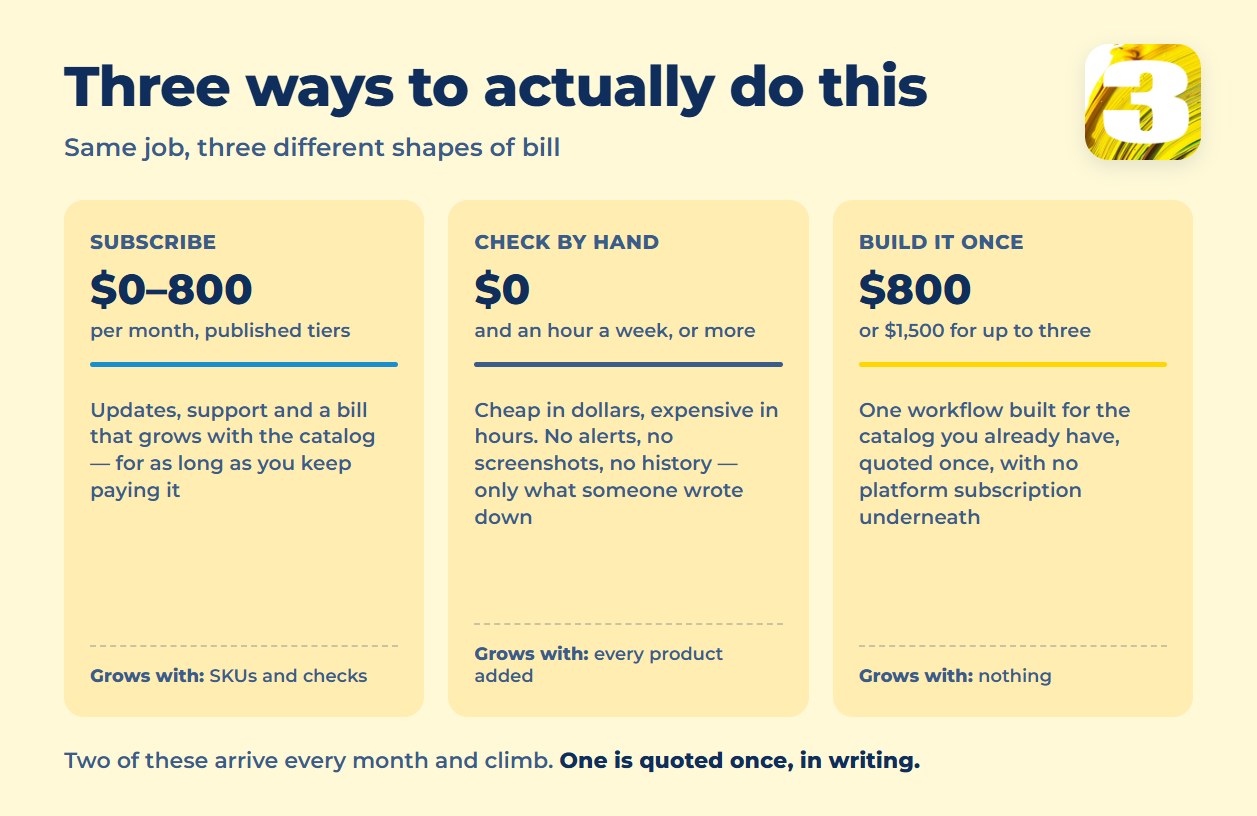
Check prices by hand. Someone opens competitor sites or marketplace listings on a schedule and writes down what they see — we worked the arithmetic of when that stops being viable in a separate piece. Cheap in dollars, expensive in hours, and it doesn’t scale much past a handful of products before the person doing it is spending more time on price checks than on anything else in their job. No alerts, no screenshots, no history — just whatever got written down.
Build the specific check once, instead of subscribing to a platform. At 3MY, we don’t sell a monitoring product — we build the exact workflow your catalog needs and price it once. A single workflow is $800. A set of up to three connected workflows is $1,500. There’s no monthly platform fee sitting underneath it, and the price doesn’t grow as your SKU count grows, because you’re not paying per product, per competitor, or per check — you’re paying for a workflow that already exists. If you’re weighing a subscription against something built for your specific catalog, our build vs. buy breakdown walks through that decision in general, and our MAP compliance and price monitoring page covers what we build in this specific case. For a sense of how we price automation work outside of price monitoring, see what workflow automation costs — and if you’re not sure whether what you need even qualifies as automation, start with what business process automation actually is.
Common Questions
How much does MAP monitoring software cost per month?
Named self-serve prices run from $0 (free tiers on Pricefy and Priceva) up to $799 a month at the top of Prisync’s published range, with Pricefy Enterprise at $499. If MAP monitoring specifically is what you need, expect to land on a mid-tier plan — Pricefy’s MAP/MSRP Monitoring starts at $189/month, Price2Spy’s at its unpublished Basic tier. Intelligence Node states a minimum project size of $5,000 a month. Skuuudle doesn’t name a plan price at all — only a budget span it quotes, in three currencies on its own page, as “from €10,000 to £100,000 to $1,000,000”, without saying over what period.
Is MAP monitoring the same as price monitoring?
No. Price monitoring tracks what competitors charge. MAP monitoring specifically flags when a reseller advertises below a manufacturer’s set floor — and MAP, MSRP and the price at checkout are three different numbers, which we untangle in MAP vs. MSRP. Several vendors sell both, but bundle MAP as a feature that only unlocks on a higher tier than basic price tracking.
Does this software stop resellers from violating MAP?
No. It documents violations — screenshots, timestamps, sometimes an email template — and leaves the decision to escalate, and the actual consequence, to a person at the brand. That split shows up in the vendors’ own documentation, not just in how we’re describing it here.
Does Amazon enforce manufacturers’ MAP policies?
We can’t answer that with a source we’d stand behind. Amazon’s own seller documentation on pricing policy sits behind a seller login, and everything else written about it is secondhand. If MAP compliance on Amazon specifically is your question, go to Amazon’s own Seller Central documentation rather than a vendor’s marketing page.
Where to Start
If your catalog doesn’t fit neatly into any tier above — too many SKUs for a free plan, not enough to justify a five-figure enterprise contract, or a MAP policy that only a handful of resellers actually violate — send us a note describing what you’re tracking and why. We’ll tell you honestly whether a $99-a-month tool covers it or whether it’s worth building the specific check once.