


Three numbers get treated as if they were one price with three names: MSRP, MAP, and the price the customer actually pays. They aren’t. Each has a different owner, a different job, and — for two of the three — a different legal weight. Mixing them up is how a brand ends up either defending a policy that never protected anything, or threatening a dealer over a discount the policy never covered.
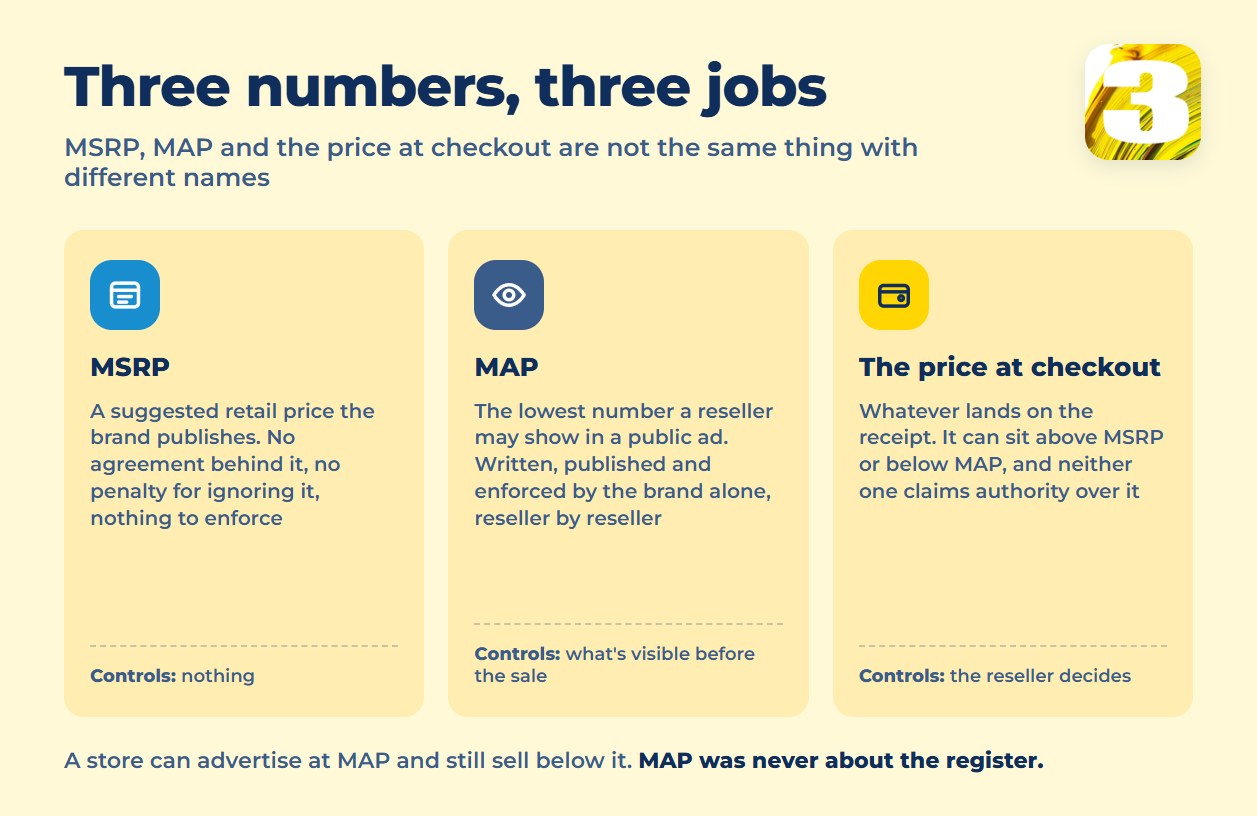
Here’s the short version. MSRP is a suggestion with no teeth. MAP is a rule about what a reseller may show in an ad, set and enforced by the brand alone. The actual retail price is whatever the customer pays, and it can sit anywhere relative to the other two. A retailer can advertise at MAP and still sell below it at checkout without breaking anything — because MAP was never about the checkout.

Three Numbers, Three Jobs
MSRP — the manufacturer’s suggested retail price — is exactly what it says: a recommendation the brand publishes, with no agreement behind it and no consequence for ignoring it. It’s a reference point for a shelf tag or a “compare at” line, useful for a shopper trying to judge whether a price is fair. It obligates nobody.
MAP — the minimum advertised price — is the lowest number a reseller may display in a public ad for a product. It’s not a suggestion; it’s a policy the brand writes, publishes, and enforces on its own, reseller by reseller. What it governs is narrow and specific: what’s printed, emailed, or posted where a shopper can see it before they buy. A store that advertises at the MAP number can still ring up a lower total at the register, in a private quote, or after a coupon — and the policy hasn’t been touched, because MAP was never written to reach that far.
The actual retail price is whatever lands on the receipt. It can sit above MSRP, below MAP, or anywhere in between. Nothing requires it to match either one, because neither MSRP nor MAP claims authority over what happens at checkout.
The line worth remembering: MAP governs what’s visible before the sale. It has no opinion about what happens at the register.
That distinction only holds up because of how MAP is structured — a brand announcing a rule on its own, not agreeing to a number with a dealer. In the US, a manufacturer may announce a minimum advertised price and stop supplying a reseller that ignores it. Once the number becomes an agreement with the reseller, it stops being a unilateral policy and is judged as resale price maintenance — reviewed case by case since the Supreme Court moved vertical price programs to a rule-of-reason standard in 2007, and more strictly under some state laws. The FTC sets out both halves in its guidance on manufacturer-imposed requirements. In Canada, section 76 of the Competition Act addresses MSRP and MAP separately, and turns on the same question: whether a supplier’s price suggestion left the retailer free to ignore it. None of this is legal advice — if a real amount of revenue rides on getting the distinction right, that’s a question for a lawyer who’s read your actual policy.
MAP, MSRP, and Street Price, Side by Side
| MSRP | MAP | Actual (street) price | |
| What it is | Suggested retail price | Lowest price allowed in a public ad | What the customer actually pays |
| Who sets it | The brand, as a recommendation | The brand, as a written policy | The reseller, transaction by transaction |
| What can be enforced | Nothing — it’s advisory only | The advertised number, not the checkout number | Nothing; it’s entirely the reseller’s call |
| What happens if “violated” | Nothing; there’s no such thing | Loss of co-op funds, then loss of supply, per the brand’s own written terms | Not applicable — a low checkout price isn’t a MAP violation |
Why MSRP Alone Protects Nobody
A brand that leans on MSRP to keep street prices in a comfortable range is leaning on nothing. Resellers list at MSRP constantly and then layer a site-wide sale, a loyalty discount, or a coupon code on top of it — none of that touches the suggested number, because the suggestion was never a commitment in the first place. If the actual goal is stopping resellers from advertising below a certain line, MSRP was never built to do that job. Only a MAP policy does, and only the version that’s written down, dated, and applied the same way to every account.
What Counts as Advertising — and What Doesn’t
MAP restricts advertising, so the whole policy hinges on what counts as an ad. The list is more specific than most brands assume:
- Counts: a homepage price, an email blast, a printed flyer, a banner, a marketplace listing’s price field, a social post with a number in it.
- Usually doesn’t count: the price a shopper sees only after adding an item to the cart, a “call for price” or “add to cart to see price” listing, a closed wholesale sheet sent under a dealer agreement, and — in most policies — an in-store tag, since it isn’t broadcast the way a public ad is.
That gap is exactly why “hide the price until the cart” exists as a tactic. If MAP only restricts what’s shown before checkout, a retailer can post “add to cart for price,” undercut every competitor once the shopper is a click from buying, and never technically advertise below the floor. It’s a loophole built into the definition, not a trick outside it.
It doesn’t work everywhere, though. Some platforms enforce a separate rule that has nothing to do with MAP and can conflict with it: Google Merchant Center requires the price submitted for an ad or a free listing to match the price shown on the landing page and at checkout, and treats a mismatch — including one caused by a cart-only price — as a policy violation with its own suspension risk, according to Google’s own guidance on inaccurate prices. A retailer running a “click to see price” tactic to stay inside MAP can end up outside a marketplace’s separate pricing rules at the same time. Keeping a price feed, a landing page, and a checkout page in sync across every channel is a sync problem before it’s a compliance problem — it’s what our product upload and sync service exists to keep from drifting apart.
Where This Goes Next
None of this matters without two things in place. First, a written policy — what belongs in that document, and the wording that quietly turns it into an agreement, is a piece of its own. Second, dated evidence: a specific listing, at a specific price, on a specific day, because “I saw it last week” doesn’t hold up when a dealer pushes back. That’s the part ongoing MAP compliance monitoring is built for, and what the tools for it actually cost is a separate question worth answering before you shop.
When that evidence has to feed something — your catalogue, an alert, a notice template — we build the connection once rather than renting it: $800 for a single workflow, $1,500 for a set of up to three.