


Most blogs underperform for a simple reason: they’re written like essays, not search-driven assets.
Too much fluff. Too little structure. No clear match with user intent.
At 3MY, we write and rebuild blog archives for a living, and five formats keep earning their place. They bring in targeted traffic, hold attention, and turn readers into enquiries — but not because the format itself is magic.
A format is a promise about what the page will answer. Match it to what the person typed and the page has a chance; miss, and no amount of writing saves it. We learned that on our own blog, where a run of posts on one subject piled up impressions and almost no clicks, because every one of them answered the same question the same way. If you are still weighing whether a company blog is worth the trouble at all, that is a separate question, and we answered it in plain language elsewhere.
1. Comparison Posts (“X vs. Y”)
Why it works:
Buyers researching tools, services, or software often have one goal: decide between two options. Google loves when your content helps with that. The “[Tool] vs. [Tool]” structure aligns perfectly with mid-funnel decision intent.
Best for:
- SaaS tools
- B2B services
- Product alternatives
Strong examples:
- Notion vs. Evernote: Which One’s Right for Remote Teams?
- Shopify vs. WooCommerce: Which One Grows With You?
What to include:
- A side-by-side comparison table
- Key use cases for each option
- A “Who should choose what?” section
SEO tip:
Target long-tail keywords like “Is [Tool A] better than [Tool B]?” and feature a clear verdict to earn snippets.
2. Listicles (Numbered Resources or Mistakes)
Why it works:
Readers and algorithms love lists. They’re scannable, structured, and naturally align with “best,” “top,” or “tools for…” keyword patterns. They also drive shares and backlinks when done well.
Best for:
- Affiliate roundups
- Educational resources
- Lead magnets
Strong examples:
- 10 AI Tools Every Copywriter Should Try This Year
- 7 Common Mistakes Founders Make When Hiring Developers
What to include:
- A dynamic table of contents
- Visuals or icons for each point
- A clear CTA at the end (email capture, trial, guide)
SEO tip:
Use “Updated for [Current Year]” in the title tag and intro — but only when something in the post actually changed. Google’s guidance on helpful, people-first content asks outright whether you are changing dates to make pages look fresh while the content stays the same, and a new date on an untouched post is exactly that.
3. Step-by-Step How-To Posts
Why it works:
“How to” queries are high-intent and conversion-ready. They often include long-tail variations and match informational search perfectly. These posts build authority and reduce user hesitation.
Best for:
- Explainer content
- SaaS onboarding flows
- Technical services
Strong examples:
- How to Set Up Call Tracking in Google Ads (Step-by-Step)
- How to Build a High-Converting Landing Page in Webflow
What to include:
- Numbered steps
- Screenshots or video walkthroughs
- Bonus section with templates, tools, or downloadable checklists
SEO tip:
Ignore the advice about FAQ and How-to markup that still fills older guides. In August 2023 Google retired How-to rich results altogether and cut FAQ rich results back to well-known government and health sites, so on an ordinary business blog neither one produces the extra lines in the search result they were added for. The markup still describes your page correctly — it simply stopped paying for itself in the way those guides promise. Put the follow-up questions into the page as ordinary headings instead, and link to internal pages for deeper guidance.
4. “What Is” Definition + Deep Dive Posts
Why it works:
Top-of-funnel users search for definitions. These posts attract traffic, win snippets, and build topical authority when supported by strong internal linking.
Best for:
- SaaS blogs
- Marketing agencies
- Knowledge hubs
Strong examples:
- What Is Conversion Rate Optimization? A Beginner’s Guide with Examples
- What Is Structured Data, and How Does It Help Your SEO?
What to include:
- Clear definition in the first 50 words
- Contextual examples and use cases
- Short FAQ or glossary at the bottom
SEO tip:
Answer the core question concisely, then expand into strategy, mistakes, tools, and trends. This turns a 300-word snippet into a 1500-word SEO pillar.
5. Case Study Breakdown (With Numbers)
Why it works:
Case studies show, not just tell. When backed by real metrics and outcomes, they earn trust, links, and direct inquiries. These posts are ideal for lead gen — even with low search volume.
One condition, and it is not negotiable: the numbers have to be measured, and the client has to agree to them being public. A round percentage nobody can trace is the fastest way to lose the trust this format exists to build. No measurement and no permission? Write the case without figures — the decisions and the order you made them in are what the reader came for anyway.
Best for:
- Agencies
- Consultants
- DTC brands with unique strategies
Strong examples:
- How We Rebuilt a SaaS Sign-Up Flow, Step by Step
- What a Shopify Redesign Actually Changed for a Small Store
What to include:
- A challenge → process → result structure
- Real screenshots, dashboards, or timeline visuals
- A CTA to “get similar results”
SEO tip:
Include the keyword in your headline but keep it benefit-driven. E.g., “Case Study: [Keyword]” vs. “How We Boosted [Metric] with [Keyword Strategy]”.
Bonus: Don’t Mix Formats — Match Intent
Each post should focus on one goal:
- Teach something
- Compare options
- Convert through proof
Trying to combine too many functions — education, storytelling, product pitch — weakens all of them.
Pick a format. Stick to it. Execute well.
And resist running one format at volume just because it is cheap to produce. Google’s spam policies treat large numbers of near-identical pages that add nothing as scaled content abuse, and they say plainly that it makes no difference how those pages were produced. Five posts that each answer one question beat fifty that answer none — which is most of what SEO without the buzzwords comes down to.
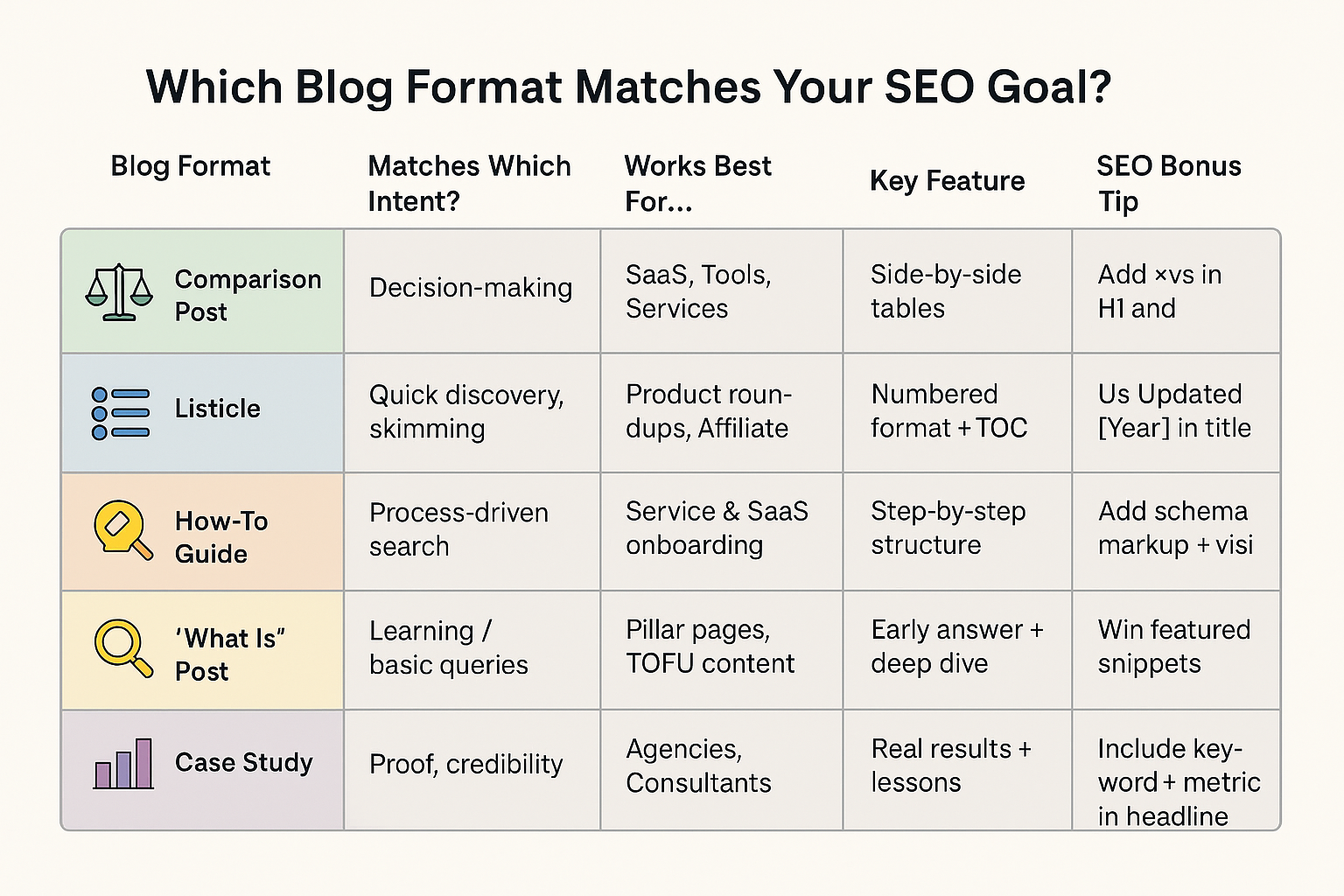
Quick reference: Match the right blog format to your SEO intent and business goal.
How 3MY Helps
At 3MY, we don’t just write blog posts.
We map intent, build structure, and design content that climbs SERPs and drives action.
Here’s how we do it:
- Content Format Strategy: We select the right format for your goals (TOFU/MOFU/BOFU)
- Topic + Keyword Planning: We target terms your buyers are actually searching — not just random blog ideas
- Optimized Writing: Clear structure, internal linking, table of contents, CTAs, and real examples
- Performance Tracking: You’ll see what’s ranking, converting, and ready for an update
One more thing worth planning for. The same structure that wins a snippet is what gets a page quoted inside an AI answer: a direct answer near the top, headings that match questions people actually ask, and nothing padded in between. You are not choosing between the two audiences — you are writing for the same one twice.
We’ll review your current blog archive, assess ranking gaps, and recommend 3–5 high-performing formats to use in your next 90 days.
No fluff. Just structure, clarity and organic growth that compounds.