


Google now shows an AI-written answer above the regular search results in roughly 43% of searches — up from about 15% a year earlier, according to Similarweb’s 2026 industry data. Semrush’s own tracking puts the number closer to 48%. Different tools, different methods, same direction: AI answers are no longer a novelty sitting at the top of the page. They’re the first thing most people see.
At the same time, the share of your website traffic that actually comes from someone clicking through from ChatGPT or Perplexity is still a rounding error. Both of these things are true in 2026, and together they explain most of the confusion around “AI search optimization.” It’s real enough to change how people find businesses. It’s small enough that most of what’s sold as “GEO” — generative engine optimization — is solving a problem that doesn’t exist yet.
This article walks through what the data actually shows: how often AI answers show up, what happens to your click-through rate when they do, what Google itself says you should (and shouldn’t) do about it, and where your money is actually well spent.

How Often Does an AI Answer Show Up Before Your Link?
An “AI Overview” is the box Google puts above the normal blue links — a short, generated summary that answers the question directly, often without the person needing to click anything. Whether it appears depends heavily on what someone is actually searching for.
According to a large-scale analysis by Seer Interactive, which tracked 53 brands across 5.47 million search queries and 2.43 billion impressions between January 2025 and February 2026, the pattern is consistent:
- Comparison searches (“X vs Y”) — AI Overview shows up 95.4% of the time
- Question-style searches — 85.9%
- General informational searches — 36%
- Transactional searches (someone ready to buy) — just 5%
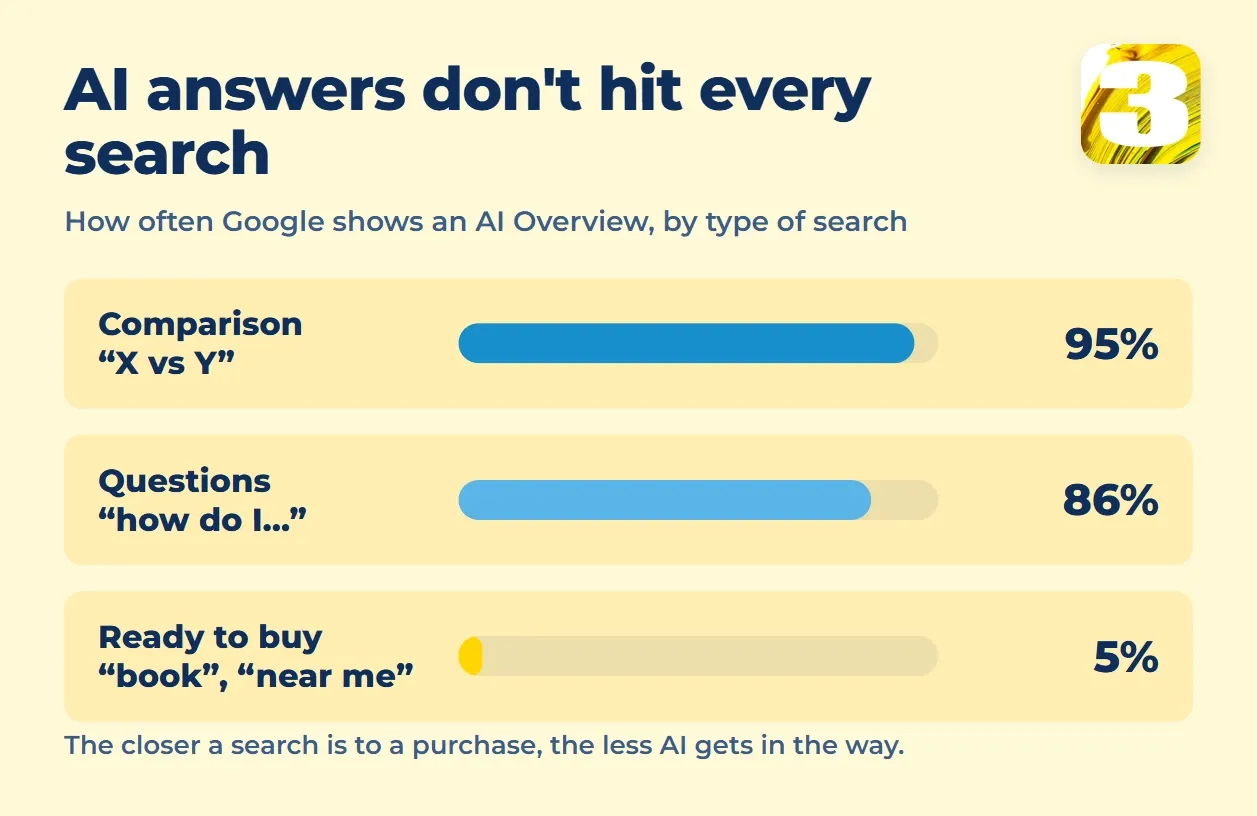
That last number matters more than the headline 43%. The closer a search sits to an actual purchase, the less likely Google is to hand the answer over to AI. If your business depends on “buy,” “book,” “quote,” or “near me” searches, AI Overviews are touching a much smaller slice of your funnel than the average statistic suggests.
What AI Search Does to the Click When It Answers First
The obvious worry is that an AI summary answers the question and the person never clicks anything. That worry is backed by data — but the picture has been shifting.
Pew Research Center tracked the actual browsing behavior of 900 U.S. users across nearly 69,000 Google searches in March 2025. When an AI summary appeared, people clicked a regular search result 8% of the time, versus 15% when no summary showed up — almost half as often. They clicked the specific source the AI cited in only 1% of visits.
And 26% of those searches ended the session entirely with no click at all, compared to 16% for ordinary searches. 58% of the people in the study saw an AI summary at least once that month.
Separately, Ahrefs found that across 300,000 keywords, the click-through rate for a #1 ranking drops by 34.5% when an AI Overview appears on that search.
Here’s the part that gets left out of most “AI is killing SEO” posts: the decline appears to be leveling off. The same Seer Interactive dataset shows the click-through rate on searches with an AI Overview rising from 1.3% in December 2025 to 2.4% in February 2026 — and on searches without one, from 2.8% to 3.8%. Their own conclusion: “the worst is probably behind us.” Traffic took a real hit. It doesn’t appear to be in freefall anymore.
The One Number That Actually Matters: Getting Cited
Whether your page ranks #1 or #6 matters less than whether the AI Overview names you as a source. That’s the practical takeaway from the same Seer Interactive research, and it’s the clearest signal in all of this.
A “citation” here means the AI answer explicitly links to or credits your page as where the information came from — usually shown as a small numbered footnote or source chip inside the summary box.
When a page is cited inside an AI Overview, it gets 120% more clicks on that impression than a non-cited page on the same search results page. When a page isn’t cited, its click-through rate drops by 67%. Across all of 2025, cited pages consistently pulled in 2 to 5 times more clicks than everything else on the same page.
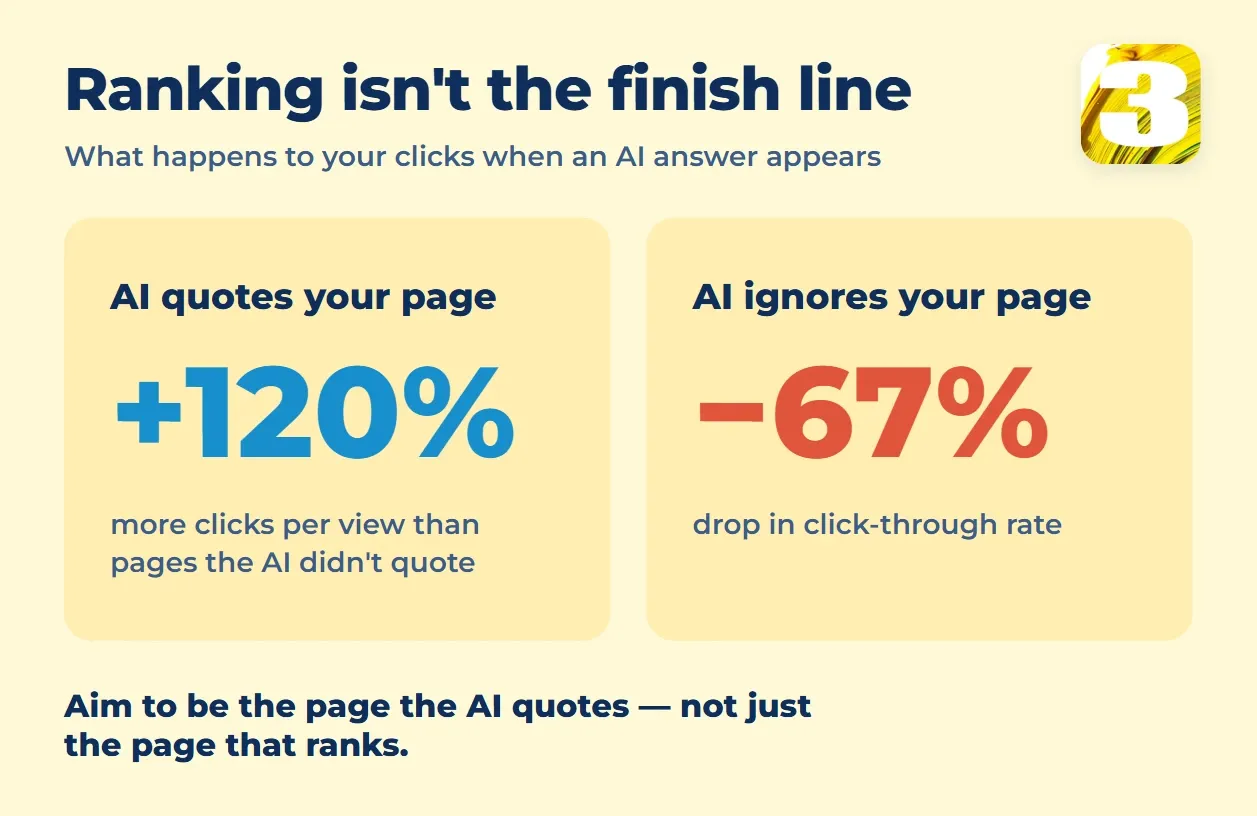
In other words: showing up in the top 10 isn’t the finish line anymore. Being the page the AI actually quotes is. That distinction is worth sitting with, because it’s the opposite of what most “AI SEO” sales pitches are optimizing you for.
What Google Itself Says You Should Do About It
Here’s the most useful thing in this entire article, and it comes straight from the source. In its official documentation on AI features and your website, last updated in December 2025, Google states plainly that there are “no additional requirements” to appear in AI Overviews or AI Mode, and “no special optimizations” are needed. Structured data — the behind-the-scenes markup (schema) that helps search engines understand what’s on a page — follows the same rules it always has, as long as it matches what’s visibly on the page.
Google went further in May 2026, in a follow-up piece specifically titled “Optimizing your website for generative AI features on Google Search.” The core line: from Google’s point of view, optimizing for generative AI search is optimizing for search in general — it’s still SEO. The same document explicitly names what you don’t need: llms.txt files, restructuring your content into AI-friendly “chunks,” rewriting your pages specifically for AI systems, or piling on structured data beyond what’s normal.
That’s a direct rebuttal, from Google’s own team, of a good chunk of what gets sold as “generative engine optimization” right now.
The llms.txt Myth, and What Else Gets Sold as “GEO”
llms.txt is a small text file some agencies have been recommending you add to your website — the idea being that it gives AI crawlers — the automated bots these AI companies send out to read websites — a clean, curated summary of your site to read instead of your normal pages. It’s modeled loosely on robots.txt, the older file that tells search engines what they’re allowed to crawl.
The problem: there’s no evidence it does anything. SE Ranking analyzed 300,000 domains using statistical modeling (Spearman correlation, XGBoost, and SHAP analysis, if you want the specifics). Removing “has an llms.txt file” as a factor in their prediction model actually made the model more accurate at predicting which pages get cited by AI — meaning the file has no measurable connection to showing up in AI answers.
It gets more damning. SE Ranking also pulled server logs from over 137,000 domains and found that 97% of llms.txt files were never fetched even once by any AI crawler. Only about 10% of domains have bothered to create one in the first place.
On the crawler side, it’s worth knowing the actual mechanics instead of the folklore. Google-Extended is a setting that controls only whether your content gets used to train Google’s AI models (Gemini) — blocking it has no effect on your regular rankings or on AI Overviews, which pull from the same Googlebot crawl everyone already allows. Separately, GPTBot and OAI-SearchBot (OpenAI), ChatGPT-User, and PerplexityBot each publicly state they respect robots.txt and each has its own name, so you can allow or block them individually if you want to.
None of this requires a special file, a rewritten site, or a retainer labeled “GEO.” It requires a normal robots.txt, which most sites already have.
What AI Systems Actually Cite
If AI answers pull from somewhere, it’s worth knowing where. Profound analyzed 680 million citations across ChatGPT, Perplexity, and Google AI Overviews between August 2024 and June 2025 (their full methodology isn’t public, so treat this as directional rather than exact).
ChatGPT’s single most-cited source was Wikipedia, at 7.8% of citations. Perplexity leaned heavily on Reddit, at 6.6%. Google’s AI Overviews also cited Reddit, but far less — 2.2% — and pulled from a much wider, more distributed spread of sources overall.
The takeaway isn’t “get mentioned on Reddit and Wikipedia.” It’s that different AI systems have genuinely different citation habits, and a strategy built around one of them may not transfer to the others.
Does Ranking #1 on Google Still Matter for Getting Cited?
Here the data genuinely disagrees, and it’s worth saying so plainly instead of picking whichever number sounds best.
Search Engine Journal reported on Ahrefs research covering 863,000 keywords and 4 million URLs, which found that the share of AI Overview citations coming from a page already ranking in the top 10 of normal search results dropped from 76% in July 2025 to just 38% by March 2026 — though the researchers themselves flagged that part of that drop may be an artifact of a change in how they measured it, not a real shift.
Other firms tell a very different story: Originality.AI puts the overlap at 92.36%, and seoClarity puts it near 99%.
That’s a massive range — 38% to 99% — measuring the same basic question. The honest answer is that nobody has a clean, agreed-upon number for how tightly AI citations track traditional rankings. What’s consistent across every version of this data is the direction: ranking well is still connected to getting cited, even where the exact strength of that connection is disputed. Normal SEO — the kind covered in our guide for business owners — is still the foundation. Nobody is claiming otherwise.
How Much Traffic Is Actually Coming From AI Chatbots
This is where the panic tends to outrun the numbers by the widest margin. Cloudflare Radar data (via TechnologyChecker.io, updated August 2026) shows that in July 2026, Google still accounted for 88.08% of search-related referral traffic across the web. ChatGPT accounted for 0.913% — genuinely up 5.3 times year-over-year, which sounds dramatic until you see the base it’s growing from. A separate snapshot from May 2026 shows every AI chatbot combined — ChatGPT, Gemini, Claude, and Perplexity together — sending just 0.29% of referral traffic.
A more targeted study looked at 973 e-commerce sites doing a combined $20 billion in revenue, tracked from August 2024 through July 2025 by Search Engine Land. Traffic arriving from ChatGPT worked out to about 0.2% of sessions — roughly 200 times smaller than the traffic those same sites got from ordinary Google organic search.
If a vendor is telling you AI chatbots are about to become a major traffic channel for your business, ask them for their source. Right now, the honest number is a fraction of a percent.
Does the Traffic That Does Arrive Actually Convert?
This is the second place where the data flatly contradicts itself, and it’s worth calling out directly rather than quietly picking a side.
The same rigorous 973-site e-commerce study found that ChatGPT-referred traffic converts lower than ordinary organic traffic — organic converts about 13% better than ChatGPT traffic, while affiliate traffic converts a striking 86% better than ChatGPT — outperforming organic too, just not by that same margin.
Meanwhile, several marketing-industry sources claim the opposite: figures like “14.2% conversion versus 2.8%” or “23 times higher,” typically traced back to a single case study on one B2B SaaS company, or to vendor-published benchmark reports built to sell a product. Those numbers get repeated constantly in sales pitches for AI-search services.
We’re not going to tell you which number is “true,” because the honest answer is that this hasn’t been settled with independent, repeatable research yet. What we’d point out instead: when a vendor pitches you AI traffic using a stat that’s the opposite of what the most rigorous study on the topic found, that’s worth noticing before you sign anything.
How to Measure AI Search Visibility
Here’s the practical problem: even if you wanted to track whether AI search is sending you business, the standard tools have real gaps.
Google Search Console added a new report in June 2026 called “Search Generative AI performance”, which shows how often your pages appear inside AI Overviews, AI Mode, and generative Discover features — broken down by page, country, device, and date. Useful, but limited: it shows impressions only. There’s no click data in it, so you can’t build a full picture of “shown in AI answer → visited site” from this report alone. Rollout has also been gradual, starting in the UK.

GA4 added a native “AI Assistant” channel in May 2026 that automatically buckets sessions from recognized AI referrers — the site that sent the visitor to you, like ChatGPT, Gemini, or Claude — into their own category instead of lumping them into generic “Referral” traffic. That’s genuinely useful, but it has a blind spot: Perplexity isn’t caught by it, and neither is traffic with no referrer at all, which is common when someone clicks a link from inside a mobile app’s built-in browser. Those sessions land in Direct or Referral, indistinguishable from everything else. There’s no complete fix for this yet — the closest workaround is manually checking Session source in GA4’s Traffic Acquisition report for chatgpt.com, perplexity.ai, and gemini.google.com.
What we see in our own tracking
At 3MY, we built our own tracking system rather than relying solely on the platforms above — largely because of the exact gap described here. That system connects visits directly to submitted leads, not just to a session source.
Through it, we can see leads that came in through a form submission after the visitor arrived from ChatGPT. We’re not going to attach a number to that — we don’t have enough of a dataset yet to say how common it is, and we’d rather understate this than oversell it. But it’s not zero, and it’s not something Search Console or a standard GA4 setup would have caught on its own.
So What Should You Actually Do?
Nothing in this data says “abandon your website.” It says: keep doing normal SEO — clear, well-structured, genuinely useful content that answers the question a real person is searching for — because that’s still what both Google’s rankings and AI citations are built on. If you’re picking topics and keywords, start with what people are actually searching for, not with what an AI crawler might prefer.
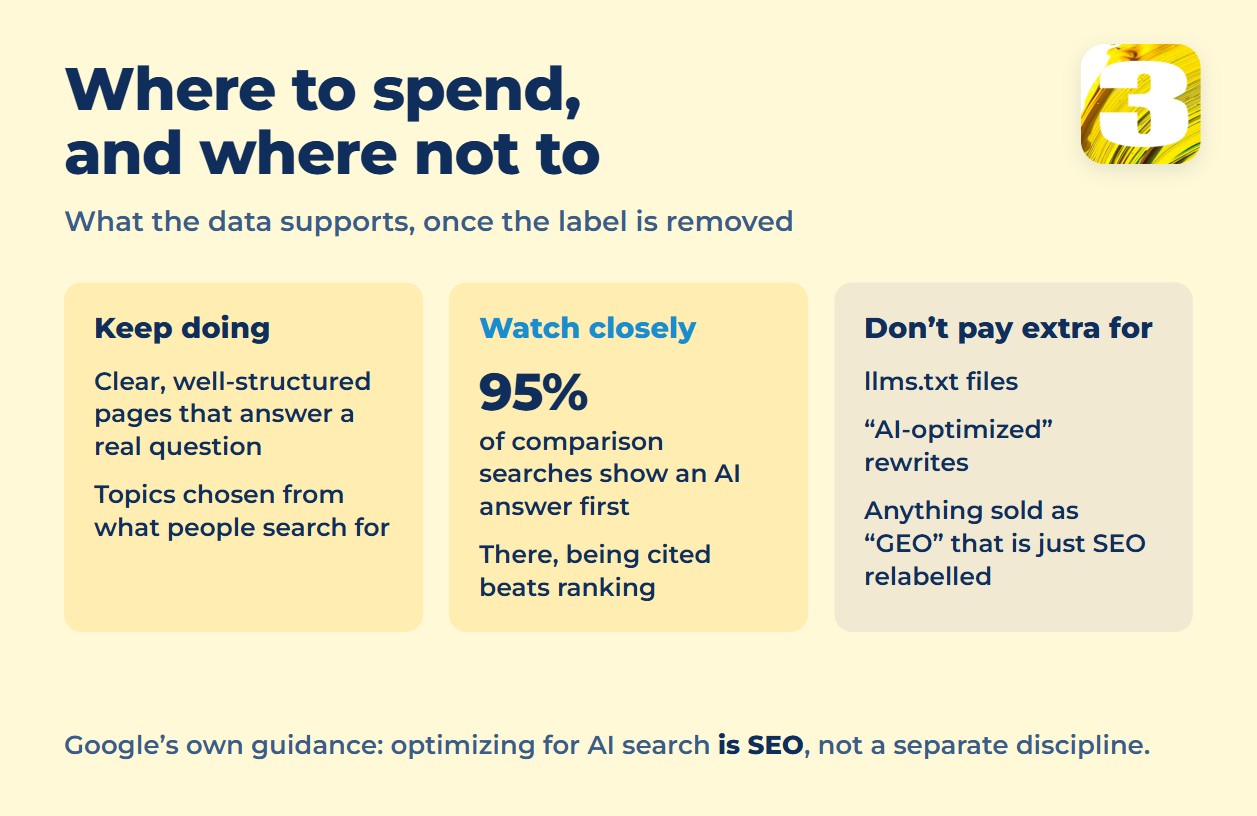
Where it’s worth paying attention: comparison-heavy pages, since that’s where AI Overviews show up most (95%) and where being cited — not just ranked — drives the click. Transactional pages are the opposite case: AI intervenes least there (5%), so it’s a smaller slice of your funnel to worry about — but if your business lives in that slice, being the cited source still matters more than the ranking position. Where it’s not worth paying extra for: llms.txt files, “AI-optimized” content rewrites, or any package sold specifically as “GEO” that isn’t just good SEO with a new label on it.
FAQ
1. Do I need to create an llms.txt file for my website?
No. Google’s own guidance says it isn’t required, and SE Ranking’s analysis of 300,000 domains found no measurable connection between having one and getting cited in AI answers — plus 97% of the ones that do exist are never even fetched by AI crawlers.
2. Should I switch my SEO budget over to “GEO” instead?
Not based on current evidence. Google itself states that optimizing for AI search is still SEO, not a separate discipline. The practices sold as distinct “GEO” tactics — content chunking, AI-specific rewrites, extra structured data — are explicitly named by Google as unnecessary.
3. How do I know if AI search is sending me any customers at all?
With standard tools, only partially. Google Search Console’s new AI report shows impressions but no clicks. GA4’s “AI Assistant” channel catches ChatGPT, Gemini, and Claude, but misses Perplexity and no-referrer traffic. A full picture currently requires either manual GA4 filtering or a custom tracking setup.
4. If my page shows up in Google’s normal top 10, will it also get cited in the AI Overview?
Often, but not reliably. Estimates of the overlap range from 38% to 99% depending on the study, which means ranking well helps but doesn’t guarantee a citation. Chasing the citation directly — making sure your page can be quoted cleanly — matters as much as the ranking itself.
5. Are AI companies allowed to use my website’s content without permission?
You have control over crawler access. GPTBot, OAI-SearchBot, ChatGPT-User, and PerplexityBot each publicly commit to respecting robots.txt, and each has its own identifier, so you can allow or block them individually. Blocking Google-Extended specifically stops your content from training Google’s AI models, but has no effect on your regular Google rankings or AI Overview appearances.
Disclaimer: AI search is one of the fastest-moving areas in digital marketing right now, and the figures above reflect the most reliable data available as of this article’s publication date. Percentages, feature rollouts, and platform behavior can shift within months — treat the specific numbers as a snapshot, and the underlying patterns (citation matters, small AI referral share, no special file needed) as the more durable takeaway.
If you want a second opinion on how your specific pages are actually performing in AI search results — not a generic audit, a real look at your data — that’s a conversation worth having. No package, no upsell attached.