


Most people who type “google ads experiments” into a search bar aren’t looking for a tutorial. They’re looking for permission — a safe way to change something in a campaign that’s finally working, without breaking the number that pays the bills. By the end of August 2026 that question split in two: is it safe to test a change yourself, and is it safe to let Google apply a change of its own.
One thing to clear up first. If what you actually want to test is which headline or description wins, that’s a narrower tool called Ad Variations, and we’ve already covered it start to finish — including the statistical threshold Google uses to call a winner — in How to A/B Test Google Ads Like a Pro. This article is about the other kind of test: changes to the campaign itself — bid strategy, match types, audience targeting, which landing page gets the click — and about a deadline that has nothing to do with your own testing schedule.

What the AI Max migration starts on September 1
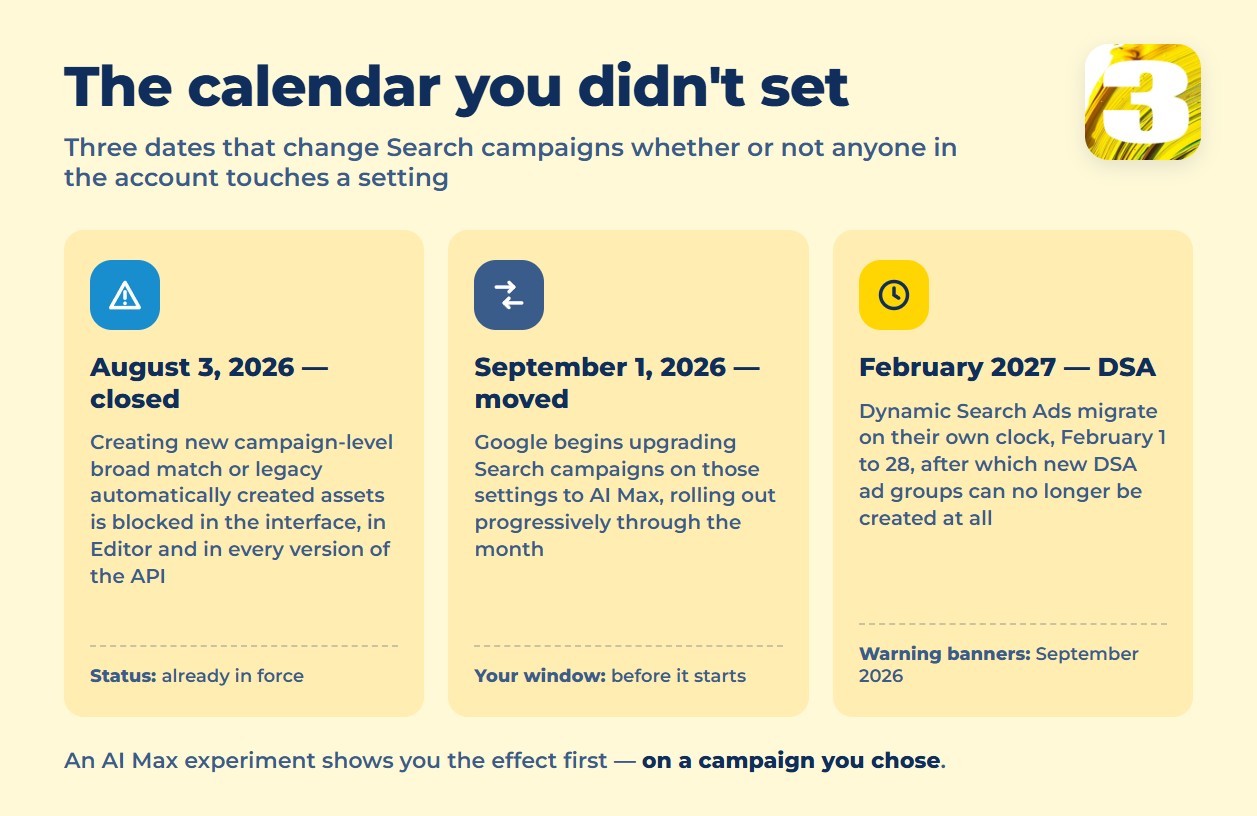
On September 1, 2026, Google Ads begins automatically upgrading Search campaigns that use campaign-level broad match or standalone automatically created assets to AI Max. Google’s own developer blog describes it plainly: “the migration job will roll out progressively throughout the month.” It isn’t a proposal sitting in a settings menu waiting for a click — it’s a rollout with a start date, and it’s already underway in a quieter sense: as of August 3, 2026, creating new campaign-level broad match configurations or legacy automatically created assets is blocked everywhere — the interface, Google Ads Editor, and every version of the API.
Dynamic Search Ads run on a separate, later clock: in-account banners appear in September 2026, a reminder notification goes out January 15, 2027, and the automigration window is February 1–28, 2027, after which creating new DSA ad groups is removed for good.
None of this means a working account is about to fall apart. It means a setting you may never have touched is about to change, on a date you didn’t pick.
A one-click way to see it coming
Here’s the part worth acting on. Open the Experiments page — the section used to be called drafts and experiments, drafts is gone, it’s just Experiments now — and you’ll find a type called AI Max experiments: a one-click test for Search campaigns. That’s a window most advertisers don’t know they have. You can watch what AI Max does to your cost per lead on a campaign you pick, before September rolls it out on a campaign you didn’t pick.
Where a custom experiment earns its keep
Outside of AI Max, custom experiments let you “propose and test changes to your Search, Display, Demand Gen, and Video campaigns” and measure the effect “before you apply them to a campaign.” In practice that covers the moves people are genuinely afraid to make on a live account: switching a bid strategy, loosening a match type, adding or dropping an audience segment, sending traffic to a different landing page. Set one up and Google splits traffic between your original campaign and a copy running the change — a 50/50 split is what Google recommends for the cleanest read.
The diagnostic those changes move is explained in what Quality Score actually changes.
What an experiment won’t do for you
An experiment is a controlled comparison, not a safety net, and it’s worth being specific about three things it can’t cover.
It won’t undo a platform-level change. If AI Max lands on your account on its own schedule, an experiment can only show you the effect in advance — it doesn’t hand you a lever to keep the old setup once the migration runs.
It won’t give you an answer in a week. Google’s own guidance recommends running an experiment for at least four to six weeks, longer if your sales cycle is slow. Anyone promising a verdict by Friday is skipping the part where the numbers become reliable.
It won’t fix a broken measurement. If conversions are being double-counted, missed entirely, or credited to the wrong action, every result your experiment produces sits on that same broken floor. We’ve written separately about how often that turns out to be the real problem, not the campaign: why your Google Ads conversion tracking is probably wrong.
The Performance Max exception to AI Max
One catch that trips people up: if the campaign you’re testing is Performance Max, Google is explicit that it “may notice a decrease in traffic because the campaign will only serve to 50% of the eligible traffic.” Your overall performance isn’t supposed to suffer — the same source says results “won’t be negatively impacted” — but the traffic volume on that specific campaign will drop for the length of the test, because it’s genuinely being split, not duplicated. “Won’t hurt your numbers” and “won’t change how much traffic this campaign gets” are two different promises, and only the first one is being made.
It’s also worth remembering an experiment leans on the campaign underneath it. Pause the original, or let it run out of budget or schedule before the test’s end date, and the experiment stops serving along with it — it isn’t an independent thing you can set up and walk away from.
Where those campaigns should sit in the first place is its own question.
Before September 1
Pick one campaign that isn’t carrying your quarter, and one you’d still sleep well about if it wobbled for a month. Write down what it’s actually producing right now — cost per lead, conversion rate, whatever number you’d notice going missing. Then launch an AI Max experiment on it before September 1 and let it run. You’ll see, on your own account and your own traffic, roughly what the automatic migration is likely to do to a campaign like yours — before it happens to the campaigns you didn’t choose to test.
That’s useful whether or not you ever call anyone about it.