


You inherited an account with forty campaigns, most of them holding two or three keywords each. Someone built it that way on purpose, probably years ago, probably following advice that was correct at the time. The question you’re actually asking is simpler than any structure guide makes it sound: split everything into narrow campaigns, or consolidate into a handful of broad ones?
Search the question and the answer you’ll get, over and over, is the single-keyword ad group — SKAG. One keyword, one ad group, one ad, tailored copy, tight control. It’s still the top-of-page advice in 2026. Google’s own support pages say the opposite, in writing, in a guide titled “The ABCs of Account Structure“:
“Move single-keyword ad groups into themed ad groups.”
That’s not a stray line. The same page frames it as the whole point of modern account structure:
“Simpler structures with consolidated, tightly-themed setups unlock better performance, easier campaign management, clearer trends, and fewer errors.”
So one side of the internet is teaching a technique the platform it’s built for is actively telling people to undo. That gap is where most account audits start, and it’s worth understanding why it opened up before you touch a single campaign.

Why SKAG stopped working — not because it went out of style
SKAG wasn’t a bad idea. It was a good idea that the platform quietly stopped needing.
Exact match used to mean exact. It now catches close variants of a phrase, which erases most of the precision a single-keyword group was built to control. Splitting one theme into ten narrow campaigns doesn’t sharpen targeting the way it did — it just multiplies the number of places the same near-identical query can land. The mechanics of that shift are their own subject, covered in our guide to keyword match types.
Smart Bidding compounds the problem. Automated bidding learns from conversion volume inside each campaign, and Google says directly what happens when you slice that volume into pieces:
“Segmented traffic forces Smart Bidding to optimize for multiple targets separately, potentially reducing efficiency.”
Forty campaigns means forty separate, thinner conversion histories instead of one the algorithm can actually learn from. And there’s a second, sharper reason a SKAG rebuild doesn’t even deliver what it promises anymore: Quality Score itself is calculated from historical impressions on exact-match traffic — a narrowing pool that most modern accounts barely touch. Splitting an account into single-keyword groups to chase a “higher Quality Score” no longer produces even that number reliably, because the traffic the score is measured against keeps shrinking.
That mechanism is explained in what Quality Score actually changes.
The account structure question that replaces the wrong one
“How many campaigns should my account have” doesn’t have a universal answer, and any guide that gives you one — five, twelve, forty — is guessing on your behalf. The honest question is narrower: what, specifically, needs to live in its own campaign rather than its own ad group?
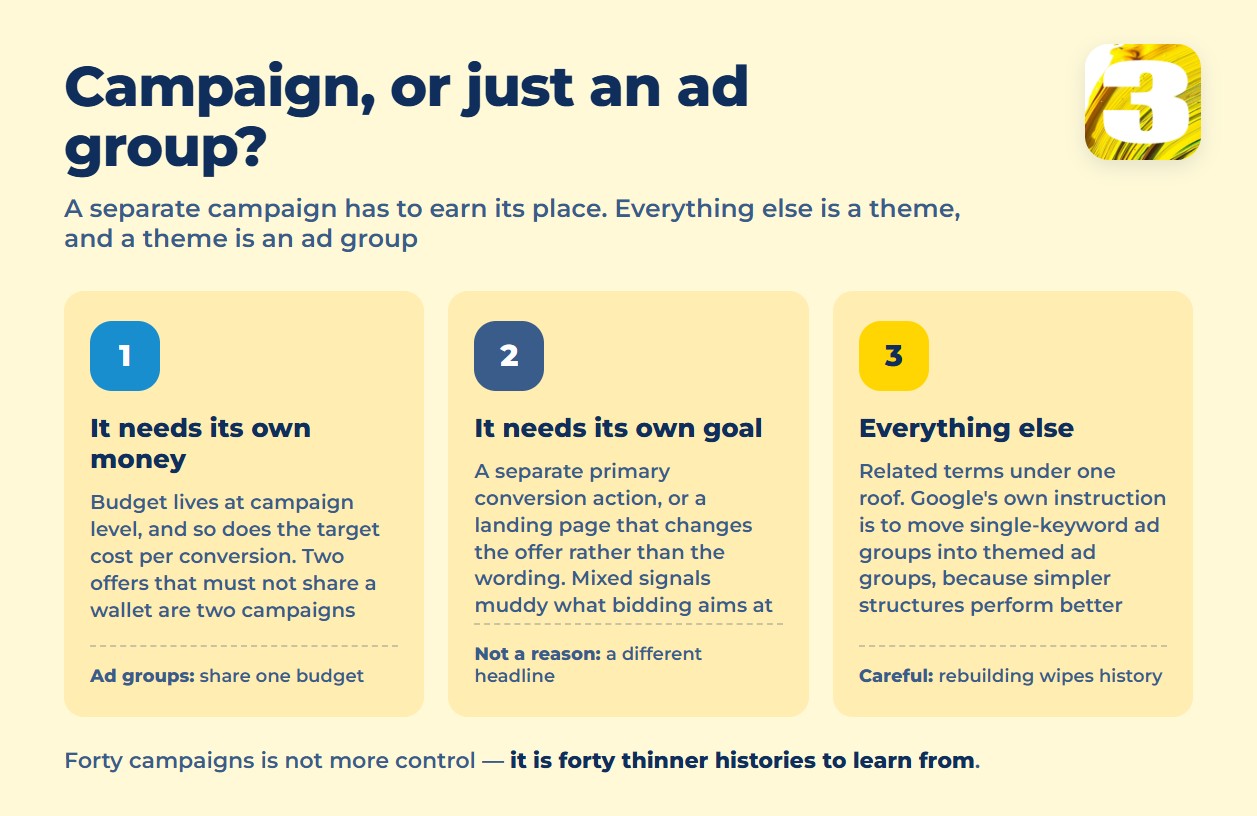
A new campaign earns its place when you need one of these, and only when you need one of these:
- A separate budget. Campaigns are the budget unit in Google Ads; ad groups aren’t.
- A separate target cost per conversion or return target. Smart Bidding strategies are set at the campaign level.
- A separate primary conversion action. A lead form and a phone call aren’t the same signal, and mixing them muddies what the algorithm optimizes toward.
- A separate landing page experience that changes the offer, not just the headline.
If none of those apply, what you’re describing is a theme — and a theme is an ad group, grouped with related terms under one campaign, not a reason to spin up a new one. Google’s own structural guidance points the same direction for ad groups themselves: consolidate matching themes rather than splitting them by match type.
Consolidating without losing what you’ve already paid to learn
None of this means restructuring in one afternoon. Google’s guide on campaign hierarchy carries a specific warning that’s easy to miss when you’re eager to clean house:
“Reorganizing your account after you’ve created several campaigns and ad groups wipes out all the valuable data you’ve accumulated.”
A rebuild done as a single cutover throws away months of signal the moment it goes live — the same signal Smart Bidding needs to perform well in the new structure. The safer path is incremental: consolidate one theme at a time, pause rather than delete the campaigns you’re folding in, and use a controlled experiment to see how the new grouping performs before it becomes the only version running.
How to run that comparison safely is covered in what to test before the AI Max migration.
Meanwhile, sitelinks, callouts, and other assets attached to fragmented campaigns need the same review once you consolidate — an asset built for a campaign that no longer exists doesn’t clean itself up.
The asset side of that cleanup is why your sitelinks don’t show.
Google Ads account structure is also changing without you asking
Consolidation isn’t only a best practice you can choose to act on — starting September 1, 2026, Google itself begins restructuring part of the account layer automatically. Search campaigns running campaign-level broad match or standalone automatically created assets get upgraded to AI Max, with the migration rolling out progressively through the month. If your account still carries dozens of narrow, single-keyword campaigns sitting on old match-type settings, you’re not just fighting an outdated structure — you’re about to have a new one assigned to you, on a schedule you didn’t set.
Who actually benefits from forty campaigns
Here’s the part nobody selling account management wants to say out loud: a sprawling, over-segmented account isn’t more sophisticated. It’s more expensive to maintain. Forty campaigns take forty times longer to review, forty separate budgets to babysit, forty places for a broken conversion tag to hide.
We’re not naming names, because the incentive is structural, not personal: an account manager paid a percentage of your ad spend has no financial reason to consolidate anything — more campaigns can look like more work, and a smaller, tighter account can look like less to bill for. We work on a flat monthly rate instead of a cut of your spend, specifically so a recommendation to simplify your account doesn’t cost us anything to make.
If your current account structure came from somewhere else and you want a second read on it, that’s the ordinary starting point for Google Ads work with us.
The test that replaces the guessing
Skip the debate about the right number of campaigns and run one check instead: open your account and find the conversion count, per month, on your single largest campaign. If that number isn’t enough for Smart Bidding to find a pattern in — and for most small accounts, it isn’t — you don’t have a structure. You have fragments that happen to share a login.
That’s the actual diagnostic. Not “how many campaigns do I have,” but “does any single one of them carry enough signal to learn from.”