


Writing a single product description is simple.
But writing hundreds—or thousands—across different categories, while keeping tone consistent, SEO aligned, and structure clean? That’s where most teams hit a wall.
At 3MY, we’ve developed a system that automates product copy at scale — without sacrificing quality, accuracy, or brand voice.
This isn’t mass-produced filler or template repetition.
It’s a hybrid approach, where structured product data meets advanced AI models, all guided by expert human oversight.
Here’s how we turn your catalog into clear, optimized, conversion-ready content — faster.
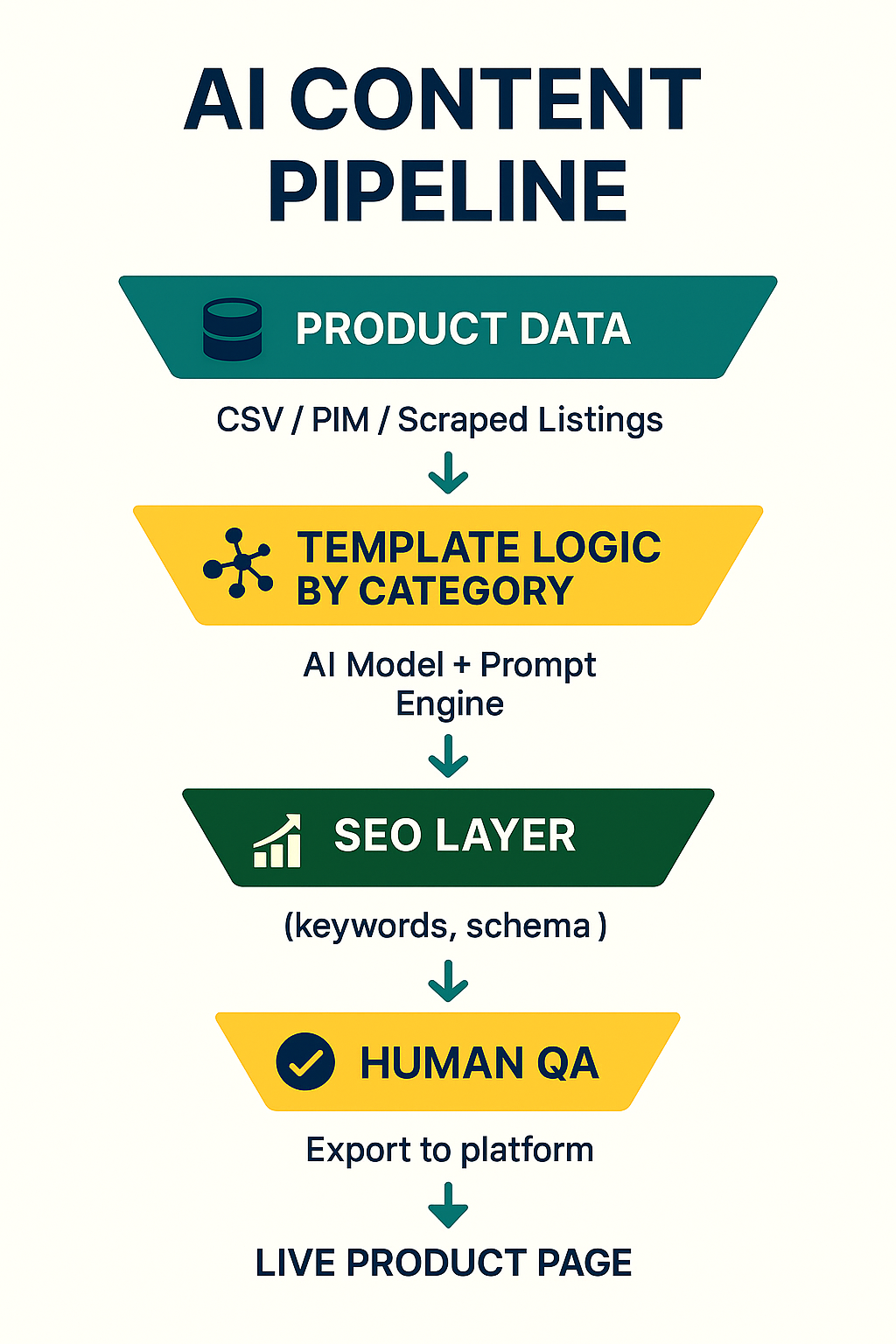
1. It Starts with Structured Product Data
AI only performs well when it understands the data it’s working with. That’s why every project begins with product mapping.
We structure and clean core data fields, such as:
| Data Field | Why It Matters |
|---|---|
| Title | Sets product context and tone |
| Category | Guides template logic and tone of voice |
| Key Features | Determines factual detail to highlight |
| Benefits | Drives emotional appeal and purchase intent |
| Specs | Supports comparison and SEO depth |
| Intended Use | Helps personalize content for specific audiences |
| Voice & Tone | Aligns output with brand personality |
We normalize this data from spreadsheets, PIM systems, or scraped listings to make it AI-ready.
2. Tailored Templates by Category
AI isn’t plug-and-play.
Different product types require different prompts, tones, and structures. A baby stroller needs a different voice than a rugged drill or an office chair.
So we build custom prompt templates for each category:
- Tone adjustments: “assuring” for health, “enthusiastic” for lifestyle, “neutral” for technical
- Format: bullet points vs. paragraphs
- Length limits: by platform (e.g., Amazon, Shopify, Google Merchant)
- Call-to-action variants depending on product funnel
This ensures brand consistency and category relevance.
3. Prompt Engineering + Model Selection
Depending on scale and output complexity, we use different models:
| Model Type | Use Case |
|---|---|
| Top-tier hosted model | Premium content for high-value SKUs |
| Smaller model, tuned on your catalogue | Mid-volume SKUs with limited variation |
| Self-hosted model | High-volume, low-risk descriptions at scale |
We describe these by tier rather than by version number on purpose. Model names change every few months; the decision underneath them — how much a given SKU is worth writing well — does not.
Our prompt logic includes conditions like:
- “If the product has a warranty, mention duration and coverage”
- “If audience is technical, favor feature-led structure”
- “If price point is premium, focus on craftsmanship over specs”
Every output is designed with reusability and compliance in mind.
4. SEO Is Not an Afterthought — It’s Baked In
We optimize every description for discoverability:
- Primary keyword placement in titles and intros
- Semantic enrichment with synonyms and contextual terms
- Character count tuning for search results and platform visibility — Google’s product data specification, for one, caps the title at 150 characters and the description at 5,000
- Formatting ready for product structured data, when applicable
This turns each product page into an SEO asset, not just a content placeholder.
One caution worth stating plainly, because most “AI content at scale” pitches skip it. Google’s spam policies name scaled content abuse: many pages generated mainly to move rankings rather than to help anyone. The policy is explicit that the method is beside the point — it targets large amounts of unoriginal content that provides little to no value to users, no matter how it’s created. Automation is not what gets penalised. Publishing thousands of interchangeable paragraphs is. Which is exactly why the next step exists.
5. Human Review Is the Step That Doesn’t Get Skipped
AI gets us most of the way there—but our editorial team always performs a final QA.
We check for:
- Tone consistency with brand
- Factual accuracy (dimensions, materials, safety claims)
- Readability and clarity
- Overused phrasing or redundancy
Our internal interface also flags potential compliance risks (e.g., unsupported claims).
6. Seamless Delivery to Any Platform
We export ready-to-deploy content in structured formats like:
- CSV for Shopify or BigCommerce
- XML or JSON for PIM and custom CMS setups
- Direct integrations for Amazon, Walmart, Etsy, etc.
That means your content pipeline stays connected from prompt to publish — automatically. Which platform you are exporting into matters more than it sounds: the difference between a store and a catalog site decides whether a description has to sell or only inform.
Why This Approach Works
| Benefit | How It Solves Content Bottlenecks |
|---|---|
| Speed | A full catalogue moves in days rather than weeks |
| Consistency | Brand tone and format remain uniform across product lines |
| SEO Visibility | Every description supports search and crawlability |
| Cost Efficiency | Fraction of the effort vs. full manual copywriting |
| Scalability | Works for 50 SKUs or 5,000 — without quality loss |
What the table can’t tell you is whether it worked on your catalogue. That answer lives in your analytics, and product-level e-commerce tracking is what makes the before-and-after readable at all.
Want to See It in Action?
We’ll show you how your product catalog can be turned into smart, SEO-rich, scalable descriptions—without adding copy debt to your backlog.
No fluff. No “AI magic.”
Just structured thinking, creative automation, and real results.