


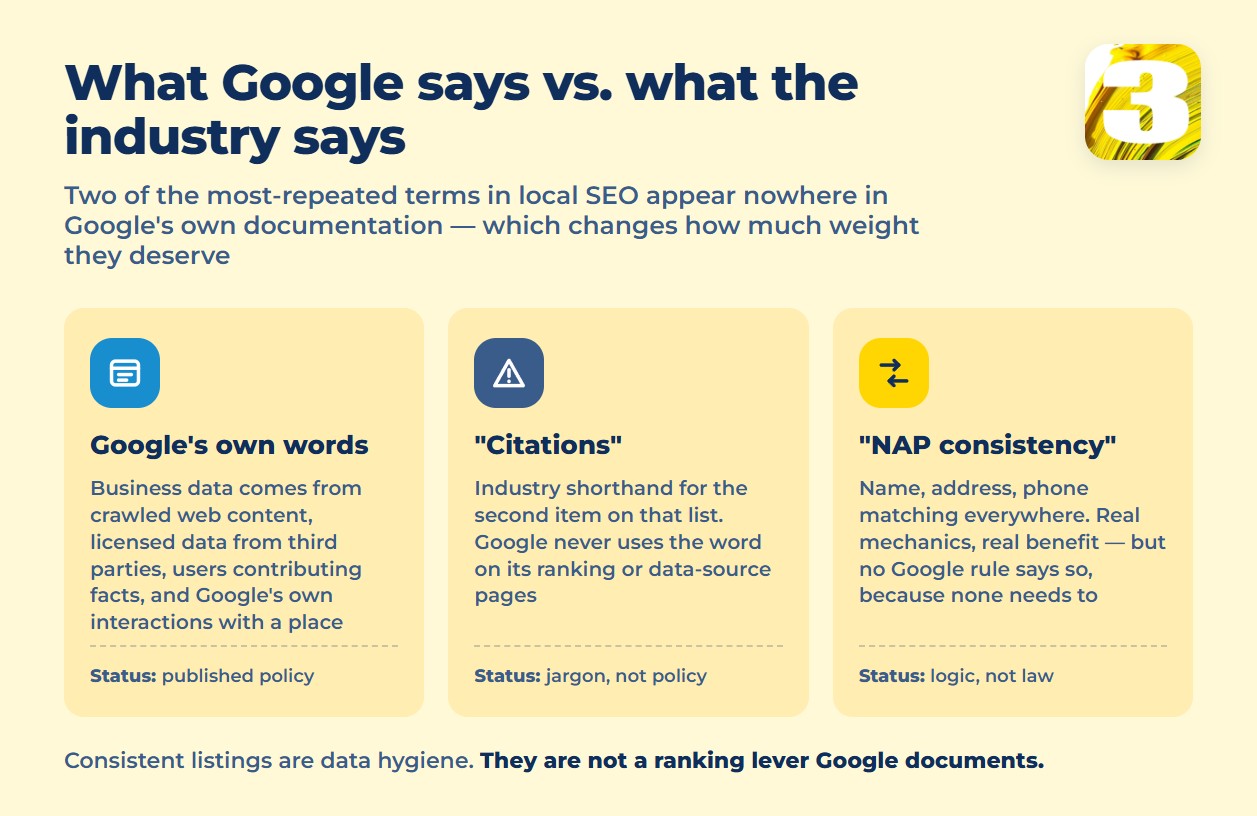
Type “local citations” or “NAP consistency” into Google’s own help center for local businesses, and you’ll find nothing. Not on the page that explains local ranking. Not on the page that explains where Google’s business data comes from. Google has never published either term. Yet almost every local SEO guide treats “citations” as a ranking factor and “NAP consistency” as a rule to follow, as if the words came from Google itself. They didn’t. They’re industry shorthand for something real, and once you strip the jargon away, the mechanism underneath is worth understanding on its own terms.
What Google Actually Says About Business Data
Google’s support page on local ranking talks about relevance, distance, and prominence. It never mentions “citations.” The closest Google gets to explaining where your business information comes from is a separate page about data sources, and it names four inputs, word for word: “publicly-available information, such as crawled web content,” “licensed data from third parties,” “users who contribute factual information,” and “information based on Google’s interactions with a local place or business.” (Google Business Profile Help)
That’s the real machinery. The industry calls the second item on that list — licensed third-party data — “citations,” because it usually means your business name, address, and phone number appearing on directory sites that license their listings to search engines and mapping platforms. The term stuck. The Google mechanism behind it didn’t change just because someone gave it a label Google never used.

What NAP Means in Practice
NAP stands for name, address, phone — the three fields most likely to appear, and disagree, across directories, your website, your Google Business Profile, and old listings you forgot existed. Google doesn’t publish a NAP rule because it doesn’t need to spell out the logic: when the same business shows up as “123 Main St” in one place and “123 Main Street, Suite 2” in another, or under a phone number you retired two years ago, whatever system is trying to match those records to one real-world business has to guess.
Consistent name, address, and phone across the sources Google pulls from make that matching easier. That’s not a policy Google wrote down. It’s what happens, mechanically, when multiple data sources describe the same business the same way — logic, not law.
Who Actually Aggregates This Data
A handful of companies act as pipes between individual directory listings and the platforms — including Google — that license or crawl that data. In the US and Canada, the names that come up most often in industry research are:
| Aggregator | Coverage |
| Data Axle | United States and Canada |
| TransUnion Digital Business Profile (formerly Neustar Localeze) | United States |
| Foursquare (absorbed Factual in 2020) | United States and Canada |
| Yellow Pages Network | United States and Canada |
Worth flagging: this list comes from an industry ecosystem page, not from Google, and while the page is presented as maintained, the underlying data it cites dates to 2017. Aggregator landscapes shift — mergers happen, licensing deals expire — so treat a list like this as a starting point for research, not a current inventory to build against blindly.
Why Citations Are Getting a Second Look
For most of the last decade, citation building lost ground as a local SEO tactic. Google’s own ranking factors — relevance, distance, prominence — never depended on how many directories listed a business, and practitioners noticed diminishing returns from chasing more listings. Whitespark’s Local Search Ranking Factors 2026 survey, published November 6, 2025 and built from the responses of 47 local search practitioners across 187 ranking factors, puts the shift directly: “Citations as a local search strategy have been decreasing in importance for the past decade, but AI SEO is breathing new life into them. 3 of the top 5 AI Search visibility factors are citation factors.” (Whitespark, Local Search Ranking Factors 2026)
Read that carefully: it’s the collective opinion of 47 practitioners, not a statement from Google or the result of a controlled experiment. No public source confirms exactly how those AI-visibility factors are weighted, so we’re not repeating specific percentages here — Whitespark’s own breakdowns by factor group aren’t independently verifiable. What the quote does establish reliably is a change in *why* citations matter: less about moving a position in Google’s local results, more about being findable and consistently described across the sources AI tools pull from when they assemble an answer.
The Practical Takeaway
Treat citations as data hygiene, not a ranking lever. Building two hundred directory listings won’t move your position in Google’s local results — nothing in Google’s own documentation supports that idea, and Google states plainly that “there’s no way to request or pay for a better local ranking on Google.” (Google Business Profile Help)
What consistent listings actually do is remove friction. Fewer conflicting records means fewer guesses for Google, aggregators, and AI tools trying to work out whether the “Main St. Bakery” in one dataset is the same business as the “Main Street Bakery Inc.” in another. That’s a smaller, more honest promise than “build citations and rank higher” — and it happens to be the one backed by what Google actually publishes.
It also connects to prominence, the one factor of Google’s three — relevance, distance, prominence — that a business can influence from outside its own profile. You can’t move your storefront closer to a searcher, and relevance mostly comes down to matching your listed category and description to what people search for. Prominence builds from signals scattered across the web: links, reviews, and how consistently your business is described elsewhere. Cleaning up citations is one of the few things you can do about prominence without touching your Business Profile at all, which is reason enough to bother, with or without a documented ranking boost attached to the count.
If a wider look at your profile is the more useful next step, our guide to Google Business Profile optimization covers relevance, distance, and prominence in full.