


Google ranks local results — the map and the list of businesses under it — on three factors: relevance, distance, and prominence. Relevance is “how well a Business Profile matches what someone is searching for.” Distance is “how far each business location is from the location term used in a search.” Prominence is “how well-known a business is,” which Google says is “also based on info like how many websites link to your business and how many reviews you have.” That’s the whole mechanism behind Google Maps ranking. Everything else — every checklist, every “how to check local search rankings” tool, every guide promising a spot in the local pack — is a discussion of these three words.
Here’s the part most of those guides skip. One of the three factors, distance, isn’t something a business can touch. It’s calculated from wherever the person searching happens to be, or from the location they typed into the search box. You can’t move it, and Google is explicit that you can’t buy it either: “There’s no way to request or pay for a better local ranking on Google.” (Google Business Profile Help) So the honest answer to how to rank higher in local pack SEO only exists inside the other two factors, relevance and prominence. Any article that promises a specific spot in the map results — top three, page one, whatever — is selling a guarantee Google itself says doesn’t exist.
Relevance: What Your Profile Says About You
Relevance is the factor a business controls most directly, because it’s built from information the business enters. Google reads your business categories, your services, your hours, your photos, your description, and matches them against what someone typed. A plumber in Calgary who lists “emergency plumber” and “drain cleaning” as services shows up for those searches; one who leaves the fields blank and relies on the business name alone doesn’t. The lever here isn’t a trick — it’s completeness and accuracy, kept current. That’s the whole focus of our guide to Google Business Profile optimization: filling in every field Google actually reads, in the order Google actually weighs it.
Categories carry particular weight. Google says plainly that “the categories that you select affect your local ranking on Google,” and recommends using “as few categories as possible” — not the longest list you can find. (Google Business Profile Help) A bakery in Portland that picks “Bakery” as its primary category and adds only the two or three that genuinely apply will out-rank a competitor that padded its profile with a dozen loosely related ones.
Prominence: What the Rest of the Web Says About You
Prominence is different — it’s built outside your profile, from signals across the web. Google’s own language: prominence depends on “how many websites link to your business and how many reviews you have. More reviews and positive ratings can help your business’s local ranking.” A roofing contractor in Winnipeg with two hundred reviews and consistent listings across directories carries more prominence than a newer competitor with five reviews and a business name that’s spelled three different ways across the web. That consistency — same name, same address, same phone number everywhere the business is listed — is its own piece of the puzzle, covered separately in local citations and NAP consistency.

“Local Pack” Isn’t a Google Term
“Local pack ranking” is what most guides call a spot in the map results — but “local pack,” “3-pack,” and “Local Finder” don’t appear on Google’s own support pages at all. They’re shorthand the SEO industry invented to describe what the map results look like on screen: a set of business listings under a map, above the regular organic results. Google doesn’t document how many spots are in that set, and it isn’t fixed — what a searcher sees depends on the query, the device, and, per the three factors above, where they’re searching from. When a guide states a specific number of “pack” positions as fact, that number came from watching a screen, not from a Google document.
Why Your Google Maps Ranking Looks Different to Everyone Else
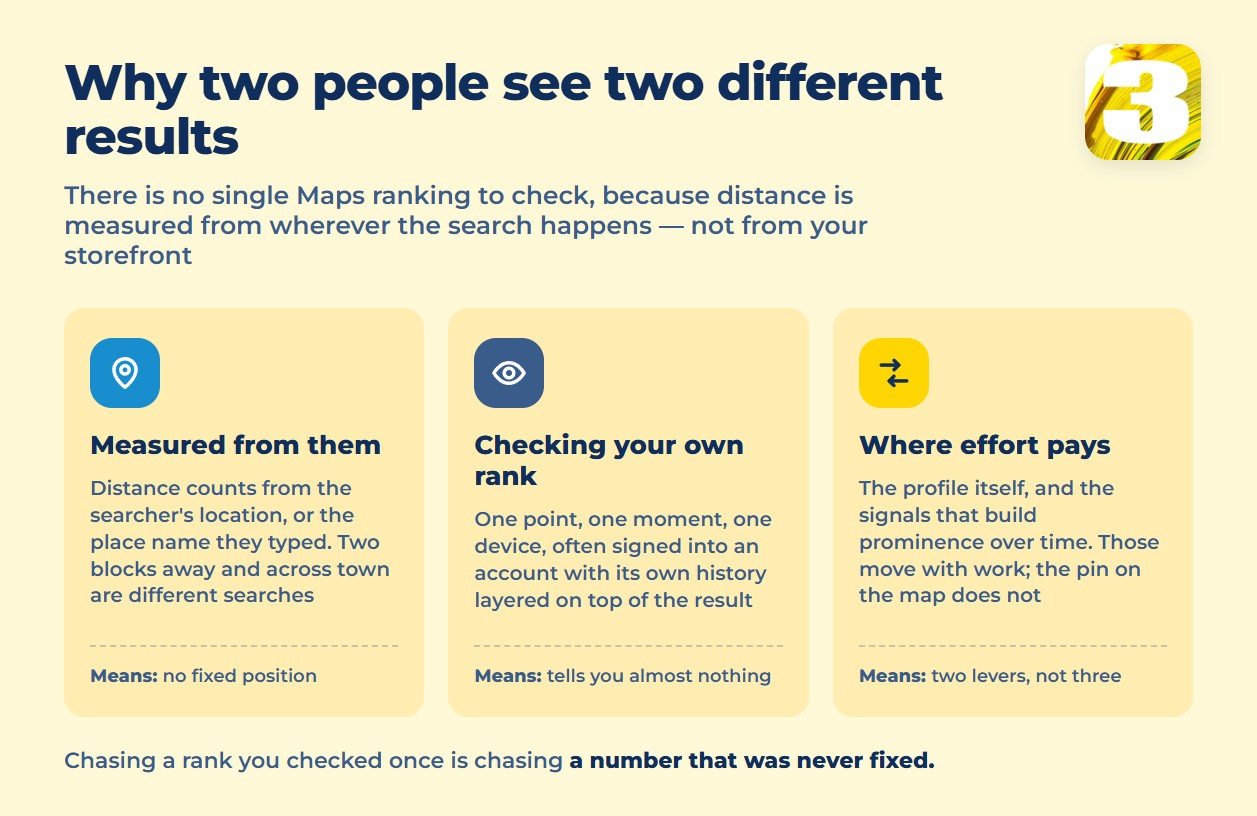
A Google Maps ranking check tells you less than it looks like it should. Distance is calculated to the location term used in the search — a searcher’s GPS position, or the city they typed. A dentist in Raleigh can rank near the top for someone searching two blocks from the office and not appear at all for someone searching from the other side of town, with the exact same profile, the exact same reviews, doing nothing differently in between. There is no single ranking to check, because there is no single search location.
The practical takeaway for a business that searched and didn’t find itself: that search was run from one point, at one moment, on one device, possibly signed into a personal Google account with its own search history layered on top. It tells you almost nothing about how customers searching from across town see the listing. Chasing that number is chasing a moving target — the two levers worth spending time on are the profile itself and the signals that build prominence over time.
Service-Area Businesses: The One Lever Worth Knowing
For contractors, cleaners, mobile mechanics, and anyone who drives to the customer rather than the other way around, Google has one specific rule that shapes everything above. A service-area business should keep a single profile for its central office, hide its street address from customers, and set a service area that “shouldn’t extend farther than about 2 hours of driving time” from where the business is based. A pest-control company based outside Sacramento claiming coverage across the entire state is working against the same distance factor it can’t otherwise influence — it’s diluting relevance for the searches close to home to chase ones too far away to realistically win.
Where the Effort Actually Goes
None of this adds up to a shortcut. Relevance is a matter of filling out a profile correctly and keeping it that way. Prominence builds slowly, through reviews, mentions, and consistent listings across the web. Distance stays outside anyone’s control, on either side of the border, whether the search comes from a law firm’s client in Halifax or a bakery’s customer in Austin. That’s the entire game — no paid placement, no trick that moves a pin closer to the searcher.
At 3MY, our local SEO services work inside exactly those two levers — profile relevance and prominence signals — because they’re the only two that exist.