


Ask “how much does a Shopify store cost” and you’ll get one number: $39 a month for the entry-level Basic plan (shopify.com/pricing, checked August 19, 2026). That number is real. It’s just not the bill.
Shopify also takes a percentage of every sale that moves through the store. Shopify calls it a transaction fee, and unlike the plan price, it doesn’t stay fixed — it shrinks as you move up tiers, and it changes again depending on which payment gateway you use. Neither shows up in the headline number. Both show up on the statement, and they get bigger as the store does better.
The question worth answering isn’t “what does the plan cost.” It’s “what does the plan cost at the revenue I’ll actually be doing in six months.” Below is that math at three points — $3,000, $10,000 and $30,000 a month — plus the exact revenue where paying a surcharge stops being cheaper than upgrading.
We build stores on WooCommerce by default; the reasons — mostly ownership — are laid out in Shopify or WooCommerce, and who owns the store. Plenty of merchants choose Shopify on purpose anyway, and if that’s you, this is the number to know before you sign up.
What Shopify Actually Charges
Two separate charges sit on top of the plan fee, and they behave differently.
Card processing, through Shopify’s own gateway (Shopify Payments), is a flat rate per transaction that drops slightly at higher tiers:
| Plan | Monthly | Card processing, online |
| Basic | $39 | 2.8% + 30¢ |
| Grow | $105 | 2.6% + 30¢ |
| Advanced | $399 | 2.4% + 30¢ |
| Plus | from $2,300 | “most competitive rates” |
(Rates from shopify.com/pricing and Shopify’s pricing overview, checked August 19, 2026.)
The transaction fee for third-party gateways only applies if you skip Shopify Payments — you already have a merchant account, or your region needs a processor Shopify doesn’t support. That surcharge lands on top of whatever your own processor already charges: 2% on Basic, 1% on Grow, 0.6% on Advanced, 0.2% on Plus. Shopify is blunt about the alternative: use its own gateway and “you only pay the credit card rate without additional third-party transaction fees.” Skip it, and the surcharge applies to every dollar the store makes, on every plan.
If you’re pricing a store out from zero rather than one line of the bill, what an online store costs to build lays out the full budget.
The Bill at $3,000, $10,000 and $30,000 a Month
Here’s where plan choice stops being about features and turns into arithmetic. The numbers below assume payments run through a third-party gateway, so the surcharge applies to full revenue on any tier. What these figures show is what Shopify charges: the plan fee plus its surcharge. Your own processor’s rate is separate and sits on top of every row equally, which is exactly why the comparison between tiers still holds.
| Monthly revenue | Basic ($39 + 2%) | Grow ($105 + 1%) | Advanced ($399 + 0.6%) |
| $3,000 | $99 | $135 | $417 |
| $10,000 | $239 | $205 | $459 |
| $30,000 | $639 | $405 | $579 |
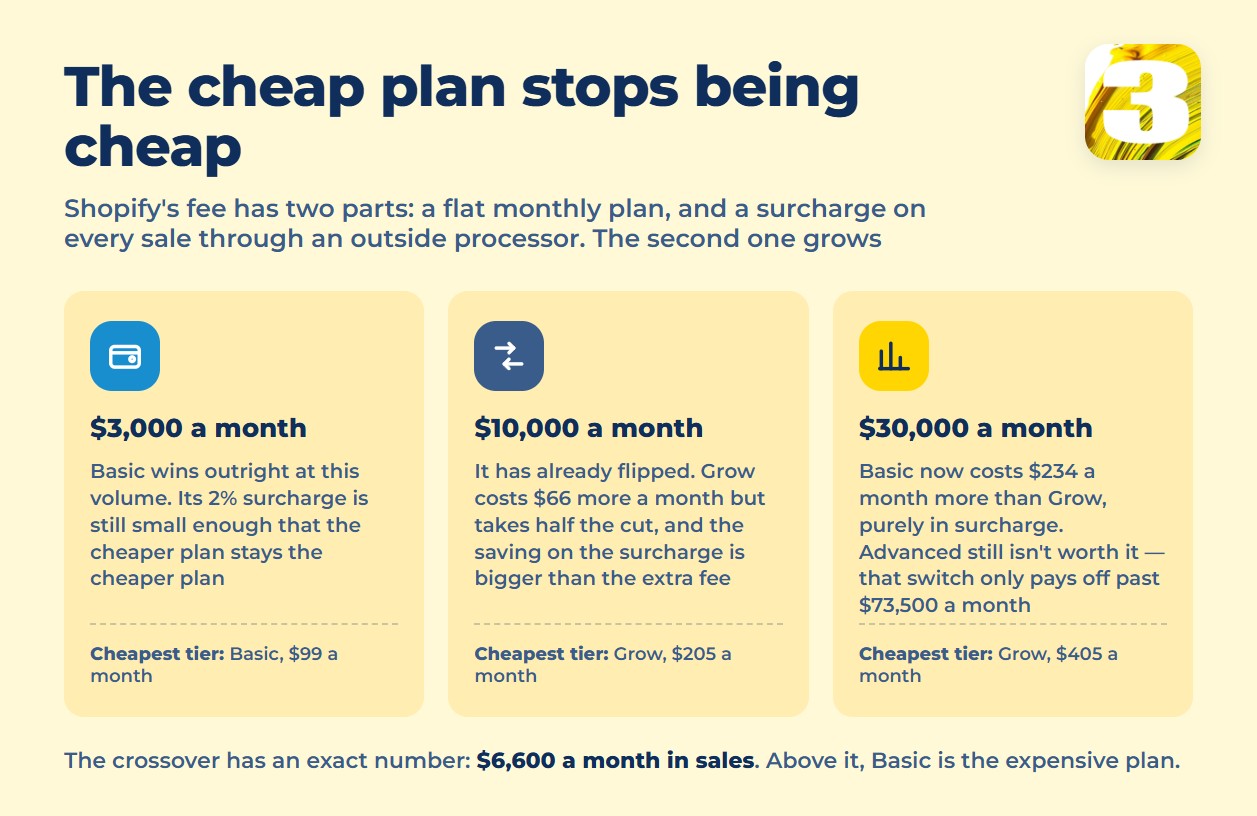
Watch what happens between the first row and the second. At $3,000 a month, Basic wins outright — the surcharge is too small to matter. By $10,000 a month, that flips: Grow’s lower surcharge saves more than its higher monthly fee costs.
The crossover has an exact number. The $66 gap between Basic and Grow ($39 vs. $105) divided by the 1-point drop in surcharge (2% to 1%) gives $6,600 a month. Past that revenue, staying on the cheap plan is the expensive choice.
The next jump doesn’t come as fast. Grow to Advanced only drops the surcharge another 0.4 points while the plan fee jumps by $294 — a crossover at $73,500 a month. At $30,000 a month, Grow is still the right tier; Advanced is a mistake most stores don’t need to make yet.
None of this applies on Shopify Payments itself — there, you pay only the card-processing rate, no surcharge, on any plan. The transaction fee is specifically the toll for routing money through someone else’s gateway, and it’s the line most cost calculators skip entirely.
What the Subscription Doesn’t Pay For
Whichever tier you land on, the fee buys a tool, not a finished store. It doesn’t write a single product description, take a single photo, or set a single shipping rate.
Every SKU needs its own title, description, images and price entered by hand. Every shipping zone and tax rule has to be built before checkout calculates correctly. Every collection needs organizing before a customer can browse it instead of scrolling past it. Shopify’s meter runs the same whether the catalog is fully loaded or half-empty — $39 charges identically in a month with ten live products and a month with two hundred.

The Fee Grid Isn’t Standing Still
Shopify’s pricing grid isn’t the fixed reference it looks like. The $5-a-month Starter plan is no longer available to new merchants as of roughly August 15, 2026; existing Starter merchants who switch away can’t switch back (Starter plan support page).
The lineup also now includes a $0-a-month tier called Agentic: no storefront at all, products sold through AI assistants like ChatGPT and Copilot, with a fee charged per completed sale that Shopify hasn’t published (shopify.com/agentic).
Both of those sat on the same pricing page the day we checked it, and one of them had just closed to new signups. Whatever number you read here or anywhere else, check it against the vendor’s own pricing page before you commit — this grid moves. If moving off it later is the question, what a migration really carries over covers what a migration tool actually carries over and what it quietly drops.
Where Shopify Genuinely Wins
Set the arithmetic aside for a moment, because there’s a case where it doesn’t matter: a store that needs to sell tomorrow, run entirely from a phone, with no developer touching any step. Shopify Payments turns on inside the same signup flow as the store itself, and its app catalog covers most of what a small store needs without custom code — no developer required to get a checkout live. That’s a real advantage. It’s also the honest reason plenty of businesses choose Shopify on purpose, revenue math and all.
What We’ll Tell You For Free
Send us your monthly revenue and who processes your payments now, and we’ll work out your actual annual Shopify bill — plan fee, processing, and the surcharge if it applies. Then we’ll tell you what the same store costs built once, on code you own: from $3,900, paid a single time, with no platform fee on anything you sell afterwards — only your payment processor’s rate, the same one you’d pay anywhere.