


Search “ecommerce website cost” and the first page hands you a range: $0 to $250,000. That’s not an answer — it’s a shrug with a dollar sign on it, wide enough to fit a $500 Squarespace trial and a six-figure custom build in the same sentence, and it tells you nothing about which one you’re looking at. Dig further and the ranges get narrower but no more credible: $5,000 to $55,000 for a catalog under a thousand products, $15,000 to $30,000 a year just to keep the thing running. None of it comes with a source you could check if you wanted to — no survey, no invoice sample, no count of how many stores were priced to get there. It’s the same figure, copied from one platform blog and agency roundup to the next, restated with more confidence each time.
Here’s a number we can actually stand behind, because it’s ours: stores we build start at $3,900, once. Everything below is what actually goes into that figure — and into everyone else’s, whether they publish it or not.
We ran into the same gap pricing out a plain business website, not a store — the same range problem shows up there too.
Ecommerce Website Cost Has Two Parts, and Every Range Blurs Them
A store’s real cost splits cleanly into two questions that almost no published range answers separately: what does it cost to build, and what does it cost every month after that, for as long as the store stays open. Lump those together and you get “$0 to $250,000.” Split them apart and you get numbers you can check.
The build is a one-time number — a template, product pages, payment setup, whatever writing and design goes into getting the store live. The recurring part is different in kind: a percentage of every sale, a monthly plan fee, a hosting bill, licenses for the extensions the catalog eventually needs. A range that mixes both isn’t imprecise, it’s answering two questions with one number and hoping you don’t notice.
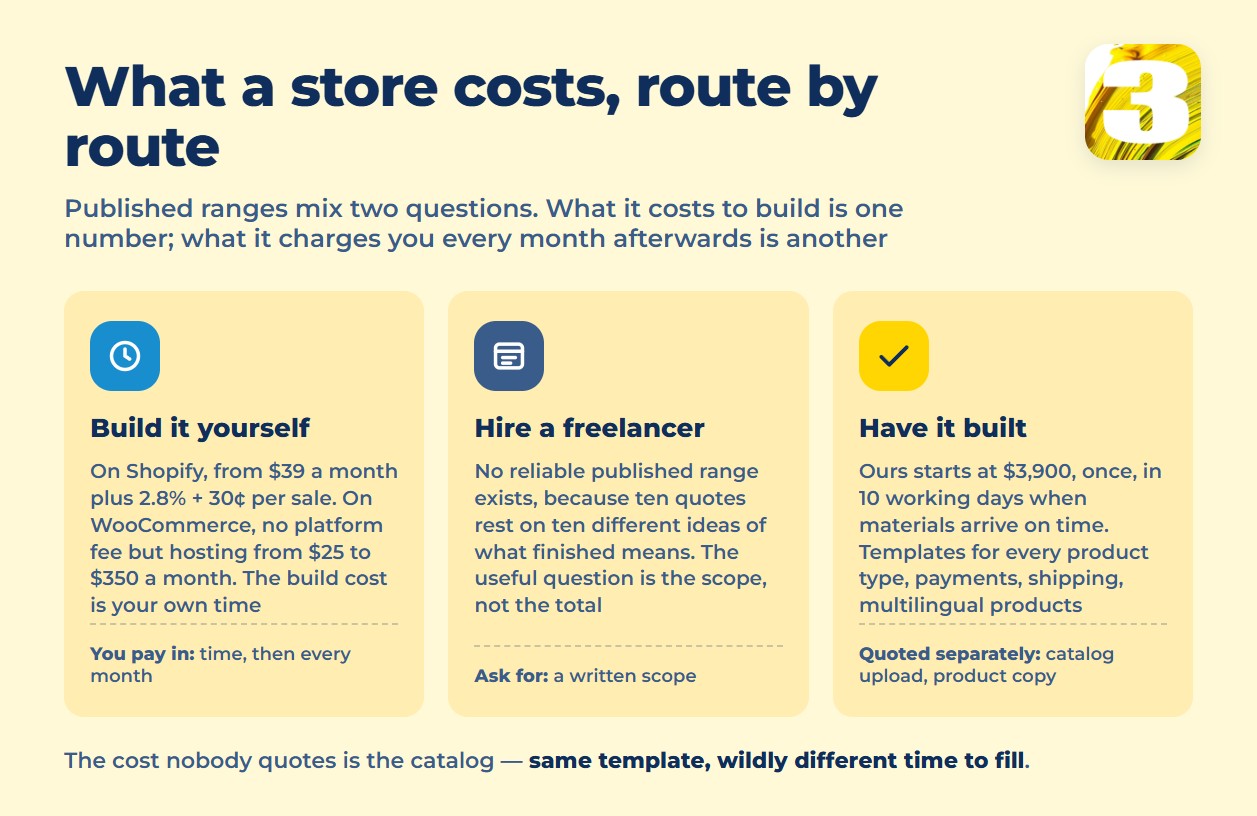
Four Ways to Get an Ecommerce Website, and What Each One Recurs
Here’s the same question broken down by route, using only numbers each vendor actually publishes:
| Route | One-time build | What recurs every month after |
| DIY on Shopify | Your own time | Plan fee from $39 (Basic), plus 2.8% + 30¢ per sale on Shopify Payments — more if you route payments through a different processor |
| DIY on WooCommerce | Your own time | No platform fee — hosting runs $25–$350/month, plus 2.9% + $0.30 per online sale through WooPayments |
| Freelancer | Depends on the person — no reliable published range exists, same as pricing a regular website | Whatever platform they put you on; the two rows above apply either way |
| Agency (us) | From $3,900, once | Only the platform’s own numbers above — we don’t add a monthly cut on top of what the platform already charges |
The freelancer row isn’t a gap in our research — it’s the honest answer. Ask ten freelancers to quote the same store and you’ll get ten numbers built on ten different assumptions about hours, revisions, and what “done” means. There’s no benchmark to check them against, so the only useful question is what’s in the scope, not what the total says.
Shopify or WooCommerce decides most of the recurring column above, and it’s worth more than a paragraph — we’ve laid out the full case for each, including who actually owns the store once it’s built. Shopify or WooCommerce, and who owns the store

Year Two: The Column No Range Ever Shows You
Everything above the table is what a store costs to open. What it costs to keep open is where most published ranges quietly stop looking.
On Shopify, the plan fee is the smallest part of year two. Selling through your own payment processor instead of Shopify Payments adds a surcharge on top of your processor’s own rate — 2% on Basic down to 0.2% on Plus — and it applies to every dollar the store makes, not a flat fee. That surcharge is exactly why “$39 a month” and “what Shopify actually costs at $10,000 a month in sales” are two different numbers. what a Shopify store actually costs Add themes ($100–$400 in the official store) and apps priced per feature — email marketing alone runs free to 250 contacts, then from $20/month for one tool — and the plan fee stops being the number that matters.
On WooCommerce, year two looks different but isn’t free: hosting that scales with traffic ($25–$350/month by the vendor’s own estimate), payment processing at 2.9% + $0.30 per sale, and official extensions that run anywhere from $84/year for product search to $396/year for subscriptions — stacked a la carte as the store needs them, not bundled into one bill.
Neither of these shows up in a “$0 to $250,000” range, because that range was never built to answer a question this specific. It was built to be wide enough that nobody could call it wrong.
What Eats the Budget Quietly: Your Catalog
Here’s the cost every quote skips entirely, and it’s usually the biggest one: getting the products into the store.
Every SKU needs a title, a description, photos, a price, and — if it has variants — sizes, colors, or bundles set up one at a time. None of that shows up in a build quote, because a build quote prices the system, not the typing. A hundred-product catalog and a two-thousand-product catalog can use the exact same template and cost the exact same amount to build, while taking wildly different amounts of time to actually fill in.
It also has a second cost that’s easy to miss: a catalog filled in badly is a catalog customers can’t find. WordPress’s default search — the engine WooCommerce sits on — only looks at titles, content, and excerpts, not the custom fields and attributes that typically hold your SKUs, sizes, and colors, so incomplete product data doesn’t just look unfinished, it makes items invisible to your own site’s search box. There’s a separate piece on why a store search misses products that are in stock.
If you already have a store somewhere else and this is a move rather than a first build, the catalog question changes shape again — what actually carries over and what has to be rebuilt by hand is its own math. Worth reading next: what a migration really carries over.
What $3,900 Actually Buys
Most of what shows up when you search this question is somebody else’s guess at what a store should cost. Here’s a number we can say plainly, because it’s ours: stores start at $3,900, paid once, for a basic store in 10 working days — as long as materials reach us on time and revisions come back promptly; miss either and the date moves with it. That’s a starting price, not a flat one — a bigger catalog or a non-standard payment setup moves the number, and we say so before work starts, not after.
What that starting price buys is the system, not the typing:
- A store template and product templates for every type your catalog actually needs — serial numbers, bundles, whatever your products require, not one generic product page
- Payment setup on whichever gateways ship with the platform out of the box
- Shipping and filter setup for the catalog
- Multilingual products through WPML — the single most time-consuming part of any store build, and the part most quotes leave out entirely
- Training so you can run the store yourself once it’s live
What it doesn’t include, and we say this out loud rather than bury it: loading a large catalog and writing product descriptions are quoted separately. If the catalog is small, we’ll load it as part of the build. If it runs into the hundreds, or you want the copy written for you, that’s a separate line — same for a payment system outside what the platform ships with. This is different from a plain website, where copywriting is already inside the price; a store is a different kind of build, and it’s priced differently on purpose.
That split isn’t a smaller offer dressed up as a choice — it’s there because store owners want different things. Some want the catalog in their own hands: nobody knows their products better, they’ll be updating prices and seasons for as long as the store runs, and the training at launch is built for exactly that. Others would rather not spend their evenings typing in hundreds of products or reworking a supplier’s price list every week — for them, we load the catalog and keep prices and stock in sync as a separate service, priced per product. Neither choice is the better one; it depends on where you’d rather spend your time.
Tell Us What You’re Selling
Send us how many products you’re listing, how you take payment now, and whether you need more than one language, and we’ll tell you plainly what your store actually costs — starting from $3,900, not from a guess.