


Search this question and you’ll get the same answer ten times over: average cost per click is somewhere between one and five dollars, here’s a table by industry, businesses typically spend a thousand to ten thousand a month. All of it is about the price of a click. None of it is about the price of a customer, which is the number you actually need before you decide whether to start.
Those aren’t the same question. A click that costs two dollars is cheap in isolation and ruinous in practice if it takes two hundred of them to produce one paying customer. A click at nine dollars can be a bargain if fifteen of them close a sale worth thousands. The price tag on the click tells you almost nothing on its own — it only means something once you know what has to happen after the click for you to get paid.
So this isn’t another list of average CPCs dressed up as an answer. It’s the calculation that turns a click price into a customer price, plus the three bills that actually make up a Google Ads budget and the one detail almost nobody mentions about how the person managing your account gets paid.
Why There’s No Price List in the First Place
Google Ads doesn’t have a rate card because it doesn’t have fixed prices. Every time your ad is eligible to show, it enters an auction: “a process that decides which ads are eligible to appear and in which order.” What you pay depends on who else is bidding for that same search, at that same moment, for that same audience — which means the honest answer to ‘what does a click cost’ is ‘it depends on the auction you happen to walk into.’
What decides the outcome isn’t only the bid. Google is explicit that ads are ranked “based on Ad Rank, a combination of bid amount, the quality of your ads and landing page, the Ad Rank thresholds, the competitiveness of an auction, the context of the person’s search, and the expected impact of assets and other ad formats.” Quality is measured through what Google calls Quality Score, “a diagnostic tool meant to give you a sense of how well your ad quality compares to other advertisers,” scored from 1 to 10 at the keyword level.
The part that matters for your budget: Google states plainly that “even if your competition bids higher than you, you can still win a higher position — at a lower price — with high-quality ads and landing pages.” A sloppy ad and a slow landing page don’t just perform worse, they raise the price of every click you buy. That’s not a sales pitch from an agency — it’s Google’s own description of how its auction works.
Google Never Publishes a Minimum
Look for an official minimum budget and you won’t find one, because Google doesn’t set one. Its own guidance says a budget “should be the average amount you’d be comfortable spending per day,” with the advice to “start small.” No floor, no recommended starting figure, no line where a campaign becomes “real.”
That absence is the reason nobody’s top-ranking article can give you a trustworthy minimum either — there isn’t an official one to quote. What exists instead is a minimum that depends entirely on your own numbers: what a click costs in your category, how often your landing page converts a visitor into a lead, and how often a lead turns into a paying customer. A budget below that threshold isn’t wrong, exactly — it’s just too small to produce a result you could learn anything from.

What It Actually Costs to Get One Customer
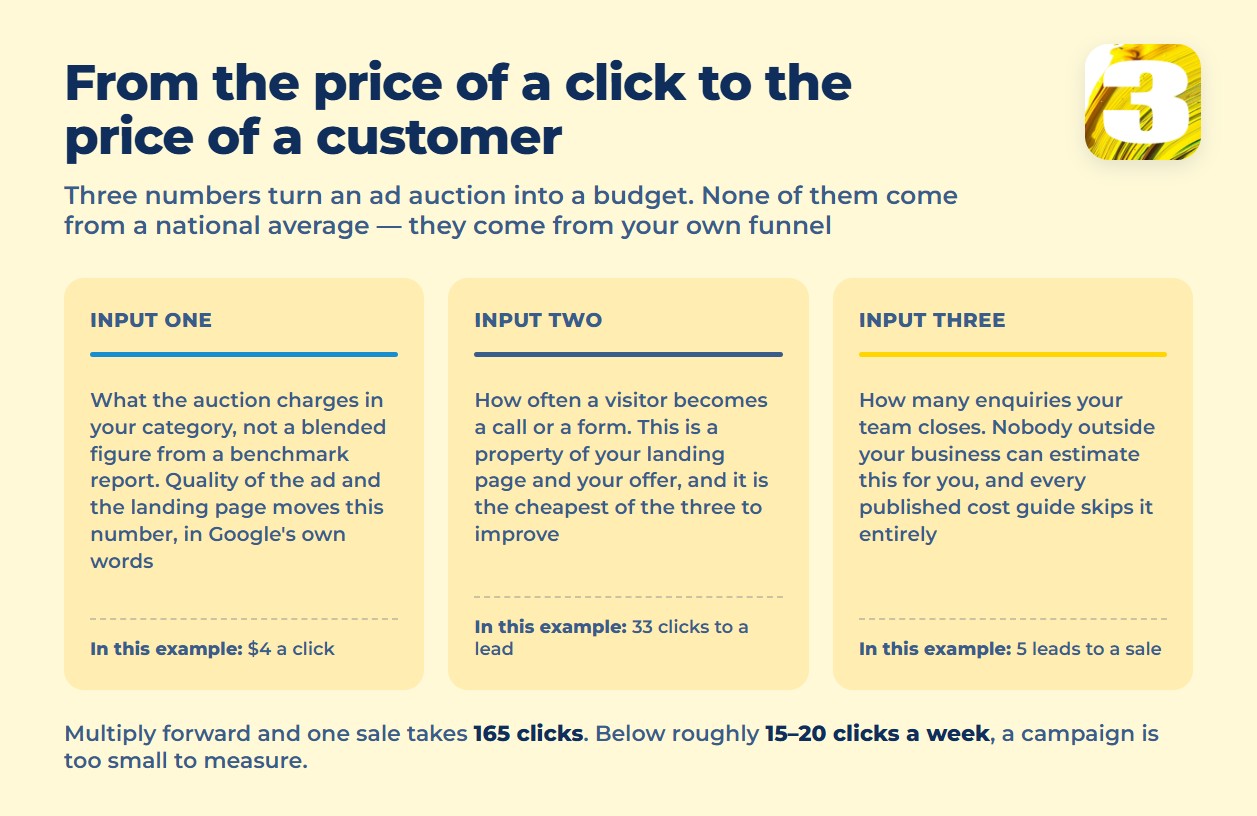
Here’s the calculation the entire top page skips. It only takes three inputs, and none of them come from a national average — they come from your own funnel.
Say the average click in your category costs $4. Say your landing page converts 3% of visitors into a lead — that’s roughly 33 clicks per lead. Say one lead in five becomes a paying customer. Run those three numbers forward and you get this:
| Step | Example input | Running total |
| Cost per click (example only) | $4 | — |
| Landing page conversion | 3% of visitors become a lead | 33 clicks → 1 lead |
| Lead-to-sale rate | 1 in 5 leads closes | 5 leads → 1 sale |
| Clicks needed for one sale | — | 165 clicks |
| Spend for one sale, at this example’s CPC | — | $660 |
None of the three inputs above is a market figure — they’re placeholders so the arithmetic is visible. Swap in your own click price and your own conversion rates and the same math still works; that’s the whole point of doing it this way instead of quoting someone else’s average. If you want a starting point for the click price specific to your own category rather than a blended national number, we’ve written separately about pricing a reasonable cost per click before you ever open the auction.
The conclusion nobody in the top results draws from this: a weekly budget that doesn’t cover somewhere around 15–20 clicks isn’t buying advertising. It’s buying a handful of visits too small to tell you anything — not whether the ad works, not whether the landing page converts, not whether the lead-to-sale rate holds. Below that line, the campaign isn’t underperforming. It’s un-measurable.
The same bottom-up math applies even if the channel isn’t Google at all — the platforms just start from different auctions and different signals of intent. There’s a separate piece on which channel to fund first, Google or Meta.
What a Click Actually Costs, By Someone Else’s Data
We don’t run our own national survey of click prices, and neither does anyone honestly answering this question outside of Google itself. The closest thing to a real dataset comes from WordStream, whose most recent report — built from over thirteen thousand search campaigns, all in the US, across the year to March 2026 — put the average cost per click in Google Ads at $5.42, ranging from $1.63 in arts and entertainment up to $9.87 in legal services.
Two caveats worth stating plainly. First, that’s a US-only sample — a Canadian account can land anywhere around it, not on it. Second, WordStream’s own numbers for Meta, drawn from a separate set of over a thousand campaigns, put average cost per click at $0.70 for traffic-goal campaigns and $1.92 for lead-goal campaigns — a reminder that “expensive” and “cheap” only mean something next to a specific goal, on a specific platform.
Not every Google product prices this way, either. Local Services Ads — the pay-per-lead listings above the map results — charge per valid lead instead of per click, and the badge attached to them changed shape this year, losing both its old name and the money-back guarantee that used to come with it. Worth reading next: what replaced the Google Guaranteed badge.
The Overspend Rule Almost Nobody Reads
There’s one budget rule that catches people off guard, and it’s written into Google’s own help pages rather than buried in fine print: “On a given day, your campaign might spend up to twice your average daily budget to take advantage of fluctuations of traffic.” That’s not a bug — a $50 daily budget can spend $100 on a busy Tuesday.
The ceiling on the other end is what keeps that from becoming a runaway bill: “At the end of the month, you will have spent no more than 30.4 times your average daily budget.” A $50 daily budget caps out at $1,520 for the month, no matter how many days ran hot. We’ve broken down how to actually size a daily budget against that rule rather than guessing at a round number and hoping it holds.
Three Bills, Not One
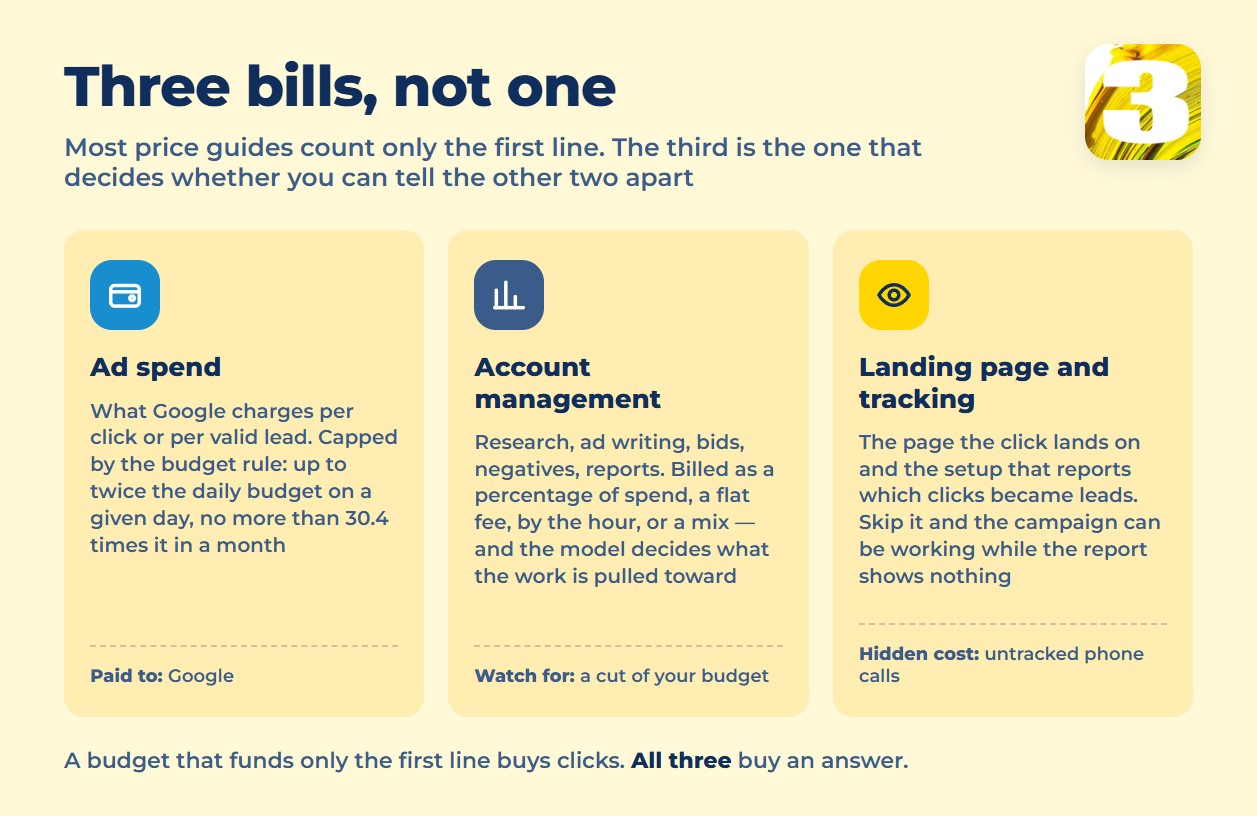
Almost every price guide talks about Google Ads as a single expense: the ad spend. In practice there are three separate lines, and skipping any one of them is how a “$500 a month” budget quietly turns into something else entirely.
The third line is the one most budgets forget, and it’s often the one doing the most damage. A landing page that doesn’t track phone calls hides exactly the leads a service business cares about most — the campaign can look like it’s failing when it’s actually working, just invisibly. We’ve written about why calls disappear from the report even when the phone is ringing.
| Line item | What it actually pays for |
| Ad spend | What Google charges per click or per lead, capped by the daily budget rule above |
| Account management | The person or agency researching keywords, writing ads, adjusting bids, reading reports |
| Landing page and tracking | The page the click lands on, plus the setup that reports back which clicks actually became leads |
Which campaign type is carrying that budget in the first place — Performance Max or a plain Search campaign — also changes both what a click costs and how much control you keep over where it shows. We compare Performance Max and Search head-to-head. Some of that spend can also buy a paid pin inside Google Maps, which runs through its own eligibility check separate from a standard search campaign. More on how paid pins on Google Maps actually work.
Who Gets Paid More When Your Campaign Fails?
Here’s the part of the bill that price guides skip entirely: how the person managing the account gets paid, and what that structure makes them want.
| Model | How it’s billed | What it rewards |
| Percentage of ad spend | A cut of whatever you spend on ads, industry figures commonly cited around 10–20% | A bigger ad budget, whether or not it’s working |
| Flat fee | One fixed price for management, regardless of spend | Fixing the campaign — spend isn’t tied to their pay |
| Hourly | Billed for time worked | Time worked, which doesn’t always track with results |
| Hybrid | A smaller base fee plus a performance bonus | Whatever the bonus is tied to — worth reading closely |
The percentage model has one property none of the others have: the person managing your account earns more the more you spend, whether that spend is producing sales or noise. Which means if a campaign genuinely isn’t working, the fix that actually helps you — cutting the budget — is the same move that cuts their invoice. That’s not an accusation, it’s just how the incentive is built.
We manage accounts on a flat rate instead, with no commission on ad spend — the structure is public on our management page, because it’s a fact worth checking, not a number worth hiding. We won’t put an exact figure in an article, because the honest one depends on how many campaigns, languages, and markets an account is actually running — which is exactly why the audit that gets you that number is free rather than a guess.

Six Questions to Ask Before You Sign Anything
A price alone doesn’t tell you what you’re buying. Before signing with anyone — us included — these six questions surface what a quote leaves out:
- What exactly is included in the management fee, and what triggers an extra charge?
- Is there a setup fee on top of the first month?
- Does the invoice grow automatically as the ad budget grows, or is it fixed regardless of spend?
- Whose Google Ads account is it — yours or the agency’s? If it’s theirs, the campaign history and the account itself don’t come with you if you leave.
- What’s the minimum contract length?
- Who pays for the landing page, and who owns it once it’s built?
If a vendor already manages accounts like yours, the fastest way to see what’s actually wrong with an existing one is a short audit of the account itself, not a sales call about what might be wrong. Covered separately: the five checks a real account audit starts with.
What “Google Partner” Actually Requires
The badge gets used loosely, so it’s worth knowing what it actually takes to hold it. To keep Google Partner status, an agency’s manager account has to maintain a 90-day ad spend of $10,000 across the accounts it manages, hold a minimum optimization score of 70%, and have at least half of its account strategists certified in Google Ads. None of that is a claim we’re making about ourselves in the abstract — it’s the standard behind the badge, and it’s the one we maintain.
What This Actually Comes Down To
There’s no honest single number for what Google Ads costs, and every guide that gives you one is answering the wrong question anyway. The right sequence is: find the click price for your category, size your landing page’s conversion rate, size how often a lead becomes a sale, and multiply forward until you know how many clicks — and how many dollars — one customer actually takes. Below roughly 15–20 clicks a week, you’re not testing an ad account, you’re guessing.
Send us your category, your landing page, and what a closed sale is worth to you, and we’ll run that math against your own numbers instead of a national average.