


Search “ADA compliance audit” and most results explain what accessibility means in general, at a level you already understood before you searched. What you actually need is narrower: what does the work cover, why do two quotes for the same site land so far apart, and what should you get back for the money. None of that requires a price list — just a clear picture of what the job actually is.
Templates Set the Audit Price, Not Page Count
An audit priced by page count is priced by the wrong number. What drives the work is how many different templates those pages are built from, not how many pages exist. A hundred blog posts running one layout are one template — test it once and the result carries across all hundred. A site with a homepage, a product page, checkout, and a booking form is four templates, even at twelve pages total. what ADA compliance actually asks of your pages goes through what actually makes a page fail — contrast, focus order, heading order, form labels — and each of those gets checked once per template, not once per page. Template count is also the detail that makes a site with several unique layouts cost more to audit than a longer business website running one design throughout.
Forms and Multi-Step Flows Take the Most Hours
A static page either makes sense to a screen reader or it doesn’t. A form has to be operated: every field needs a label that survives without a mouse hovering over it, every error has to announce itself as more than a red border, and a multi-step checkout or booking wizard has to keep someone on track from the first field to confirmation. That’s tested by hand, one interaction at a time — which is why a five-page site with one contact form can audit for less than a three-page site built around a multi-step quote request. Running a scanner across the same pages isn’t the same job; how to test your own site for accessibility covers where automated checking stops and a person has to take over.
What an Audit Charges Separately: PDFs and Third-Party Embeds
Any downloadable PDF gets checked with different tools than a web page — reading order, tagged headings, alt text inside the document — and it’s worth asking upfront whether documents are even included, because plenty of quotes quietly skip them. Booking widgets, live chat, an embedded map, a payment step in someone else’s iframe get tested the same way, but none of that code belongs to the site owner. The audit can report exactly where an embed breaks; fixing it means a request to the vendor or replacing the tool, not a patch applied during the audit itself.

Retesting, and Whether the Report Has to Satisfy Someone Else
A fix that isn’t retested is a guess that it worked. Retesting after remediation is usually its own pass — a shorter round through the same templates to confirm the flagged issues are actually gone. Separately, an audit meant to guide a developer and one meant to be handed to a landlord, an insurer, or someone on the other side of a complaint aren’t the same document: the second needs more structure and a summary written for someone who won’t open the code. If a letter is already on your desk, what the first few days look like matters more than the audit — see what actually triggers a web accessibility lawsuit.
A List of Errors Isn’t a Report You Can Work From
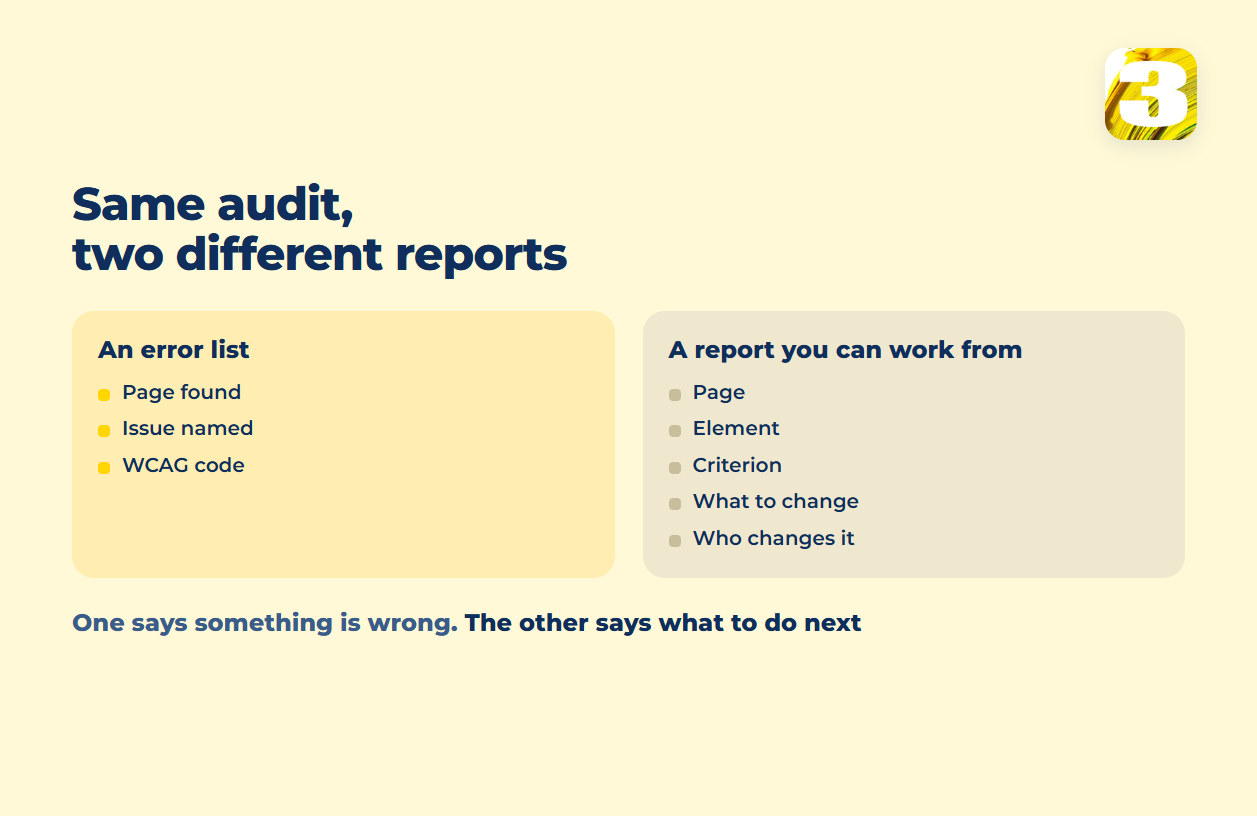
Two documents can both be called an audit report and only one is useful. The thin version names pages and lists which WCAG criteria failed — accurate, and close to useless on its own, because nobody on a team knows what to do with a criterion number. The version worth paying for lists, per issue: the page, the specific element, the criterion it fails (per WCAG 2.2), what needs to change, and who owns the change — design, development, or whoever writes the content. That last column is the one people forget to ask for, and it’s the difference between a report read once and one a team actually works through.
Why Fixing Costs More Than Checking
Checking describes a problem in a sentence. Fixing it means a developer changes markup, a designer adjusts a color or a focus state, someone rewrites a label or an error message, and then someone retests to confirm it held. An audit invoice that arrives without a remediation estimate on the same document is a bill for information you can’t act on yet. Ask for both numbers together, from the same team, before either one is signed off.
What We Take On, and What We Don’t
On a site we build, a separate audit afterward isn’t the plan: contrast, focus states, heading order, and form labels get decided while the page is laid out, in the same pass that covers the copy and the on-page SEO. On a site we didn’t build, we take on both halves — finding what’s broken and fixing it — which matters mostly because it removes a handoff. An audit written by one company and handed to another for repair spends its first week being re-read by people who weren’t there when it was written, and the ambiguous items get argued about instead of fixed.
What we won’t do is quote a number before seeing how many distinct templates the site is built from, whether documents are in scope, and what’s embedded from somewhere else. A flat price quoted before those three questions are answered is an estimate made without looking.
An Audit Doesn’t Hand You a Status
No audit, checklist, or widget issues a certificate that says a site is compliant: there is no body that awards one. That is separate from the question of which technical standard applies to you, which for a private business in the US is its own puzzle — see which accessibility rule applies to you. ADA.gov says as much about reports themselves: “A ‘clean’ report does not necessarily mean everything is accessible.” WCAG, published by W3C’s Web Accessibility Initiative, is a set of guidelines, not a law — conformance to it is something a site owner states, not something a third party certifies. That’s a different conversation with a different number: see how much a website costs and what goes into a build.