

6 things you’ll learn
- Why emergencies, implants and checkups need three separate campaigns, with our bid check for Canada and the US
- How to stop paying for calls from bargain hunters, job seekers and patients with insurance you don’t take (Canada’s CDCP, US Medicaid, provincial plans)
- How to price a new patient by what they are worth over the years, not by the first visit
- What Google’s health rules and your regulator’s advertising standard mean for a dental ad
- What to ask a dental PPC agency, including why a share of treatment fees is a red flag
- Local Services Ads: available to US dentists, not in Canada
In this article (contents)
- Dental PPC by Treatment: Emergencies, Implants and Checkups
- Wrong Calls: Bargain Hunters, Insurance Seekers and Job Seekers
- Competing With Dental Chains and Big Brands on Google
- What a New Patient Is Worth to a Dental Practice, and What a Click Can Cost
- Why the Report Shows Clicks, Not Patients
- Google’s Health Rules: What Dental Ads Can’t Target
- Dental Advertising Rules: “Specialist”, Reviews, Prices and Free Offers
- Who Picks Up: Front Desk Hours and Weekend Emergencies
- Local Services Ads for Dentists: Pay per Lead, Only in the US
- Hiring a Dental PPC Agency: Account Ownership, Fees and Fee Splitting
- Frequently Asked Questions
- Send Us Your Treatment List for a Free Audit
A toothache at 9 pm is a call now. An implant search is an expensive consultation, and some of the people typing it are comparing prices or clinics abroad. A checkup brings a patient who may stay for years. Run them as one campaign and you pay implant prices for checkup traffic. That is the first thing that sets Google Ads for dentists apart; the others are a front desk that has to pick up, Google’s health rules and your regulator’s advertising standard.
We are a Google Partner, and our Google Ads specialist has 15 years in the field. The bids below come from our own Keyword Planner check of dental searches in Canada and the US. The mechanics of calls and forms that reach a small practice are covered in our main guide, so here we stay with what is specific to PPC marketing for dentists.
Not sure which treatments are worth advertising in your area? Start with a free audit.
Dental PPC by Treatment: Emergencies, Implants and Checkups
The same account holds three very different kinds of search. Here is what our check found (top-of-page bid ranges, which are not the price you pay per click):
| Search | Canada: searches per month · top-of-page bid | US: searches per month · top-of-page bid |
| dentist near me (includes “emergency dentist near me”) | 246,000 · $6.53–36.87 | 1,830,000 · $6.83–32.13 |
| emergency extraction near me | 260 · $4.28–32.57 | 14,800 · $5.82–30.37 |
| dental implants | 12,100 · $2.37–18.21 | 165,000 · $10.01–42.07 |
| same day dental implants | 170 · $2.43–21.20 | 2,900 · $13.78–58.99 |
| invisalign | 49,500 · $2.18–11.95 | 368,000 · $2.49–15.77 |
| teeth whitening | 14,800 · $2.03–10.11 | 165,000 · $2.89–10.99 |
In Canada, emergency and “near me” searches carry the highest bids in the table; in the US, implants do. Emergency clicks are worth paying for only while someone answers. Implants in the US run about 2.3 to 2.8 times higher than in Canada at the top of the range, so expect an implant budget to go less far there. Aligners and whitening carry lower bids.
Why a brand name sits in this table. Invisalign is not a treatment but a brand of clear aligners made by one company, Align Technology. Patients search for it the way people ask for a “Kleenex” instead of a tissue: in our check, “invisalign near me” gets 12,100 searches a month in Canada, while the generic “clear aligners near me” gets 260.
So a clinic that offers aligners ends up bidding on the brand, but only if it actually provides Invisalign; otherwise the ad brings in people asking for a product you don’t offer. Google doesn’t restrict trademarks used as keywords. In ad text, it may restrict a trademark after the owner complains, though not for an ad whose landing page clearly sells the trademarked product or service and shows prices (Google’s trademark policy).
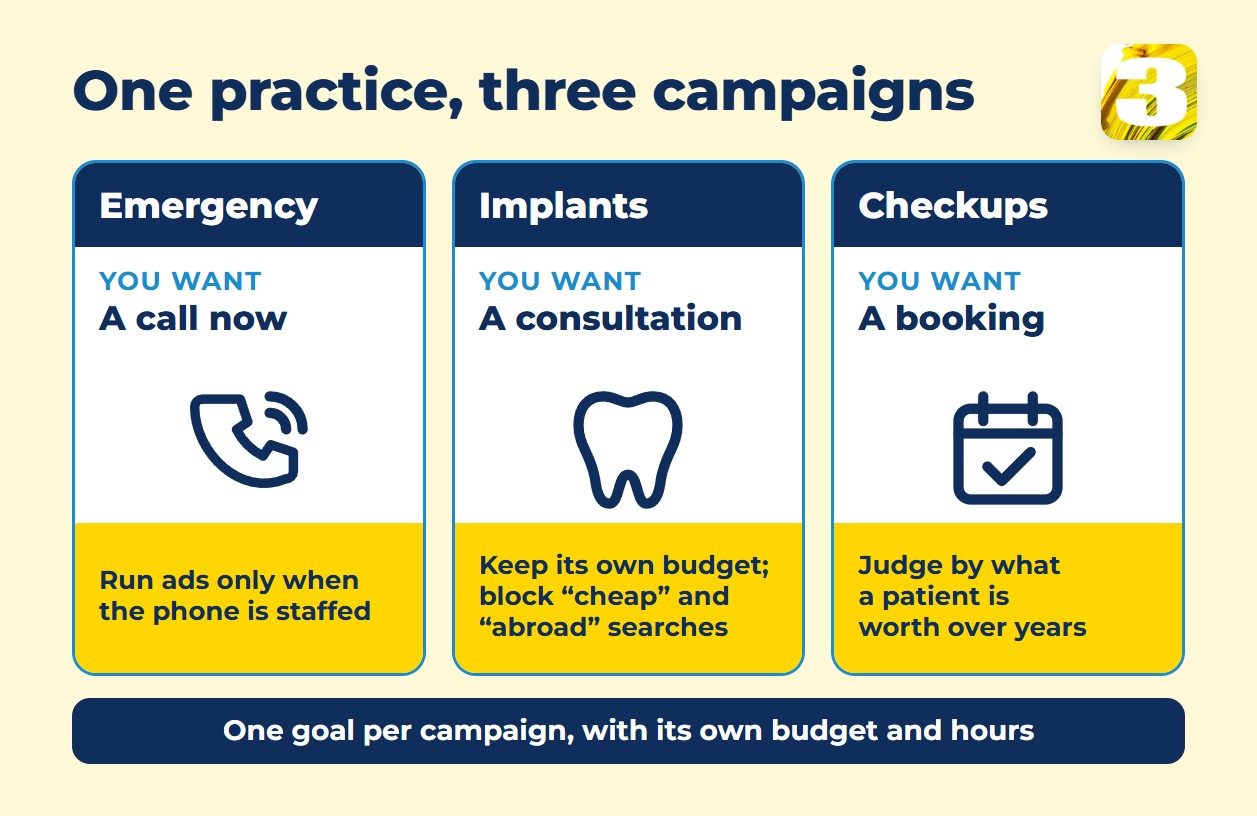
That gives three campaigns with three goals. Emergencies: a phone call now, with ads running only when the line is staffed. Implants: a consultation, with its own budget and a long list of searches to block. Checkups, family dentistry and cosmetic work: a booking, judged over years. Orthodontist ads sit with the third group, or in their own campaign if braces and aligners are most of your practice.
Try this today
A first step that costs nothing. Open your search terms report for the last 30 days and count the queries with “cheap”, “cost”, “abroad”, a job word or an insurance plan you don’t take.
Wrong Calls: Bargain Hunters, Insurance Seekers and Job Seekers
You pay for a click whether or not the person can become your patient. In dentistry, three groups of searchers are where we would look first.
Bargain hunters and implant shoppers abroad. Implant research turns up searches like “cheap dental implants”, “dental implants abroad”, “turkish teeth implants”, “$399 dental implants” and implant brand names such as Straumann, Nobel and Zimmer. Some of these searchers are comparing prices or reading about a product, not booking a consultation with you; your search terms report shows how many. Keep implants in their own campaign, start on phrase and exact match, and add what you don’t offer as negative keywords. If you do offer financing, keep “affordable” out of the block list, or you will block the very searches you want.
Job seekers and students. Broad matches on “dentist” and “dental” can collect people looking for work or a course. Block “jobs”, “hiring”, “salary”, “career”, “school”, “course” and “dental assistant” as a start, and check the new queries every week.
Patients with insurance you don’t take. These searches have volume, and their bids are lower than for “dentist near me”. In Canada, “cdcp dentist” has 3,600 searches a month with a top-of-page bid of $0.15–6.10, and “dentist accepting cdcp” has 170 ($4.90–21.67). In the US, “medicaid dental offices near me” has 22,200 ($2.59–15.51) and “dentist that take medicaid near me” has 18,100 ($2.71–17.19). The first question is whether you take that plan.
Canada’s dental plan, the Canadian Dental Care Plan (CDCP), shows why the answer matters. Canada.ca says: “Participation in the CDCP is voluntary.” A clinic can sign up formally through Sun Life or send claims one at a time, or do neither.
The patient has conditions too: no access to private dental insurance and an adjusted family net income under $90,000, and for many families the plan pays only part of its own fee schedule. A patient may assume every clinic takes the plan, click your ad and hear “we don’t” at the front desk. That click is gone.
Provincial programs add their own conditions (in Quebec, for one, RAMQ pays for some children’s dental services only at participating dentists). Check which public programs apply in your province or state, and what your clinic has agreed to.
- If you take a plan: give it its own ad group and landing page that says how it works at your clinic, and leave what it covers to your front desk.
- If you don’t: add the plan’s name (“cdcp”, “medicaid”) as a negative keyword, and never write “accepted” or “covered” in an ad.
An ad should never promise that a plan will cover a given patient: that depends on the patient’s eligibility. If you take Medicaid, the US volume above is low-bid traffic worth its own ad group; if you don’t, block it.
Our starting list of negative keywords for a dental account. Paste it into a shared negative keyword list (Google Ads accepts one word or phrase per line). Typed without quotes or brackets, each line is a broad-match negative: it blocks any query that contains those words, but not their plural forms, which is why both “course” and “courses” are listed. Then remove anything you actually offer: if you take CDCP, delete “cdcp”; if you place Straumann implants, delete “straumann”; if you sell whitening kits, delete “kit”. Pet owners search for “dog teeth cleaning” too, which is why the animal words are there.
cheap
cheapest
abroad
mexico
turkey
turkish
costa rica
hungary
straumann
nobel
zimmer
job
jobs
hiring
salary
career
careers
school
course
courses
training
dental assistant
hygienist program
diy
at home
kit
home remedy
dog
cat
pet
veterinary
reddit
youtube
cdcp
medicaid
The list is a start, not a finished filter: add the irrelevant queries you find in your own search terms report.
Competing With Dental Chains and Big Brands on Google
A group of clinics can bid for a whole city, and “dentist near me” in our check has a top-of-page bid of up to $36.87 in Canada and $32.13 in the US. One clinic is unlikely to win that term for long, and it doesn’t have to. Our judgment, from how we build accounts:
- Shrink the map. Target the postal or ZIP codes your patients actually drive from, not the metro area.
- Pair the treatment with the place. “Emergency dentist [your area]” and “invisalign [your city]” pull fewer searches than the head term, but from people who can reach you.
- Don’t start with a bare brand name. “invisalign” alone mixes patients with people shopping for a product. Your conversion data will show whether those searchers ever book.
- Keep your Business Profile in order. For “near me” searches the map result competes with your ad, and a well-kept profile costs nothing per click (our local SEO service covers it).
What a New Patient Is Worth to a Dental Practice, and What a Click Can Cost
A new patient is not one invoice. A checkup patient may return for cleanings and bring a family, an implant patient brings one large case and may refer friends, and an emergency patient may never come back. So compare the cost of a new patient with what that kind of patient is worth to you over the years they stay.
Here is the arithmetic. Say one click in ten becomes a call or form, and one lead in three becomes a patient. That is 30 clicks per new patient. At an $8.00 click (the category average below), that is about $240. At a $30 click, near the top of the bid ranges above, it is about $900. If a new patient brings you $1,500 in profit over the years they stay, even $900 is not a loss. If they bring $300, $240 leaves almost nothing before management fees. Work out both numbers per treatment, because they differ a lot.
We start accounts from $30 a day in ad spend, and the right minimum depends heavily on the industry and the cost per click. Google caps a month at 30.4 times the daily budget, so $30 a day means at most $912. At $8 clicks that is about 114 clicks a month, or three to four new patients by the example above; at $30 clicks, about 30 clicks and one patient. Our small business guide has a quick test of whether a budget is big enough for the bidding to learn anything.
What the sources say
What the benchmark says. LocaliQ and WordStream publish search averages from their customers’ Google and Microsoft Ads campaigns (updated June 2026; no country or period named). For Dentists & Dental Services they show a cost per click of $8.00, a conversion rate of 10.67% and a cost per lead of $72.97, against $5.42 per click and $66.69 per lead across all industries. At $72.97 a lead, a full $912 buys about 12 leads. A lead is a call or a form, not a patient: at one lead in three, those 12 leads are about four new patients, close to the example above.

Why the Report Shows Clicks, Not Patients
Google counts clicks, calls and forms. The front desk books appointments. Nobody connects the two unless you set it up. We set up the tracking, show the results in a live Looker Studio dashboard and recommend one more step:
- Our own call and form tracking. Google’s forwarding numbers are available in Canada and the US, but we don’t rely on them: our call tracking shows each call’s campaign, we review missed calls monthly, and on WordPress sites our plugin records each form’s campaign. The mechanics are in our guide on why Google Ads misses phone calls.
- A label on each call, added by your front desk: new patient, existing patient, not a patient (wrong number, job, insurance you don’t take) or missed. Without it, a count of calls can’t tell patients from noise.
Importing booked patients back into Google Ads (see offline conversion import) means sending data about real people. With patient data, ask your privacy officer or regulator first what you may send, and whether HIPAA in the US or a provincial health-privacy law applies.
Your own patients clicking your ad. Existing patients search for the clinic’s name and may click whatever comes first, and each click is a charge for someone who was coming anyway. Look at the search terms report for your clinic’s name and your dentists’ names. Then decide: a small campaign on your name can keep a rival from taking the top spot, and its results go in a separate line, so “new patients from ads” isn’t inflated by people who already know you. The “existing patient” label on calls does the same job.
Google’s Health Rules: What Dental Ads Can’t Target
Google’s healthcare and medicines policy doesn’t name dentists or dental clinics; its only dental line says ads for dental insurance alone aren’t restricted. Prescription drug terms such as Botox are the exception (see the FAQ). For a regular dental account, the limits are about audiences and call recording.
What the sources say
What Google says about audiences. Google treats Health as a sensitive interest category, and its examples include “invasive medical procedures, including cosmetic surgery, surgical procedures, or injections”. Dentistry is not named on that page. For sensitive categories, “advertisers promoting products and services that fall within sensitive interest categories are unable to use advertiser-curated audiences”, which in practice means your own remarketing lists (Google calls them “your data segments”) and Customer Match.
What Google says about call recording. Google’s call recording page says call recording “will remain turned off if you previously turned it off, or if your business was identified as operating in healthcare or financial services”, and that you can turn it on yourself. Without recording, a call counts as a conversion if it lasts long enough.
Our reading: routine checkups and cleanings are probably outside the category, surgery such as implants may fall into it, and Google decides which side an ad lands on. So plan an implant campaign that works without remarketing, and don’t build your reporting on recorded calls: recording needs Google’s forwarding number, and our own call tracking doesn’t use it. Our guide to who to exclude from retargeting covers the audience side.
For ad text we keep a personal condition out of the ad. “Emergency dentist in your area” names a service; “Is your abscess getting worse?” points at the reader’s condition, and we would not write it.
Dental Advertising Rules: “Specialist”, Reviews, Prices and Free Offers
Your regulator sits above Google. Canadian colleges and US state boards publish their own advertising standards, and they differ.
Here is how three of them compare on the lines that most often end up in a dental ad.
| In the ad | Ontario (RCDSO) | Quebec (dentists’ code of ethics) | US (ADA Code, for ADA members) |
| “Specialist” | Say whether you are a general practitioner or a specialist whenever the ad mentions a treatment | Only a specialist recognized by the Ordre; everyone else writes “dentiste généraliste” (3.09.04–3.09.05) | “Specialist in”, for recognized specialties only; general dentists say they are general dentists (5.H, 5.I) |
| Patient testimonials | Not allowed | Not allowed (3.09.10) | Not named in the sections we cite; New Jersey, for one, bars those about technical quality or competence |
| “Best”, “state of the art” | Not allowed: superlatives and claims of superiority | No comparative advertising (3.09.03) | A claim of better quality than other dentists needs reasonable substantiation (5.F.2) |
| Promised results | Nothing that suggests an expectation of favourable results | No guarantee of a treatment’s effectiveness (4.02.01) | Nothing likely to create an unjustified expectation about results (5.F.2) |
| A price | An unqualified fee is the maximum fee, laboratory costs included | Only the items the code lists; a regular price stays in force 90 days after its last publication (3.09.07–3.09.08) | Covered by the general rule: not false or misleading (5.F) |
The texts behind the table: Ontario’s advertising guidelines, Quebec’s Code de déontologie des dentistes (in French, current to July 1, 2026), the ADA Code of Ethics and New Jersey’s N.J.A.C. 13:30-6.2 (as published by Cornell LII). British Columbia’s standards are broader: marketing must be accurate and not mislead the public (Standard 6.2), and failing a standard may be considered misconduct. Ontario counts material published by someone on a practice’s behalf as the practice’s advertising, so an agency’s ads are yours.
Before-and-after photos aren’t named in the Ontario list we read, but they sit close to Ontario’s “expectation of favourable results” and the ADA’s “unjustified expectation about results”. We would keep them out of ads and ask the regulator before putting them on a landing page.
Here is how the table above, plus the insurance and Google-health points earlier in the article, turn into headlines (30 characters or fewer, the Google Ads limit). These are our examples, not text any regulator has approved.
| We wouldn’t write | We would write | Why |
| Best Dentist in Oakville | Family Dentist in Oakville | Superlatives are barred in Ontario, comparative claims in Quebec; the ADA wants substantiation |
| Implant Specialist | Implants by a General Dentist | “Specialist” only for a recognized specialty; a general dentist says so (Ontario, Quebec, ADA) |
| Perfect Smile Guaranteed | Whitening Consultations | No promised results |
| Our Patients Love Us ★★★★★ | New Patients Welcome | Testimonials are not allowed in Ontario and Quebec |
| Implants Only $999 | Implant Fees Explained Upfront | Ontario: an unqualified fee is the maximum fee, lab costs included; Quebec lists what a price may contain |
| Free Whitening for New Patients | Book Your First Exam Online | Not in the table above: check your regulator’s free-offer rule before any “free” |
| CDCP Accepted, Fully Covered | We Take CDCP Patients | Coverage depends on the patient’s eligibility (see the insurance section); only if you take the plan |
| Is Your Abscess Getting Worse? | Emergency Dentist Open Today | Names a service, not the reader’s condition (our practice, not a Google rule); only on days you are open |
Before launching dental clinic ads:
- Find your regulator’s current standard and note its date.
- Say whether the dentist is a general practitioner or a specialist, in the form your regulator wants.
- Check your regulator’s price rules before you advertise a fee (Ontario, for one, treats an unqualified fee as the maximum fee, laboratory costs included), and don’t advertise “free” unless you checked the free-offer rule.
- Keep a copy of every ad. Quebec’s code asks for 5 years after the last publication, and New Jersey for 3.
Who Picks Up: Front Desk Hours and Weekend Emergencies
Your ad rings the front desk, where the administrator is checking in a patient and the dentist is in gloves. “Weekend dentist near me” has 2,900 searches a month in the US and 110 in Canada, with top-of-page bids of $3.91–19.69 and $1.82–14.96, and it arrives when many front desks are closed.
Match the ads to the staffing. Show emergency ads only in the hours someone answers (ad scheduling guide), or send calls to an after-hours answering service when the clinic closes. A missed emergency call can go to the next clinic on the list, and you have already paid for the click.
What a missed call costs, in numbers. Take the example from the section on patient value and count every lead as a call: one click in ten becomes a call, one call in three becomes a patient. At an $8 click, each call has cost you about $80 in clicks; at a $30 click, about $300. If a new patient is worth $1,500 in profit over the years, each answered call is worth about $500 on average, because one in three books. So a missed call loses about $500 of expected profit, and the $80–300 you paid for the click buys nothing.
If the front desk misses one call in five, about $180 of a $912 month’s ad spend (one fifth) pays for calls nobody answered, before you count the lost profit. Your call tracking shows the real share of missed calls; check it before you raise the budget.
See how we run Google Ads for clinics, from campaigns to call tracking →

Local Services Ads for Dentists: Pay per Lead, Only in the US
Local Services Ads charge per lead, not per click. Checked October 27, 2026. Google’s Local Services Ads list for the US includes “Dentist” and “Orthodontist”. Canada’s list has 16 categories, all home services, and no dentists. Google’s US help page adds that “Booking leads aren’t available for health care verticals”, and another Google page says lead credits aren’t available for “health care verticals”. Ask Google whether dentists count as a health care vertical before you plan on credits for poor leads.
Google also plans to move these ads into Performance Max, and its timeline puts “healthcare services” in 2027 (Phase 3, which covers “non-U.S. accounts and all remaining supported business categories”). Canada isn’t named, and a Canadian dentist has no Local Services list to move.
A Canadian clinic competes for “dentist near me” on the map instead. Start with your Google Business Profile, then see our guide to ads on Google Maps.
Hiring a Dental PPC Agency: Account Ownership, Fees and Fee Splitting
DIY can work for one treatment in one area, if someone reads the search terms every week. It gets hard once you add implants, emergencies and a second location.
If someone calls offering to set up your campaigns, treat it as a sales pitch until you have read, in writing, which campaign types, locations and conversions it would change. Don’t agree on the phone to a change you can’t explain in one sentence.
A share of the money. Two kinds exist. A share of your ad spend is a pricing question. A share of the treatments patients pay for is a different thing, and some regulators call it fee splitting.
Ontario’s College tells dentists not to engage in advertising promotion that would result in “the sharing or splitting of fees or payments to a third party that relate to the amount of business that you obtain as a result of an advertising or marketing campaign”. The ADA Code (4.E.1) says a dentist who pays a third-party vendor for marketing “a specific amount or percentage of professional fees collected for dental procedures” “is engaged in fee splitting”. Check your own regulator’s text. We charge a flat fee, not a share of your spend or your treatments.
Ask any Google Ads agency for dentists, us included:
- Whose account is it, and will you be an admin?
- What happens to the account if you leave, and how long is the contract?
- Does the report show booked new patients, or only clicks and calls?
- How are calls counted, and are missed calls visible?
- Who checks the ads against your regulator’s standard before launch?
Before we build a campaign, we audit your case: which treatments are worth advertising, your area, the hours your front desk answers, the plans you accept, your regulator, and how calls are counted. Then we build it as part of our Google Ads management, on a flat fee.
Frequently Asked Questions
1. Do I need a separate landing page for each treatment?
For implants and emergencies, yes. The ad and the page should say the same thing, so a visitor who clicked “emergency dentist” lands on a page about emergencies. A page for one treatment also lets you show how you quote prices, which plans you take and who treats (general dentist or specialist) the way your regulator expects. Our website development service builds those pages.
2. Google Ads or Facebook ads for a dental practice?
Search reaches people who already have a toothache or are searching for a treatment. Social ads show up for people who weren’t searching, which can suit whitening or aligners. Start with search; the full comparison is in Google Ads vs Facebook Ads.
3. Can I advertise Botox in a dental ad?
Only within narrow limits. In Canada and the US, Google lets you use prescription-drug terms in ads and landing pages “in accordance with local laws and regulations”, but you must be certified to keyword-target them.
In Canada, the Food and Drug Regulations (C.01.044) let a public ad for a prescription drug give only its name, price and quantity. Health Canada names Botox as an example: “no direct or indirect reference can be made to its therapeutic use and/or benefits”, so no before-and-after pictures. Whether a dentist may offer it at all is for your college or state board.
Bid figures: our Keyword Planner check of October 27, 2026, top-of-page bid ranges, not actual cost per click. Examples with “one click in ten” are illustrations, not data from our accounts. Google’s, canada.ca’s, RAMQ’s and regulators’ pages were checked October 20–27, 2026; LégisQuébec is current to July 1, 2026. LocaliQ/WordStream averages are as updated June 2026. This is not legal advice; confirm with your college or state board.
Send Us Your Treatment List for a Free Audit
Tell us which treatments you want more patients for, your area and who answers the phone. We’ll check which treatments are worth advertising, where Google’s health rules may limit your ads, and whether every call is counted.