


5 things you’ll learn
- How much a law firm should spend, worked out from the ad cost of one signed case
- Which practice area to advertise first, and why
- Which searches bring clients, plus 20 negative keywords for day one
- What bar rules allow in an ad, with three sample ads
- Five mistakes we see in law firm accounts, and how to fix them
In this article (contents)
- How Much Should a Law Firm Spend on Google Ads?
- PPC for Lawyers: Which Practice Area to Advertise First
- Keywords That Bring Clients and Keywords That Burn Budget
- Google Ads for Lawyers: Sample Ads and What Bar Rules Allow
- What a Law Firm Landing Page Needs
- Phone Calls: Don’t Run Urgent Ads Nobody Answers
- 5 Mistakes We See in Law Firm Google Ads Accounts
- Local Services Ads for Lawyers: US Yes, Canada No
- Law Firm PPC Agency or DIY: What to Ask Before You Hire
- Frequently Asked Questions
- Find Out What a Signed Case Would Cost Your Firm
At mid-range top-of-page bids, a thousand dollars of Google Ads for law firms covers about 70 clicks on “divorce lawyer” or 30 on “criminal lawyer” in Canada, and just 10 on “dui lawyer” in the US. Law firm PPC pays when the case is urgent and someone picks up the phone. Start with one practice area and count signed retainers, not clicks.
We are a Google Partner, our Google Ads specialist has 15 years in the field, and we run campaigns for family and criminal law firms in Canada. Starting from zero? Send us your practice and city for a cost estimate. Already running ads? Ask for a free audit.
How Much Should a Law Firm Spend on Google Ads?
Attorney PPC budgets work backwards from signed cases. The table takes the midpoint of our bid ranges and follows the clicks to a signed retainer: one click in ten becomes a call or form, half of those book a consultation, one consultation in three signs. That is 60 clicks per signed case.
| Search | Mid top-of-page bid | Clicks per $1,000 | Signed cases per $1,000 | Ad spend per signed case |
| criminal lawyer (Canada) | $31.75 | 31 | 0.53 | about $1,900 |
| divorce lawyer (Canada) | $14.18 | 71 | 1.18 | about $850 |
| dui lawyer (US) | $103.59 | 10 | 0.16 | about $6,200 |
These are top-of-page bids, so read the last column as a ceiling: real clicks often cost less (FAQ 4). To budget, multiply the signed cases you want by the ad spend per case, then add the management fee. Three new divorce clients a month is about 3 × $850 = $2,550 in ads.
Then check the floor. Below about 10 inquiries a month, bidding has too little to learn from. Ten inquiries take about 100 clicks: roughly $3,200 a month for criminal in Canada, $1,400 for divorce and $10,400 for DUI in the US.
Our accounts start from $30 a day (about $912 a month), and the minimum depends heavily on the industry and the cost per click. In law that is below the floor for every practice in the table: $912 buys a divorce campaign in one city about six inquiries a month, so treat it as a test, not a verdict. If your budget is below the floor, narrow the practice or the region instead of spreading it thin, and give a practice two to three months before you decide. Before launch we look at your practice, region and who answers your intake; these tables are where we start, not the plan.
What the sources say
What the benchmark says. LocaliQ and WordStream publish search averages from Google and Microsoft Ads (updated June 2026; no country named): attorneys and legal services average $9.87 per click and $131.63 per lead, about 13 clicks per lead. Its $9.87 average click sits well below our bid midpoints, which is why the table is a ceiling.
Before you spend anything, pull your last three months of inquiries and count calls, forms, consultations and signed retainers. Put your own shares in place of these.

PPC for Lawyers: Which Practice Area to Advertise First
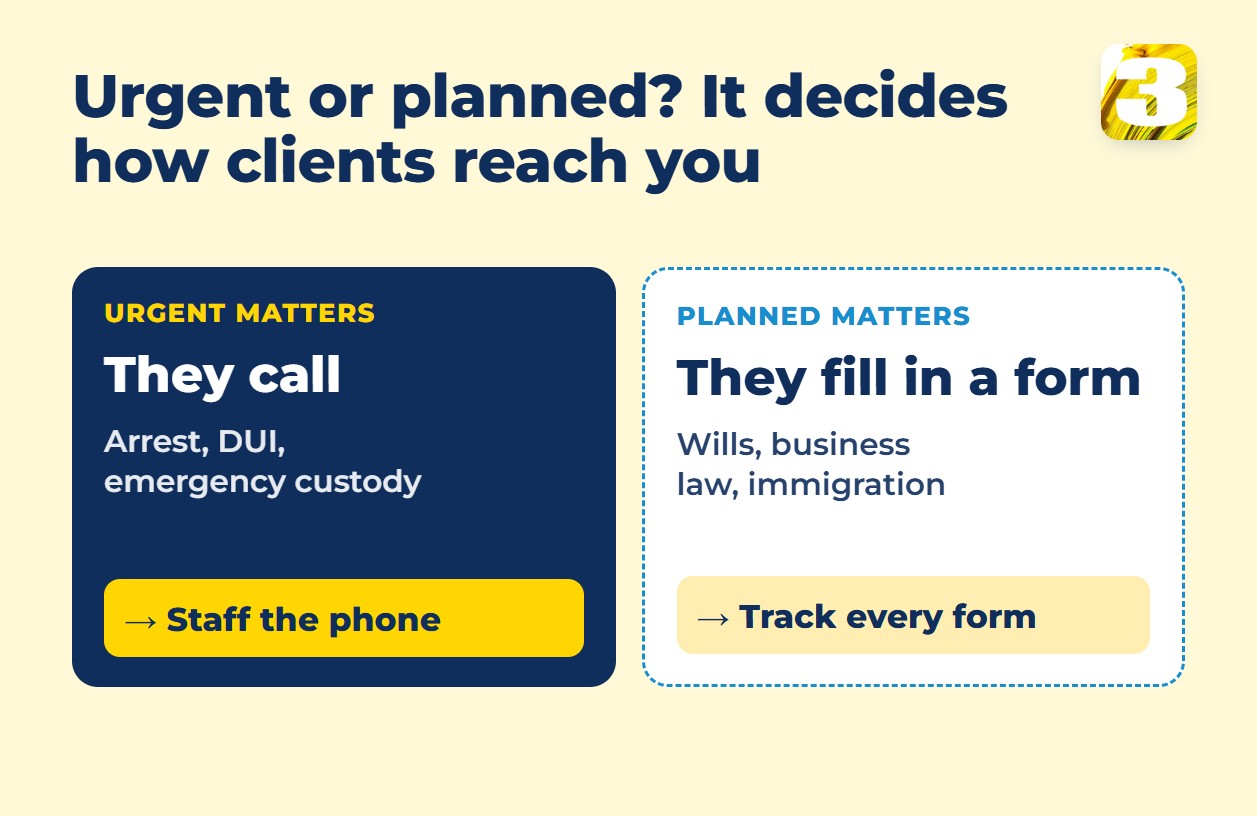
For a small firm we would start with an urgent practice where you can quote a fee on the first call. The table shows what each practice costs and how its clients reach you.
| Practice | Canada bid | US bid | Reaches you by | Start here? |
| Criminal defence | $12.84–50.66 | $9.80–93.99 | Call | Yes: urgent, clear need |
| DUI | $20.09–69.46 | $21.95–185.23 | Call | Yes, with a bigger budget |
| Child custody | $3.46–30.13 | $5.24–54.23 | Call or form | Yes |
| Divorce | $4.62–23.73 | $7.03–49.16 | Call or form | Yes: lower bids |
| Immigration | $4.20–14.86 | $7.02–32.30 | Form | Later: slower decision |
| Personal injury | $19.65–109.36 | $94.57–491.59 | Call or form | Only with a large budget |
Personal injury needs deep pockets: US bids run up to about $490 a click. Wills and estates we didn’t measure, but we expect the same slow form pattern as immigration.
We run family and criminal law in Canada and left immigration out of those campaigns because the urgency isn’t there. Each practice gets its own campaign; our base plan covers up to three campaigns, so up to three practices.
Keywords That Bring Clients and Keywords That Burn Budget
Buy searches from people who need a lawyer now, in your area:
- “[practice] lawyer near me”. “criminal lawyer near me” has about 4,400 searches a month in Canada and 90,500 in the US.
- “[practice] lawyer [city]”, such as “divorce lawyer toronto” or “dui lawyer austin”.
- Situations, such as “charged with dui what to do”. Check volumes in Keyword Planner first.
Start on phrase and exact match. Broad match on a bare “lawyer” also collects job seekers, students and people after free advice.
Twenty negative keywords to add on day one:
- Free help (6): free, pro bono, legal aid, free legal advice, legal clinic, hotline
- Work and study (7): salary, jobs, career, internship, law school, scholarship, how to become
- Do-it-yourself and trivia (7): paralegal course, template, forms, DIY divorce, definition, meaning, wiki
If your firm offers something free, such as a short first call, take “free” off the list, and if you accept legal aid certificates, take “legal aid” off too, or you will block searches for the very thing you offer. Add the rest as negative keywords and read the search terms report regularly.
Google Ads for Lawyers: Sample Ads and What Bar Rules Allow
Three headlines (30 characters at most) and a description (90 at most), character counts in brackets. Names, cities and hours are placeholders. The DUI sample shows US rules; it is not one of our campaigns.
Criminal defence, Canada
- Headline 1: Criminal Lawyers in Calgary (27)
- Headline 2: Calls Answered 8am to 10pm (26)
- Headline 3: Smith & Lee Law Office (22)
- Description: Criminal defence for charges in Calgary. Call to discuss your case with a lawyer today. (87)
Divorce, Canada
- Headline 1: Divorce Lawyers in Toronto (26)
- Headline 2: Parenting Time and Support (26)
- Headline 3: Free First Call: What to Bring (30)
- Description: Family law firm in Toronto. Get answers on separation, custody and support from a lawyer. (89)
DUI, US
- Headline 1: DUI Defense Lawyers in Austin (29)
- Headline 2: Arrested for DUI? Call Us (25)
- Headline 3: Lawyer John Smith, Austin TX (28)
- Description: DUI defense in Austin. Speak with a lawyer about your charge. Phone answered 24 hours. (86)
None says “specialist”, “expert”, “best”, “#1” or “guaranteed”. The divorce ad promises a free first call and nothing more (see mistake 2); drop that headline if your first call isn’t free, and write “24 hours” only if someone answers around the clock.
Provinces and states adopt their own versions of the model rules. Here is what the ABA Model Rules, the Federation of Law Societies’ Model Code and a few local rules say about the words that trip law firm ads:
| In your ad | What the rules say | Source |
| “Specialist”, “expert” | Model Code: no “specialist” without law society certification; “expert” without recognition is called misleading. ABA: a certification claim needs an approved or ABA-accredited certifier, named in the ad. | Model Code 4.3-1, ABA 7.2(c) |
| “Best”, “#1” | Ontario treats them as rankings that must not mislead; the Model Code lists suggesting superiority among possible breaches. | Ontario 4.2-1 |
| Guarantees | Raising expectations unjustifiably may breach the Model Code; Florida specifically bars promising results. | Florida 4-7.13 |
| Past results | Model Code: may breach the rule unless the ad adds that past results aren’t necessarily indicative and outcomes vary. ABA comment: truthful results can still mislead; a disclaimer may help. | ABA 7.1 comment |
| Filing with the bar | Texas: file within 10 days after the ad runs. Florida: at least 20 days before its first showing. Both have exemptions; ask whether search ads count. | Texas 7.04(a), Florida 4-7.19(a) |
Three more rules. A fee in the ad must say what it covers and whether taxes and disbursements are extra, and you charge it every time (Model Code 4.2-2). ABA 7.1 bars false or misleading communications, so a “free” offer must be exactly what the caller gets (ABA 7.1). And the ad names a responsible lawyer or firm with contact information (ABA 7.2(d); Texas wants a lawyer’s name, not only the firm’s, and the primary practice location; Florida adds the office’s city or county; Ontario asks you to say you are licensed as a lawyer).
Add three assets. A location asset shows your address and map from your Business Profile. Callouts (25 characters each; Google shows up to 10) can read “Calls answered 8am-10pm” (23), “English and French” (18) and, if true, “Free first call” (15). A structured snippet lists practices under “Service catalog”: “Criminal defence, Impaired driving, Assault”. We skip the call asset (a phone number in the ad that routes through a Google forwarding number) and count calls with our own tracking.
What a Law Firm Landing Page Needs
Send each ad to a page for that one practice, not the home page. Check ten things:
- One page per practice, matching the ad’s headline.
- The phone number tappable (a tel: link) on the first screen of a phone.
- Honest hours: when a person answers, and when you call back after hours.
- Where you practise: provinces, states, courts.
- What the first call and the consultation each cost, exactly as the ad states it.
- A short form: name, phone, one line about the matter. Say when you will reply.
- Who you are: lawyers’ names, licensing and firm contact.
- Reviews only after you check your bar’s rules on testimonials; the Model Code lists testimonials with emotional appeals as something that may breach 4.2-1.
- A page in your clients’ language: French in parts of Canada, Spanish in much of the US.
- Speed: open the page on mobile data. If the number takes seconds to appear, fix that first.
We check this page before every launch. If a practice needs a new one, we build it as part of our Google Ads management.
Phone Calls: Don’t Run Urgent Ads Nobody Answers
In the family and criminal campaigns we run, most clients call. Someone arrested, charged with DUI or facing an emergency custody dispute calls at any hour, and the case goes to the lawyer who picks up (why answering first wins).
So match ads to answers. Run urgent-case ads only in the hours a lawyer or an after-hours answering service picks up, and set the ad schedule to match (dayparting guide).
Then count what happens (why Google Ads misses phone leads). A call is not a case: label each one (new client, not a case, or missed) and send signed retainers back to Google Ads so bidding learns from cases.
If you use Google’s forwarding numbers anyway, Google records those calls by default and plays callers a notice; ask your law society or state bar whether recording intake calls fits your confidentiality duties.
See how we track every call and form from law firm ads →
5 Mistakes We See in Law Firm Google Ads Accounts
Each one costs money quietly. For each: what we see, where to look, how we fix it.
1. Ads show outside the area you can serve
Campaigns aimed at one city also reach people who merely showed interest in it, because Google’s default location option is “Presence or interest”. You pay for clicks from people you can’t represent.
Check: Campaigns → Settings → the campaign → Locations → Location options (Google’s steps; more in our location targeting guide). Fix: we switch to “Presence” and keep targets to the places the firm may practise and the courts it appears in.
2. A paid lawyer attracts people looking for free help
Two causes, one result: calls, but no clients. The ad promises a “free consultation” or “free case review” the firm doesn’t give. Or the negatives and match types from the keyword section were never set.
The honest version is to promise exactly what you give. In the law firms we advertise for, the free part is a short first call: the firm tells the caller which documents to prepare and books an appointment. The consultation itself is paid, so the ad says “free first call”, never “free consultation”.
Check: the search terms report, and your ad text for “free”. Fix: state the real offer, add the negatives above, start on phrase or exact match.
3. One campaign for every practice
Criminal, DUI and divorce share one campaign and one daily budget. Cheap divorce clicks can use it up early, so by evening, when people call after an arrest, the criminal ads may already have stopped. Or the dearer DUI clicks drain it first. Either way the report blends practices with very different costs (at our bid midpoints, about $45 a click for DUI in Canada against $14 for divorce), and you can’t see which one pays.
Check: does any campaign name two practices? Fix: one campaign per practice, each with its own budget, and compare cost per signed case.
4. Google adds things you didn’t ask for
Google keeps adding automation to Search campaigns. Auto-apply recommendations can change an account without anyone reading the change. AI Max, which Google’s help says new Search campaigns get by default, matches searches beyond your keywords, rewrites ad text and can send clicks to other pages. For a law firm that means queries you never chose and wording you never approved, such as “free” or “best”.
Check: Campaigns → Recommendations → Auto-apply settings, and the AI Max setting in each campaign. Fix: we untick auto-apply and review AI Max before launch.
Setting it once and forgetting it doesn’t work. Google keeps adding new options, so someone has to read search terms, recommendations and generated text regularly and clear out what doesn’t belong. That is a standing part of our Google Ads management, and the first thing to ask any agency.
5. Calls and forms aren’t tracked
The report shows clicks, but nobody can say which ad produced a signed case, so bidding optimises blind. Check: compare Google’s call count with your phone log. Fix: our own call tracking shows each call’s campaign, including the missed ones; on WordPress sites our plugin records which campaign each form came from; signed retainers go back to Google Ads.
Local Services Ads for Lawyers: US Yes, Canada No
What the sources say
What Google says. Local service ads for lawyers (Google calls them Local Services Ads) charge per lead, not per click. Google’s help lists 17 lawyer categories in the US, with state bar license checks for each lawyer in the firm. Canada’s list has 16 categories, all home services; lawyers aren’t among them. Google is moving these ads into Performance Max: its late-2026 phase names “professional services” without naming lawyers, and non-US accounts are listed for 2027.
A Canadian firm can’t use Local Services Ads for legal services today. A US firm can test them beside Search.
Law Firm PPC Agency or DIY: What to Ask Before You Hire
DIY legal PPC can work for one practice in one city, if someone has time to read search terms regularly. If you hire PPC management for lawyers, ask:
- Whose account is it, and will you be an admin?
- Does the report show signed cases, or only clicks and calls? (Our clients see a live Looker Studio dashboard.)
- How are calls counted, and are missed calls visible?
- Is the fee flat or a share of your spend? (Ours is flat.)
- Who writes the ads, and who checks them against your bar’s rules before launch?
- Who reads the search terms, recommendations and generated text, and how often?
Frequently Asked Questions
1. Is Google Ads worth it for a law firm?
It can be, when ad spend plus the management fee per signed case is lower than what that case pays you, and someone answers the phone. Compare the ad spend per signed case in the first table with your average fee for that practice.
2. How long until Google Ads for attorneys brings cases?
Launch on our side takes from 48 hours, unless your bar wants ads filed first (Florida’s 20 days, see the rules table). Urgent practices can bring calls within days of going live; planned matters arrive more slowly.
3. Can we bid on another law firm’s name?
Google doesn’t restrict trademarks as keywords, but if the name is a trademark and its owner complains, Google may restrict it in ad text, including in a direct competitor’s ad. Bars can be stricter: North Carolina’s 2010 Formal Ethics Opinion 14 found that using another lawyer’s name as a keyword breaks its rules.
4. Why is my real cost per click different from the table?
The table shows Keyword Planner’s top-of-page bid range, what advertisers bid to appear above the results. You pay per click at auction, often less than the top of that range, and the price moves with your ad’s quality, your area and the hour.
5. Can we run ads in French?
Yes. Ads in English and French are included in our management. Give each language its own ads and its own landing page, so a French search meets a French page.
Bid figures: our Keyword Planner check of October 21, 2026, top-of-page bid ranges. Budget shares are examples, not data from our accounts; “reaches you by” and “start here” are our judgment. Google’s help pages and the rules cited were checked October 21–26, 2026. This is not legal advice; confirm with your law society or state bar.
Find Out What a Signed Case Would Cost Your Firm
Starting from zero? Send your practice and city, and we’ll run the same Keyword Planner check for your market and estimate the ad spend per signed case. Already running ads? We’ll audit your account, call and form tracking, and where inquiries go unanswered. We run law firm campaigns in Canada and take on US firms too.