


If you’re running Search, Shopping, or Performance Max campaigns, some of your ads are probably already showing next to — and inside — Google’s AI Overviews. Nobody flipped a switch for this. Google made the eligible campaigns eligible automatically, folded the reporting into the dashboards you already use, and didn’t send a memo. That’s the part worth sorting out before you start second-guessing a budget number that looks slightly off.
There’s a separate, older question — how to get your pages cited organically inside AI Overviews and AI Mode — and our pillar piece on that covers it in full. This one is about the paid side only: where your ads can land, what your account actually shows you, and what changes the moment Google migrates a campaign to AI Max.
Ads in AI Overviews: Two Placements That Aren’t the Same Thing
Google Ads support draws a real line here, and the two sides of it have very different reach.
Above or below the AI Overview is the wide one: ads are eligible in all 200+ markets where AI Overviews exist at all, across the same formats you already run — text, Shopping, local, and app ads out of Search, Shopping, Performance Max, and App campaigns.
Inside the AI Overview itself is much narrower. As of the current support documentation, that placement is live in exactly 12 countries — Australia, Canada, India, Indonesia, Kenya, Malaysia, New Zealand, Nigeria, Pakistan, Philippines, Singapore, and the US — and only in English, on both mobile and desktop. Canada and the US both sit inside that list, so any account running in either country is squarely in the frame. French is not covered, which matters if any part of your account targets French-language audiences in Canada — those impressions aren’t eligible for the in-answer placement, whatever else is happening around it.
Google’s own description of the mechanic: both the user’s query and the content of the AI Overview itself are factored in when it decides which ads to serve. It’s not a fixed slot pulling from a separate pool — it’s reading the answer along with the search.

Your Campaigns Are Already Eligible — There’s No Toggle to Find
This is the detail that trips people up: there is no AI Overview ad campaign type, and no setting to turn this placement on or off. Text and Shopping ads from your existing Search, Shopping, and Performance Max campaigns are eligible for the in-answer placement automatically. If a campaign already qualifies to serve, it’s already in the pool.
That’s convenient in the sense that you don’t have to build anything new. It’s also the reason so many advertisers only find out this is happening when someone asks them about it — the eligibility is silent, and nothing in the campaign list flags which impressions came from inside an AI Overview versus a normal results page.
What AI Max Campaigns Actually Add
AI Max isn’t a new campaign type sitting next to Search and Shopping — it’s a layer of expansions applied to a Search campaign: broader search term matching, automatic text customization of your headlines and descriptions, and final URL expansion to send traffic to whichever page on your site Google decides fits the query best.
Google’s own May 2025 announcement rolled AI Max out as an open beta for all advertisers. A year later, Google’s own recap called it the fastest-growing AI-powered Search ads product it has shipped, and — worth being precise about, since the two get conflated — the support page for AI Max for Search campaigns no longer carries a beta label, while the page for AI Max for Shopping campaigns still does. Same brand, two different statuses, on two pages you can check yourself.
On performance, Google states that advertisers who activate AI Max in Search campaigns typically see 14% more conversions or conversion value at a similar CPA or ROAS. That number is Google’s own internal data from 2025, covering non-Retail advertisers — not an independent study, and worth reading as a vendor claim rather than a guarantee for any specific account.
Reporting: Rows Inside Your Existing Reports, Not a Separate Line
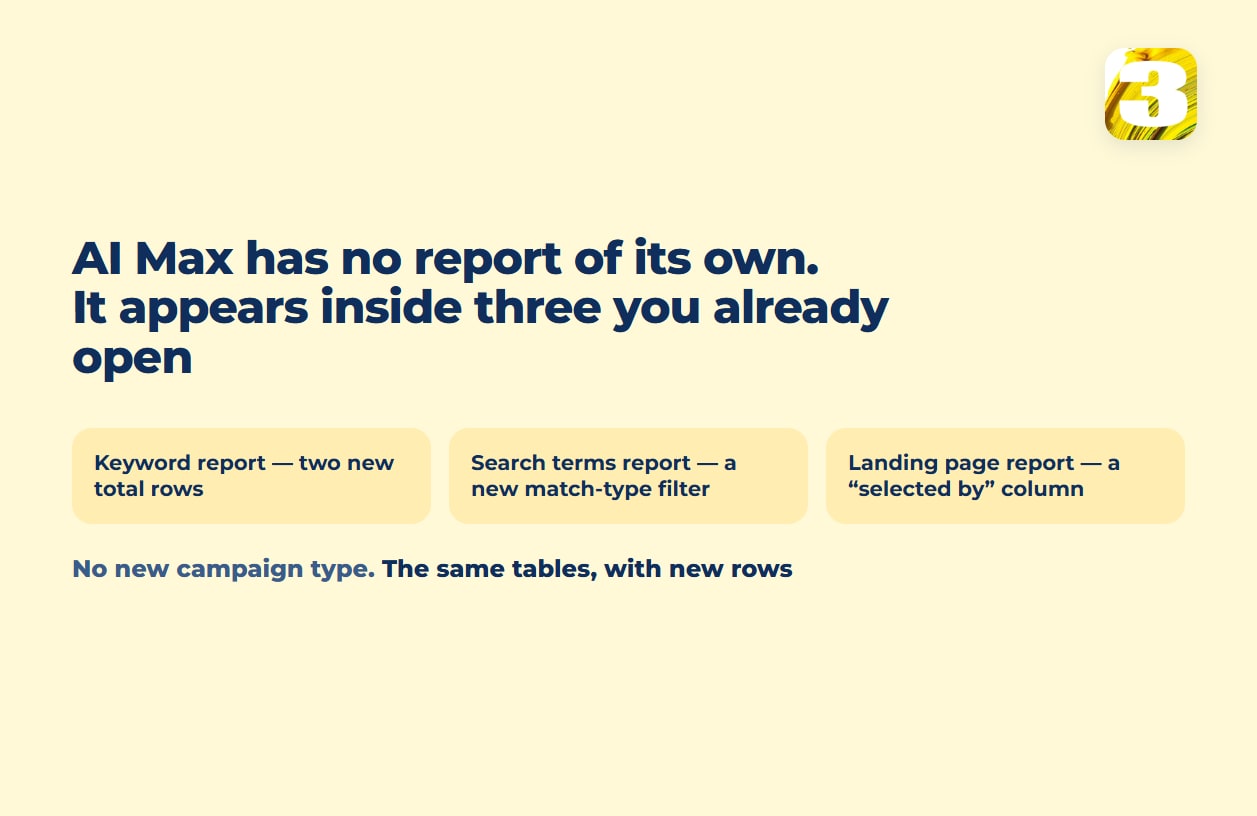
Here’s the part that actually affects how you read your account. AI Max isn’t broken out as its own campaign type in reporting, so there’s nowhere to look for “AI Max performance” on its own. Instead it shows up as rows inside reports you already have: the keyword report gets aggregated lines like “Total: AI Max expanded matches” and “Total: AI Max landing page matches”; the search terms report can be filtered to “Match type = AI Max”; the landing page report gets a “Selected by” column showing when Google picked the destination itself.
If you’ve noticed unfamiliar rows in a keyword report and assumed it was a reporting bug, it likely wasn’t — it’s AI Max activity folded into the same table. We wrote a companion piece on running experiments before letting a campaign migrate to AI Max, for anyone who wants to measure the shift rather than just notice it after the fact.
The Migration Dates Worth Having on Your Calendar
Some of this migration isn’t optional or scheduled by you. Google’s April 2026 announcement confirmed that campaigns built on Dynamic Search Ads, Automatically Created Assets, or broad match set at the campaign level get automatically upgraded to AI Max. Automatically Created Assets and campaign-level broad match start that auto-upgrade in September 2026. Dynamic Search Ads specifically got a later timeline — Google pushed that sunset and auto-upgrade to February 2027. If your account leans on any of the three, the decision about when it moves isn’t entirely yours.
Ads Inside AI Mode: Still Just a US Test
Separate from AI Overviews, Google is testing ads that appear below and integrated into AI Mode responses, in the US only. Google hasn’t published which campaign types are eligible or whether the test will expand to other countries — the honest answer right now is that this one is still a test, not a rollout, and there’s nothing more specific to report until Google says so.
What to Watch in Your Own Account
We’re a Google Partner, and we manage Google Ads accounts across a range of industries — attorneys, a clinic, a fencing manufacturer, an event company. The AI Max migration is the kind of change that’s easy to miss inside a busy account: nothing announces itself, the rows just appear. The Automatically Created Assets and broad match upgrades are running this month, which makes checking whether any of your campaigns use them a this-week job rather than a someday one — and the Dynamic Search Ads deadline in February 2027 is far enough out to plan around rather than react to.
If you want a second set of eyes on what’s already changed in your account, that’s exactly what we do for clients running Google Ads.