


Four acronyms show up in outreach emails this year, all selling roughly the same thing: generative engine optimization (GEO), answer engine optimization (AEO), LLM SEO, and the catch-all “AI SEO.” The pitch is usually a monthly retainer and a promise to get your business cited inside ChatGPT, Gemini, or an AI Overview. Before signing anything, it’s worth knowing which of these four words actually has a research paper behind it, what Google itself says about optimizing for its own AI answers, and — the part that matters for your budget — how much of a “GEO package” is the SEO work you already pay for under a different name. Our full breakdown of how often sites get cited, and by which crawlers covers the numbers; this piece is about the sales pitch itself.
Where the Term Actually Comes From
GEO isn’t marketing copy someone made up for a deck. A research team published “GEO: Generative Engine Optimization” on arXiv on November 16, 2023, and the paper later ran in the Proceedings of KDD 2024 in Barcelona. On their own test set, the authors reported visibility gains of up to 40% from the content strategies they tried — with their own caveat attached: “efficacy of these strategies varies across domains.” That’s a real study, on a specific dataset, with a stated limit. It isn’t a guarantee that any agency’s version of those strategies does the same for your site.
Answer Engine Optimization Has No Paper Behind It
AEO doesn’t have the same trail. The phrase floated around the featured-snippet and voice-assistant era well before generative answers existed, but who coined “answer engine optimization” in the sense it’s sold in today, and when, isn’t something we could pin down. The earliest clear use we found in that current sense sits in a marketing agency’s blog post from May 2023 — which tells you more about who sells the term than who invented it.
LLM SEO Is a Label, Not a Discipline
LLM SEO (sometimes “LLMO”) is younger still, an informal shorthand that spread through marketing content in 2024 and 2025. No founding author, no paper, no proceedings. It describes the same work as GEO and AEO under a third name.
Three acronyms, one actual paper — and “AI SEO,” the fourth label, is a plain-English wrapper for the same three with no claim to being anything else. Worth remembering the next time a proposal lists them as separate line items.
What Google Says About Optimizing for Its Own AI Answers
The company running the AI Overviews and AI Mode results you’re supposedly optimizing for has published its own position on this, and it cuts against most of what gets sold as GEO. From Google’s guide to optimizing for generative AI features, updated July 10, 2026:
“The best practices for SEO continue to be relevant because our generative AI features on Google Search are rooted in our core Search ranking and quality systems.”
The same guide is specific about what it says you don’t need:
“You don’t need to create new machine readable files, AI text files, markup, or Markdown to appear in Google Search.” “There’s no requirement to break your content into tiny pieces for AI to better understand it.” “You don’t need to write in a specific way just for generative AI search.” “Structured data isn’t required for generative AI search, and there’s no special schema.org markup you need to add.”
We take the llms.txt claim and the rest of the tactics apart one by one in the pillar piece linked above; the point here is broader — the same guide says no special AI file or format is needed at all.
Danny Sullivan, Google’s Search Liaison, put it plainly at WordCamp US on August 28, 2025: “Good SEO is good GEO, or AEO, AIO, LLM SEO, or LMNOPO.” Coming from the person Google puts in front of the SEO industry, that’s about as direct as it gets.
What’s Actually Inside a “GEO” Package
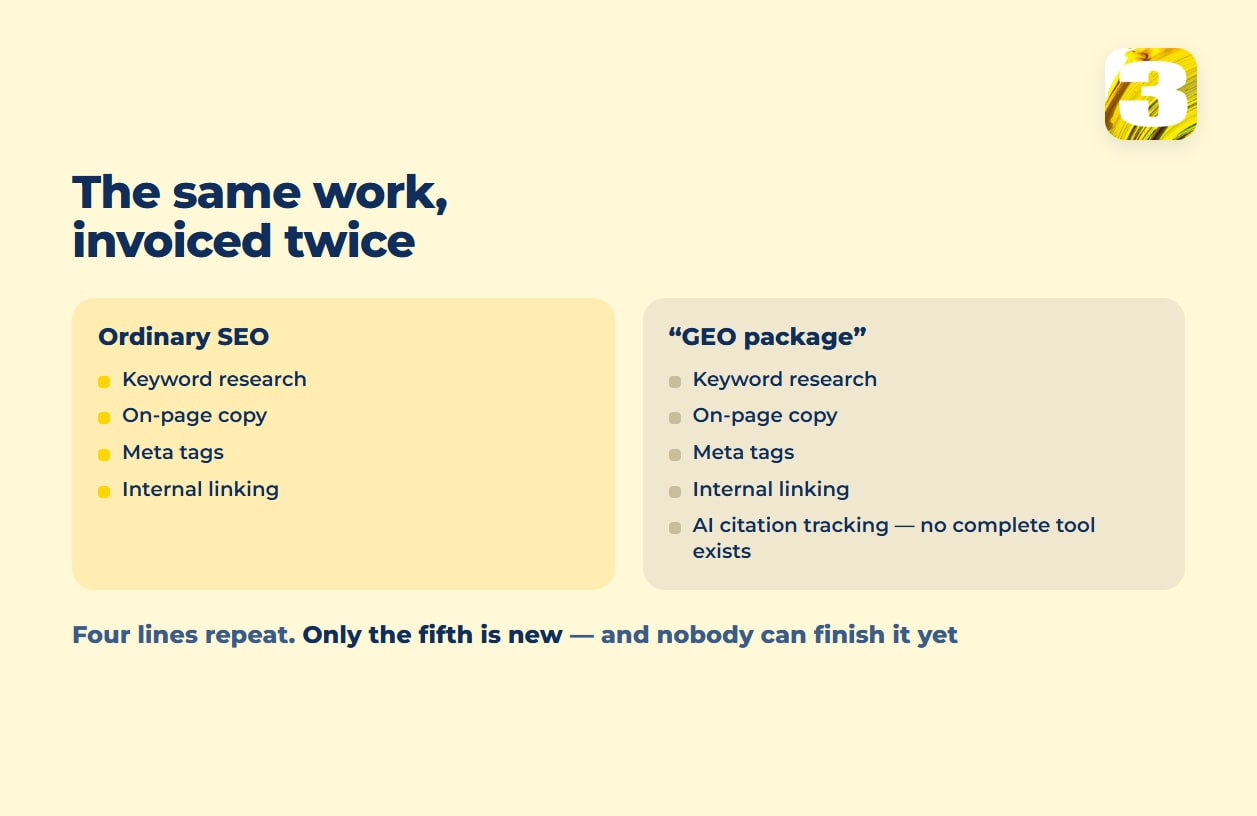
Set a typical commercial GEO proposal next to a standard SEO contract, and most of the line items repeat: crawlable, fast-loading pages; clean heading structure; schema markup; content that answers a specific question in the first few sentences; a publishing cadence that keeps pages current. None of that is new work invented for AI — it’s core SEO, priced once, now relabeled and priced again.
The one piece that genuinely doesn’t overlap is measurement, and it’s also the hardest to deliver honestly. Which bot actually controls your citations, and what Search Console and GA4 still can’t show you about the clicks that follow, is a subject of its own — our piece on the one AI bot you should never block goes through it. The short version: the tools everyone uses, including Google’s own, don’t cover it fully yet. So when a GEO package promises to “track your AI citations,” ask what that number is actually built from.

Six Questions Worth Asking Before You Sign
- What exactly is being measured — impressions, citations, or clicks — and which tool produces that number?
- Can you see the raw data yourself, or only a summary someone compiled?
- What does the monthly report actually look like — a live dashboard, or a PDF?
- Which specific AI bots are being managed, and can the vendor name the difference between a training bot and a search bot for at least one major system?
- Which deliverables in this proposal are already inside a standard SEO scope?
- What happens to the fee if citations don’t move?
A vendor with real answers has specifics for all six. A vendor selling the acronym has a slide.
Why We Don’t Sell a Separate GEO Package
We don’t have a GEO line item, and that’s not a gap in what we offer — it’s the point this whole article is making. Most of what a GEO proposal bills for is ordinary SEO, and the part of it built into our website price is this: keyword research, on-page copy written to match what people actually search, meta tags, and internal linking — done once, on landing pages and the homepage, not billed again under a new acronym. The one part that’s genuinely new — citation tracking — we’re honest that no one’s tooling, ours included, covers completely yet, so we’re not charging a monthly fee for a number we can’t fully stand behind.
Where we can publish a number, we do: the website price and the automation sprint both name theirs outright, with what’s included spelled out rather than added as a module later. Where a job genuinely varies — ongoing work on a site we didn’t build — we quote after looking at it, and say so rather than inventing a package price. What we won’t do is bill a second time for work already inside the first invoice, which is why we’d point you toward the SEO work that already does most of what a GEO pitch promises.
And if credentials matter to you, ours are the kind a platform issues and can revoke: we’re a Google Partner and Meta Certified — not a “GEO certificate” that nobody outside the agency printing it can verify.