


Yes — putting products into Google’s free listings program costs nothing in media spend. You upload a feed to Merchant Center, opt in, and your catalog becomes eligible to show up unpaid, the same way an organic search result is unpaid. No bid, no daily budget, no auction for the slot. That part is true, and it isn’t a trick.
What “free” doesn’t mean is guaranteed, controlled, or measured the way a Google Ads campaign is. Those three gaps are the actual story, and almost nothing written about free listings mentions the first one.

Where free listings actually show up now
The program used to live almost entirely on the Shopping tab — a result you’d only see if you clicked “Shopping” first. That’s no longer the full picture. Google’s own support page lists the surfaces plainly: free listings can appear on “Google Search, Google Maps, Gemini, YouTube, the Shopping tab, Google Images, and Google Lens.” Gemini and Lens on that list matter more than they look — a clean product feed isn’t just feeding a tab anymore, it’s feeding whatever answer an AI assistant hands back when someone describes what they want instead of typing a product name.
We can’t put a number on how much of that traffic reaches a store, and we’re not going to invent one. What we can say, because we watch it directly through our own lead-tracking setup, is that we do see form submissions and inquiries from people who arrived by way of ChatGPT — not Google Search, not a paid click, ChatGPT specifically. Standard analytics mostly can’t show this: referrer data from AI assistants is thin or missing, so most stores have no idea it’s happening at all. We’re not calling it a lot. We’re saying it’s real, it’s visible in our own numbers, and it’s one more reason a messy product feed is a worse idea in 2026 than it was three years ago.
You may still see the older name for this program, “Surfaces across Google,” in old posts or a legacy settings field somewhere. Independent industry write-ups place the rename to “free listings” around April 2020, when Google opened the program to all US merchants; we couldn’t pull a direct quote from Google’s own announcement confirming that exact switch, so treat the date as well-sourced history, not an official citation.
What free listings don’t give you
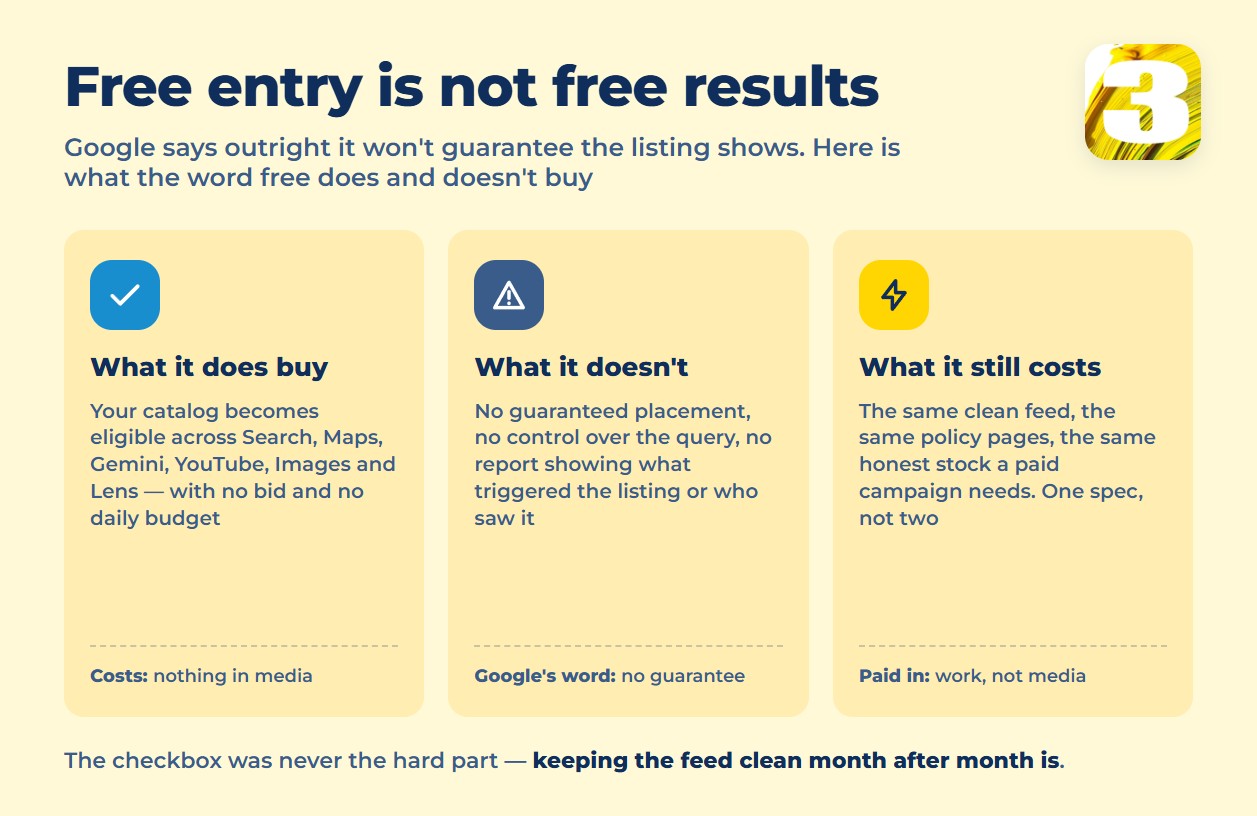
Here’s the part that gets skipped: Google directly denies any guarantee that a free listing will show up at all. From its own support documentation: “The status on the Free listings page controls permission to show products for free across Google, but doesn’t guarantee that your products will be shown to customers.” And a line later, more plainly: “Your products aren’t guaranteed to show across Google, as we rely on the data you provide to us to match your products with what customers might be searching for.”
That’s not boilerplate caution. It’s a description of how the system works. You don’t choose the search terms a free listing responds to — Google matches your product data against whatever someone typed, the way it decides what counts as a relevant organic result. There’s no keyword list to bid on, no negative keyword to block a bad match, and no report showing which queries triggered your listing or how many people saw it before clicking. If your account also runs paid Shopping campaigns, that reporting depth is one of the real differences between the two, worth understanding before you assume free listings will tell you anything close to what a campaign dashboard does. There’s a separate piece on whether Shopping belongs in your ad mix at all.
Free listings can also go dark the same way paid ones can. An account flagged for a policy violation loses both its paid ads and its free listings at once — the eligibility switch is shared. Worth reading next: what gets a Merchant Center account suspended.
The entry is free — the preparation isn’t
Nothing about qualifying for free listings is different from what feeds a paid Shopping campaign. Same feed, same required fields, same rules about accurate pricing and honest availability. Google’s product data specification doesn’t have a looser “free listings” version and a stricter “paid ads” version — it’s one spec, and a listing with a wrong price or a phantom in-stock item is just as likely to get pulled from a free surface as a paid one. More on the feed fields that keep a product from showing.
The same goes for the site behind the listing. Google’s editorial and professional requirements call for visible contact information and a clear return, refund, or cancellation policy on the store itself — not buried in a PDF, not assumed. Miss either one and Merchant Center can flag the account whether or not you’re spending a dollar on ads.
One thing worth saying carefully, because we’ve seen it stated too confidently elsewhere: Google’s free listings support page doesn’t call out a Google Ads account as a requirement, the way it does for paid Shopping ads. That’s a read on what the page doesn’t say, not a quote confirming “you don’t need one” — a Merchant Center account by itself appears to be enough to qualify, but we’re not going to phrase that stronger than the source allows.
What this actually means for a store
If your catalog is clean — accurate prices, honest stock levels, a return policy that’s actually posted — free listings cost you nothing extra to turn on, and they now reach further than a Shopping tab most shoppers never open on purpose. If your feed is messy, opting in changes nothing, because the same data problems that block a paid ad block a free one too. Google’s own getting-started guide for Merchant Center covers both halves of the setup — linking a store platform like Shopify so products sync automatically, and finding the free listings switch once they’re in — and it’s worth reading before assuming the checkbox is the hard part.
The checkbox was never the hard part. Keeping a feed clean enough to qualify, month after month, as products and prices change, is the actual work behind both the free tab and the paid one.
If that’s not something you want to own by hand, it’s the specific thing our product upload work exists to handle — someone checking prices, stock, and images against Merchant Center’s rules on an ongoing basis, whether the listing behind them is free or paid.