


WhatsApp Business API pricing today charges you per delivered template message, split into four categories with different rules. The “free 24-hour window” that older whatsapp api pricing guides lean on is closing — after October 1, 2026, that window stops covering free-form replies too. And most of what ranks for whatsapp business platform pricing quotes one number that’s really two numbers stacked: Meta’s wholesale rate, plus whatever the reseller adds on top without labeling it separately.
That reseller is called a Business Solution Provider, or BSP — Twilio, MessageBird, 360dialog, and dozens of others. You don’t connect to WhatsApp directly; you connect through one of them, and their markup rides on every message next to Meta’s rate. Reviews written by BSPs rarely draw that line, because drawing it makes their own fee visible.
What Meta Actually Bills You For on the WhatsApp Business API
Every priced message falls into one of four categories, and they don’t all follow the same rule right now — or after October 1, 2026.
| Category | Billed now | Billed from October 1, 2026 |
| Marketing | Always | Always — no change |
| Utility | Only outside the 24-hour customer service window | Always — inside the window too |
| Authentication | Only outside the window | Only outside the window — no change |
| Service (non-template) | Free, inside the window | Billed — at the same rate as utility and authentication |
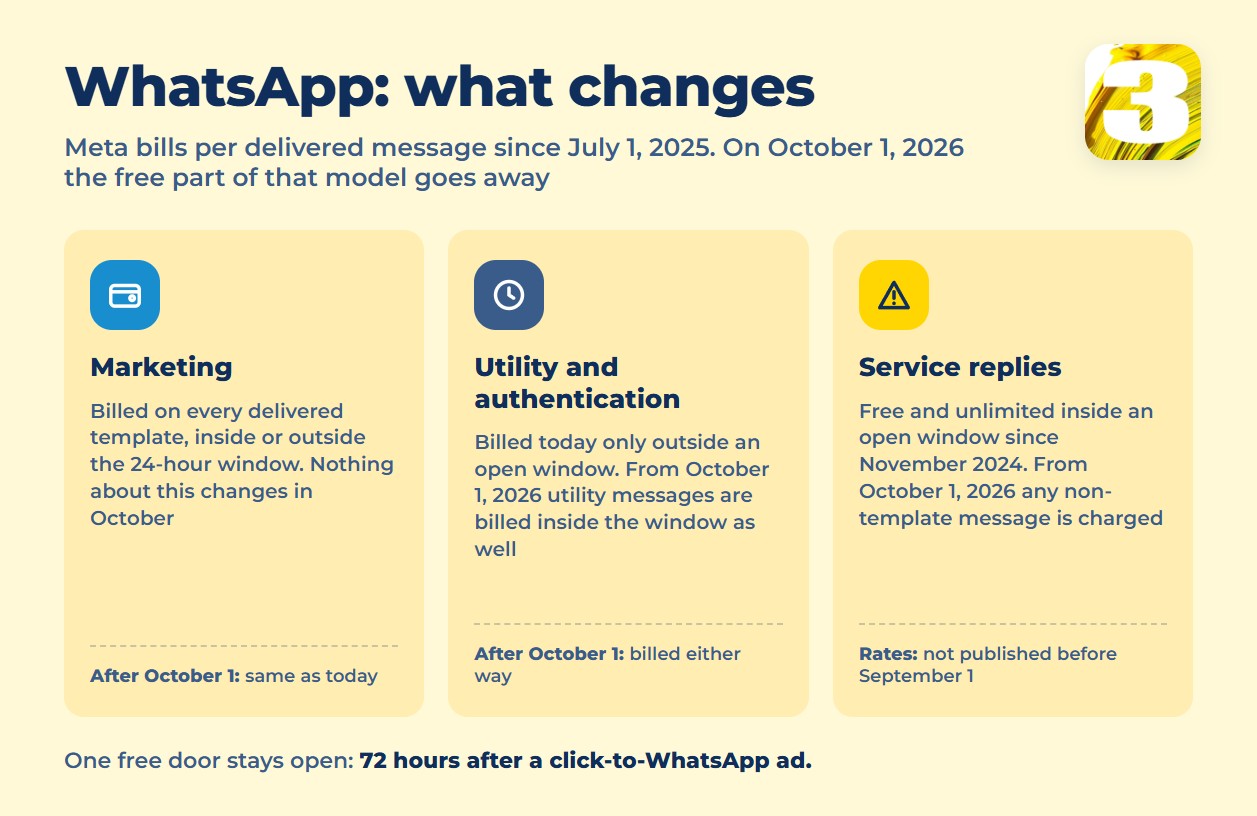
Marketing has been billed on every send since Meta moved to per-message pricing on July 1, 2025. Utility and authentication messages — order updates, appointment reminders, one-time codes — are billed only when they’re sent outside an open conversation window. Service messages, the free-form replies a human agent or a bot sends back and forth once a customer has messaged you, have been free and unlimited inside that window since November 2024.
Two Dates You Need Before You Connect
The first date is October 1, 2026. Meta’s documentation on non-template messages states it plainly: starting that date, utility messages sent inside the 24-hour window become billable, and so does every other non-template message — “any non-template message is charged.” Before that date, replying to a customer inside an open conversation costs nothing. After it, it doesn’t.
The second date is tied to the first. Meta says the rates for those newly billed messages will be published no later than September 1, 2026. As of this writing, they don’t exist. Any article quoting a dollar figure for what a utility or service message will cost after October 1 is either guessing or repeating someone else’s guess — the number isn’t public yet, and won’t be for a few more weeks. That’s worth knowing before you sign a BSP contract that locks in “current rates,” because there’s nothing current to lock in for that category.

WhatsApp Business API Pricing in North America
Meta treats Canada and the United States as a single pricing region, and on January 1, 2026, it lowered utility and authentication rates for that region specifically. We weren’t able to pull the exact dollar figures for this article — the rate card loads dynamically by country and doesn’t hand over a static number to a page fetch. What you can do instead: open that page yourself on the day you connect a number, select your country, and read the current rate for each category. Rate cards move; check it at signup, not from a screenshot someone posted months earlier.
The Two Windows That Are Actually Free
There are two ways a conversation stays free, and only one of them survives past October 2026.
The customer service window opens for 24 hours the moment a customer messages you. Inside it, non-template replies are free — until October 1, 2026, when that stops applying to utility and service messages.
The Free Entry Point is different and unaffected. When a customer taps into a chat from a Click-to-WhatsApp ad, or from a button on your Facebook page, and you reply within 24 hours, it opens a 72-hour window where “you can send any type of message to the user at no charge.” Based on what Meta has published, this is the one window that stays free after October 2026. If free customer contact matters to your model, this is the door that stays open.
Three Line Items Other Estimates Leave Out
The BSP markup. Twilio, for one, adds a $0.005 per-message fee of its own on top of whatever Meta charges for the message category — published on Twilio’s pricing pages as a separate line, not folded into Meta’s rate. Multiply that by message volume and it stops being a rounding error.
Whoever answers inside 24 hours. A conversation window only stays open while someone — a person or a bot — keeps replying inside it. Miss the window and the next message to that customer has to go out as a paid template again, at the marketing or utility rate, whichever applies. Slow response times don’t just cost you the customer’s patience; they cost you the free window.
Template approval and consent. Every template — the pre-written message format used for anything outside a live conversation — has to be approved before it can be sent, and messaging someone who hasn’t opted in isn’t just against Meta’s terms, it’s the fastest way to trip the next section. Budget the review cycle into your launch timeline, not just the message rate.
Five Questions to Put to a Provider Before You Sign
The split between Meta’s rate and a provider’s own fee isn’t hidden, exactly — it’s just rarely volunteered. These five questions surface it, and they’re answerable in an email:
- On my invoice, which line is Meta’s rate and which line is yours? Ask for the two separately, per message category, not as one blended per-message price.
- Is there a monthly platform fee, a per-seat fee, or a minimum volume commitment on top of the per-message cost?
- What happens to my pricing on October 1, 2026, when utility messages inside the window and all non-template messages become billable? A provider who hasn’t heard of the change is telling you something useful about how closely they follow the platform.
- Who is responsible for getting my templates approved, and what’s the typical turnaround when one gets rejected?
- If I leave, do I keep my WhatsApp Business Account and phone number, and what does migrating to another provider involve?
That last one matters more than it looks. The number and the account are the asset; the provider is a connection to them, and providers know that switching feels harder than it is.
Meta’s Rule About “General-Purpose” AI Assistants
Since January 15, 2026, Meta has barred AI providers from using the WhatsApp Business API to deliver a general-purpose AI assistant — a ChatGPT-style tool — as the primary product, rather than as an incidental feature of something else. The rule was announced on October 18, 2025, applied to new API registrations from October 15, 2025, and took effect for everyone on January 15, 2026.
The exception matters more than the rule for most businesses reading this: a company running a bot to handle its own customer service isn’t barred. Meta’s own framing, cited by TechCrunch, is a travel company running a support bot for its own travellers — that stays allowed. The rule targets assistants sold as standalone AI products riding on WhatsApp’s infrastructure, not a business answering its own customers. A fair number of pricing roundups blur this distinction and scare readers who were never at risk.
What Happens If You Break the Rules
Meta’s policy enforcement page lays out escalating consequences, not a single strike: restrictions start at 7 to 30 days and can end in permanent account deactivation for repeat or serious violations. Template approval requirements, opt-in rules, and the AI assistant policy above all feed into the same enforcement ladder — this isn’t a separate risk from the pricing conversation, it’s part of the same bill if you get it wrong.
Where This Leaves You
Nobody selling API access is going to volunteer which part of your invoice is Meta’s and which part is theirs — that split is on you to ask for. What a business chatbot costs breaks down end to end, including the token and hosting costs a WhatsApp bot runs on once it’s connected. If you’re deciding whether to build the bot behind that number yourself or lean on automation instead, what an AI chatbot actually is and when you need one and what workflow automation costs are the next two questions worth answering.
3MY is Meta Certified, which is one of the few places that’s worth stating plainly — the WhatsApp Business Platform is Meta’s platform, and reading its pricing and policy pages the way this article did is part of how we scope every WhatsApp project before quoting one.