


There’s no single price for a chatbot, and that’s not evasiveness — it’s how the market is built. A working chatbot is three separate costs stacked on top of each other. First, what you pay the platform to run the conversation. Second, what it takes to get your actual information into that conversation. Third, what it costs to connect the bot to the system where the real answer lives — your inventory count, your calendar, your CRM record. Every “starting at $X” number on a vendor’s pricing page covers exactly one of those three. The other two show up on your invoice later, or on your developer’s, and almost nobody selling a platform puts them in the headline number.
There’s a reason the pricing pages read the way they do. Chat platforms don’t charge a flat monthly fee anymore — they meter something: a seat, a resolved “outcome,” a conversation with an AI reply in it, a minute of a voice call. Published starting points run from roughly $24 a month for a chat platform to $0.99 per resolved conversation on an outcome meter — but the starting point isn’t the number that decides anything. Meter-based pricing means the bill moves with how much the bot actually gets used, which is also, not coincidentally, exactly when a business is most tempted to call the bot a success. The better it performs, the more it costs. And on an outcome meter you pay the same whether the bot solves the problem or recognizes it can’t and passes the customer to a person. That trade-off is real, it’s arithmetic, and it’s worth seeing in numbers before you sign anything.
What Determines Chatbot Pricing: Three Layers, Not One Number
The conversation is what the platforms sell. It’s the software that holds the chat window open, decides what to say next, and hands off to a person when it’s stuck. This is the layer with a price tag on the vendor’s website, and it’s almost always metered by something other than a flat monthly fee — per resolved case, per AI-touched conversation, per seat, per minute.
The knowledge is how your actual business gets into that conversation: your product catalog, your return policy, your service hours, your pricing tiers. A bot that doesn’t know your return window can’t help anyone, regardless of how good the underlying model is. Someone has to structure that information into a knowledge base the bot can search and keep it current when a price changes or a policy updates — and that work is rarely bundled into the subscription. It shows up as its own line item more often than buyers expect; Retell AI, for instance, prices a knowledge-base lookup during a call at $0.005 per minute, on top of the platform fee, the speech engine, and the model itself.
The action is what happens when the answer isn’t in a document at all — when the customer wants to know if an item is in stock, wants to book a specific time slot, or wants their order status pulled from the system that actually tracks it. That means connecting the bot to your inventory system, your booking calendar, or your CRM, and that’s closer to a workflow automation project than a chat subscription. It’s also the layer vendors talk about least, because the cost depends entirely on which systems you’re already running, not on their platform. It’s the layer that decides whether the conversation leaves a trace, too: we run our own lead-tracking system, and it surfaces requests arriving through AI assistants that standard analytics never attributes to anything. A conversation that doesn’t land anywhere countable is a conversation you paid the meter for twice. We’ve written separately about what workflow automation costs and what business process automation actually covers — both apply directly to this third layer, whether or not “chatbot” is in the name of the project.
If you’re still deciding whether a bot is the right tool at all before pricing it out, that’s a separate question worth answering first — see why a business needs an AI chatbot now.
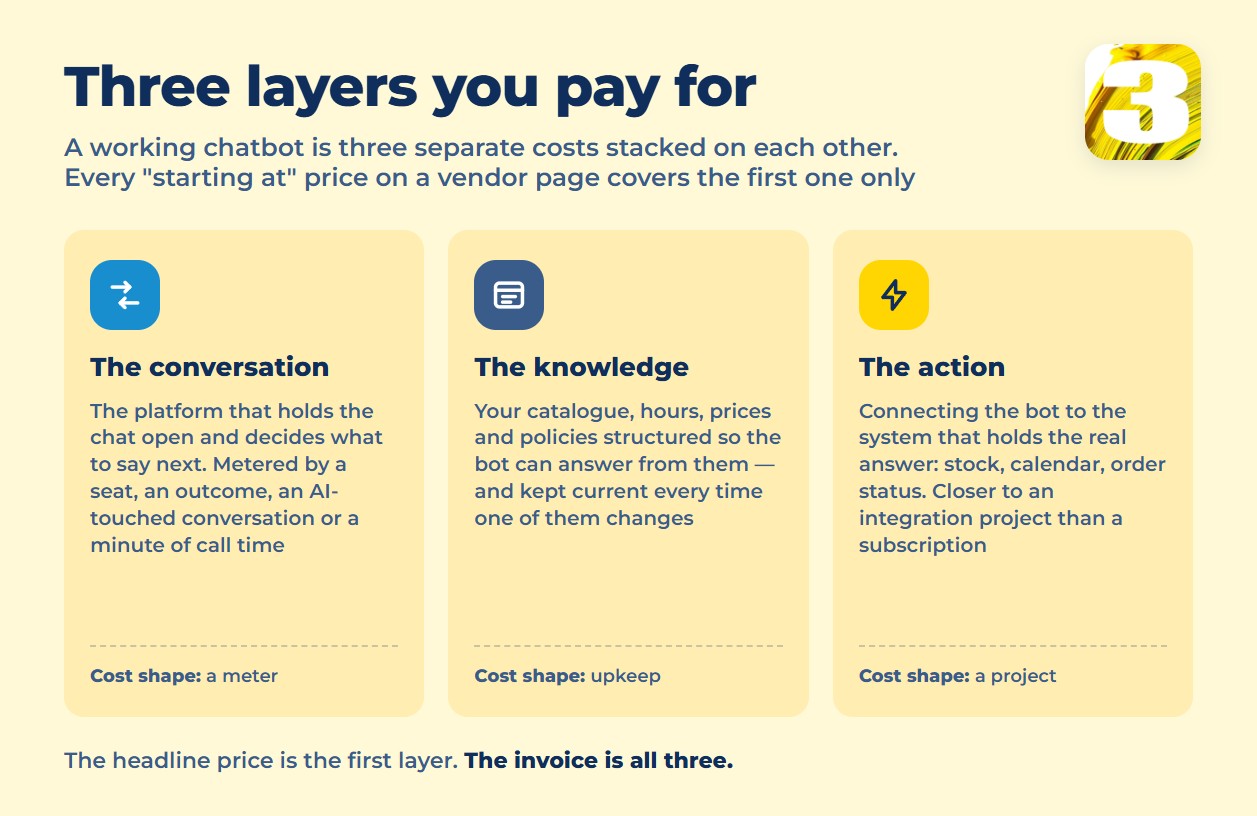
Which layer bites first depends on what you’re asking the bot to do. A bot that answers “are you open Sunday” lives almost entirely in the first two. A bot that books the Sunday slot has all three — and the difference between a bot that answers and one that acts is where most quotes quietly diverge.

What the Big Platforms Actually Charge for the Conversation
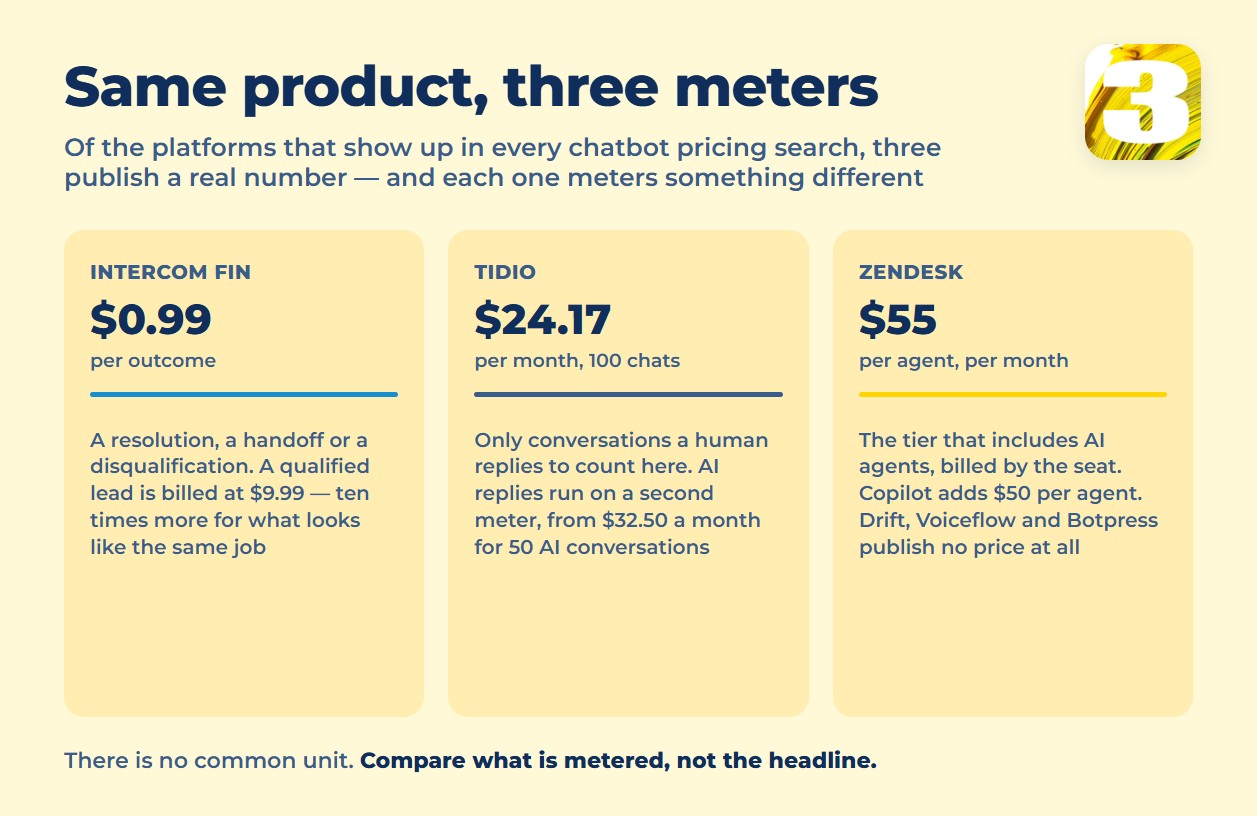
Here’s what’s published, directly from vendor pricing pages, with the honest note that three of the six platforms below don’t publish a number at all.
| Platform | What’s actually metered | Starting rate |
| Intercom Fin | Outcome — resolution, procedure handoff, or disqualification at $0.99 each; qualifying a lead runs $9.99, ten times more | $0.99 per outcome, 50-outcome monthly minimum when connected to a third-party helpdesk, plus $29 per helpdesk seat/month |
| Tidio | “Billable conversation” — a chat carrying a message from a human agent; Lyro AI conversations are billed on a separate meter | Starter from $24.17/month; Lyro AI from $32.50/month for 50 AI conversations |
| Zendesk | Per-seat pricing for the tier that includes AI Agents; Copilot is a separate per-agent add-on | Suite Team $55/agent/month billed annually, plus $50/agent/month for Copilot |
| Drift (Salesloft) | Not published | The pricing page’s own words: “please contact us” |
| Voiceflow | Not published | Usage-based billing described only as “transparent,” no rate shown; enterprise sales get a demo, not a number |
| Botpress | Plan names only — Pay-as-you-go, Plus, Team, Enterprise | No public rate we could verify without signing up |
Notice what that table is actually saying: of the six platforms above, only three publish a real number, and each of those three meters something different — an outcome, a conversation, a seat. There is no common unit to compare them on. That’s the state of the market, not a gap in this comparison.
One platform is missing on purpose. ManyChat is cheap enough to matter to a small business, but its pricing page wouldn’t open for verification, so its numbers aren’t in the table. Quoting a price we couldn’t read would be exactly the habit this article is complaining about.
What Happens to Your Bill as Volume Grows
The starting price on a pricing page is almost always the lowest tier at the lowest volume. Here’s the same math extended to volumes a real small or mid-size business actually sees, using three different published metering models — a per-outcome text bot, a per-minute voice line, and a per-message channel. These are calculations built from each vendor’s own published rate, not a vendor’s promise about what your bill will be.
| Monthly volume | Per outcome — Fin, $0.99 per resolution | Per minute — Vapi platform fee, $0.05/min, 3-minute call | Per message — Twilio’s WhatsApp send fee, $0.005 each |
| 500 | $495 | $75 | $2.50 |
| 2,000 | $1,980 | $300 | $10 |
| 10,000 | $9,900 | $1,500 | $50 |
The three columns are not comparable with each other. Each one counts a different unit — a resolved outcome, a three-minute phone call, a single delivered message — and a message is not the same event as a resolved case. Read each column down, never across. Three more things worth knowing before you read the table as final:
- The Fin column uses the $0.99 “resolution” rate. If a meaningful share of your conversations are lead qualification rather than support resolution, Fin’s own page prices that at $9.99 per outcome — ten times the number in this table, for what looks like the same job from the outside.
- The Vapi column is the platform’s own orchestration fee, and Vapi says so directly: it “excludes model provider costs” — the speech recognition, the language model, and the voice synthesis are billed separately, on top of the number above.
- The Twilio column is Twilio’s own messaging fee for sending through WhatsApp, not Meta’s per-message charge on top of it. Meta’s rates vary by country and category, and the rates for service messages — which become billable on October 1, 2026, when non-template replies inside the free 24-hour window stop being free — will be equal to the utility and authentication rates for the same country. Meta has said it will publish them no later than September 1, 2026. Until then, price a WhatsApp bot off your country’s current utility rate and re-check in September; the full breakdown of WhatsApp’s categories and dates is a separate article.
Build Once Instead of Subscribing
There’s a version of this that doesn’t involve a platform subscription at all: a bot built once, for your specific catalog, policies, and systems, running on infrastructure you control rather than a vendor’s metered account. It’s worth pricing with the same three layers, because it has all three too.
The conversation becomes tokens instead of a meter — billed by how much text goes in and out, not by how many customers you helped. Anthropic’s own worked example puts it in concrete terms: processing 10,000 support tickets, at an average of roughly 3,700 tokens per conversation, on their Haiku 4.5 model comes to about $37 total — call it 0.37 cents per conversation. That’s a vendor’s illustration of their own pricing, not a number we measured, and it moves with the model you run, the length of your conversations, and how much of your knowledge base gets pulled into each answer. Add the server the bot runs on: a fixed monthly hosting bill, in the range of a small business’s other hosting, and unaffected by how busy the bot is.
The knowledge and the action don’t get cheaper because you own the code. Structuring your catalog and policies into something a bot can answer from, and connecting it to whatever system holds real-time inventory, booking, or account status, is project work either way — and it’s the part worth getting a fixed scope for in writing. What workflow automation costs is the closest published guide to what that integration work involves.
And a subscription genuinely wins in three cases. If your volume is low, a metered plan can cost less than a build for a long time. If you need a full helpdesk around the bot — tickets, routing, reporting, an SLA — buying that whole stack beats assembling it. And if nobody inside your business will own the system after launch, a vendor’s support desk is worth paying for. The difference isn’t that one option is better; it’s whether your monthly bill ends up near-fixed or running faster the busier you get.

Three Costs That Never Make It Into a Quote
Keeping the knowledge current. A bot answers from whatever you loaded into it. Change a price, add a service, shorten your hours, revise a return policy — and until someone updates the source the bot reads, it keeps confidently telling customers the old version. No vendor prices that upkeep, because it isn’t their work; it’s yours, or your agency’s, forever. It’s also the single most common reason a bot that launched well starts embarrassing a business six months later, which is a longer story in itself — see what a chatbot knowledge base actually does.
The human behind the handoff. Every honest bot has a line it won’t cross, and someone has to be there when it does. That has two costs. One is staffing: a handoff that lands in an inbox nobody watches at 7 pm is not a handoff — which is the same problem as a phone call after closing time, in a different channel. The other is metered, and it surprises people — on Intercom Fin, a “procedure handoff,” where the bot recognizes it’s out of depth and passes the conversation to a person, is billed at the same $0.99 as a resolution. You pay the same for the bot solving it and for the bot knowing it can’t.
Knowing whether it worked. If a conversation the bot handled doesn’t show up anywhere in your reporting as a lead, an inquiry, or a booking, then the channel is invisible to whoever decides your budget next quarter. Plenty of businesses discover this only when they try to justify the subscription and find they can’t. Deciding, before launch, what counts as a result and where it gets recorded costs an afternoon; reconstructing it a year later costs the renewal argument.
None of these three appear on a pricing page, and none of them are optional. They’re the difference between a chatbot that gets renewed and one that quietly gets switched off.
Questions to Ask Before You Sign Anything
A few questions, asked before a contract or a platform trial, catch most of the surprises in this article before they land on an invoice:
- What exactly is metered — a seat, a conversation, an outcome, a message, or a minute? Get the definition in writing, not the sales page’s summary of it.
- What does the bill look like at your real monthly volume, not the lowest published tier? Run the arithmetic yourself, the way the table above does — and before you sign, run it against a free trial: Fin offers 14 days without a card, Tidio starts every account with 50 free AI conversations, and Retell gives $10 in credits. Two weeks of counting your own outcomes beats any estimate in this article.
- Is keeping the bot’s knowledge current — new prices, new hours, a policy change — included in the subscription, or billed separately as support hours or a maintenance retainer?
- Does connecting the bot to your inventory, calendar, or CRM come with the platform, or is it scoped and priced as a separate integration project?
- If any of this runs on WhatsApp: is the quote you’re being given built for the pricing that exists today, or for the per-message charges on service and utility messages that take effect October 1, 2026?
- Does the advertised starting price stand alone, or is it bundled with a required seat fee, minimum volume, or a second product you’d also need to buy?
Talk to Us Before You Commit to Anything
You don’t need a full audit to get an honest answer here. Send us two things: roughly how many customer conversations you handle in a month, and the three questions your customers ask most often. We’ll run your volume through the three metering models in the table above and send back what each one would actually bill you, plus a plain answer on whether a bot could handle those three questions and what it would need to be connected to in order to do it. That’s a smaller ask than a sales call, and it’s the fastest way to find out whether your case is a $0.99-per-outcome problem or a $9.99-per-outcome one.