


Call your own business tonight, after closing, and listen to what actually happens. At most small businesses, the phone rings a few times and drops into voicemail — or it doesn’t ring at all, because the line was switched to “do not disturb” at 6 pm. Nobody checks that voicemail until the next morning, if anyone checks it at all.
There’s a ladder of fixes here, and it’s worth walking from the cheap end up, because most of what gets sold as “the answer” starts two or three rungs higher than most businesses need.
- Cheapest: an automatic text sent to anyone whose call you missed, with a link to a short contact form, and the answer delivered into whatever your team actually opens in the morning. This alone closes most of the gap — the caller gets an immediate reply, and you get a written request instead of a voicemail nobody plays back. There’s no monthly meter on it either; it’s a one-time wiring job between your phone, your form and your calendar.
- Middle: a live answering service — a real person, usually shared across several businesses, who takes a message or books a simple appointment.
- Most expensive, and not for everyone: a voice bot that answers the call itself, holds a conversation, and tries to book or qualify on the spot.
None of these is automatically the right one. A text-back and a form cover most missed calls at a fraction of the cost of a voice bot, and for a lot of small businesses that’s the entire fix. A voice bot earns its cost when call volume is high enough, or complex enough, that a form alone loses too many people. Most vendors selling “24/7 AI receptionist” skip the first two rungs entirely, because there’s no recurring revenue in a text message.
The One Real Study, and Why Its Date Matters
Almost every scary statistic in this topic comes from a company that sells the fix — which doesn’t make the numbers false, but it does mean they’re motivated. There is exactly one independent-looking study behind most of them: 411 Locals listened to the phones of 85 small businesses across 58 industries for 30 days. A live person answered 37.8% of calls. Another 37.8% went to voicemail. 24.3% got no answer at all — no voicemail, nothing.
Here’s the part that matters most: that data was collected in 2013–2015 and published in 2016. It’s now cited across vendor blogs written in 2025 and 2026 as if it were a current finding. Phone habits, voicemail habits, and text habits have all shifted in a decade, and nobody has repeated the study since. Treat the 37.8/37.8/24.3 split as a decade-old snapshot worth taking seriously, not a current measurement of your market.
The other numbers you’ll run into — “85% of callers never call back,” “$126,000 a year in lost business,” “43% of calls happen after hours” — trace back to the marketing pages of companies selling answering services and voice bots, not to independent research. That doesn’t automatically make them wrong. It means you should read them as a seller’s estimate, not a fact, and decide for yourself whether they apply to your business.
If You Do Add a Voice Bot, Here’s the Real Meter
The advertised “price per minute” on voice platforms covers only the orchestration layer — the part that routes the call. The bill also includes speech recognition, the language model, speech synthesis, and the phone line itself, and vendors don’t always put those on the same page as the headline number.
Retell AI advertises $0.07–$0.31 per minute and breaks down what’s inside that range on its own pricing page: infrastructure around $0.055/min, speech synthesis around $0.015/min, the language model $0.003–$0.16/min depending on which one you pick, and telephony around $0.015/min. A knowledge base adds $0.005/min, and a branded caller ID is $0.10 per outbound call.
Vapi’s platform fee is $0.05/min plus $0.005 per message, and its own pricing page says plainly that this “excludes model provider costs” — the model, the transcription, and the voice are billed separately, on top.
Then there’s the phone line itself. Twilio’s published rates: outbound calls to local or toll-free numbers run $0.0140/min; inbound calls to a local number are $0.0085/min plus $1.15/month to keep the number; inbound to a toll-free number is $0.0220/min plus $2.15/month. Text messages add $0.0083 per SMS plus a carrier fee of $0.0025–$0.0045.
None of these numbers is wrong on its own. The mistake is reading the headline figure and assuming it’s the whole bill.
What Actually Happens After the Call — Check This Yourself
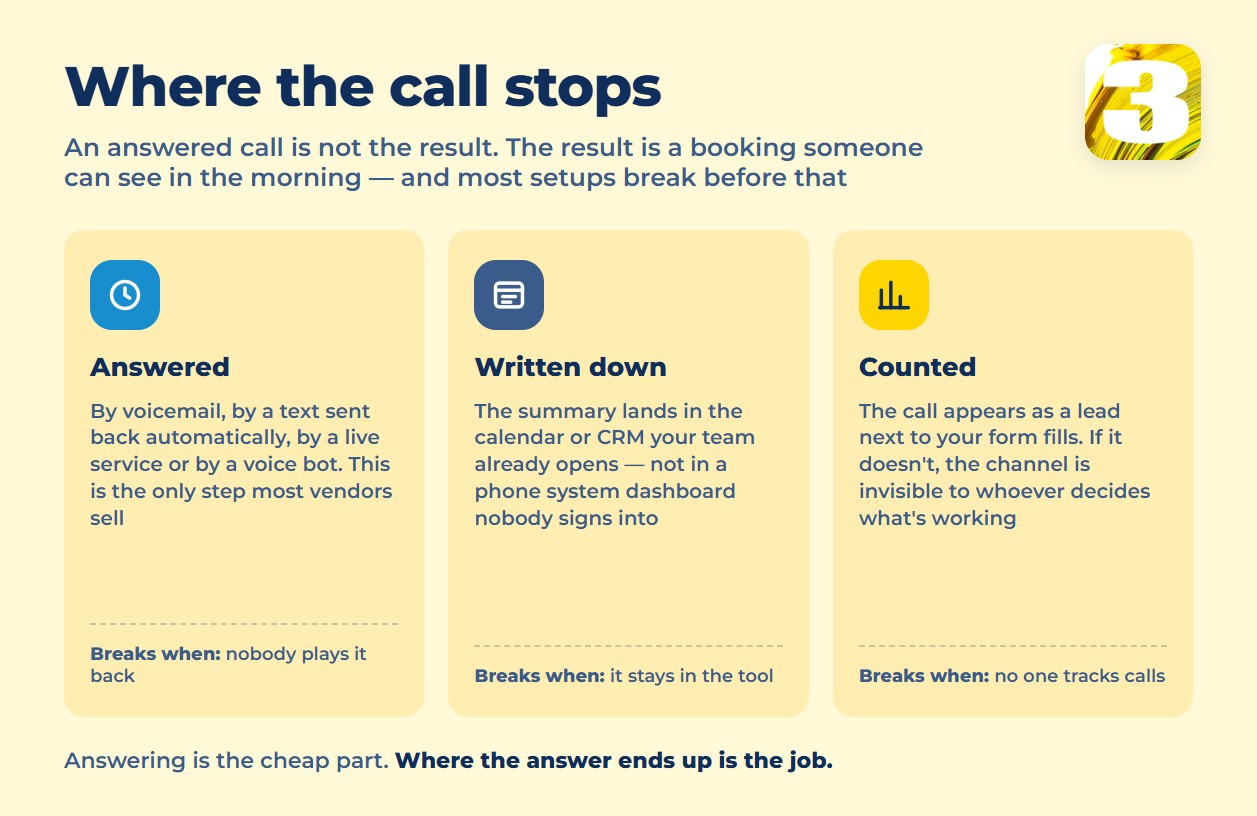
Whatever you already have in place — voicemail, a live service, or a bot — the answered call isn’t the finish line. Run through this list against your own setup:
- Does the summary of the call land in your calendar or CRM, or does it sit inside the phone system’s own dashboard where nobody looks?
- Does that call count as a lead in your marketing numbers? If it doesn’t show up in the same report as your form fills, the channel is invisible to whoever is deciding what’s working.
- What happens when the bot quotes the wrong price? Who finds out, and how long does it take?

Where Voice Bots Still Trip Up
Names, street addresses, and phone numbers said out loud are still where voice bots misfire most — homophones, spelling, and background noise all work against speech recognition in ways typed text doesn’t. For most businesses that’s a minor annoyance. For field services, the address isn’t a detail attached to the job — the address is the job, and a slightly wrong street number is a truck on the wrong block. That’s why our own project tracking pulls the job site address straight out of the incoming request rather than leaving it to be retyped from a call summary.
Do You Have to Tell Callers It’s a Bot?
In California, the B.O.T. Act (SB 1001) has required clear disclosure when a bot is used to influence a sale since 2019 — but the law’s disclosure duty and its “10 million monthly US visitors” platform threshold are written in a way that leaves real ambiguity about whether a small business’s own bot on its own phone line is covered. Don’t assume either extreme: it isn’t obviously exempt, and it isn’t obviously in scope either. Read the text yourself before deciding.
Canada has no federal law requiring bot disclosure right now. ISED opened a public consultation on AI transparency on July 23, 2026, including when a caller has to be told they’re speaking to a machine — but nothing is law yet.
The practical takeaway either way: a short line — “you’re speaking with our automated assistant” — costs nothing and closes the question before it becomes one, regardless of which jurisdiction eventually settles the rule.
What We See From the Other Side
We run our own lead-tracking system, and it shows something standard analytics misses entirely: requests that arrived through AI assistants rather than search or ads. Search Console reports no clicks from AI answers at all, and GA4’s channel groupings miss a good share of that traffic. It’s the same pattern as an after-hours call — a channel that works, but goes uncounted until someone builds a way to see it. What a chatbot actually costs walks through the bill layer by layer if you decide you need one, and how routine work gets automated covers the plumbing behind it.
So finish the test this article started with. We’ll tell you which rung of the ladder you actually need. That’s a smaller question than “which vendor,” and it’s the one worth answering first.