


Every page you create and every ad you run starts with one assumption: what your audience is searching for.
The problem? Most businesses guess. They plug a seed word into Keyword Planner or a paid equivalent, take the highest-volume terms, and push them into content or Google Ads. And then they wonder why bounce rates climb or conversions stay flat.
Effective keyword research isn’t about volume. It’s about alignment between query, intent, and your offer.
High Volume, Low Intent: The Traffic Trap
It’s easy to chase keywords like “CRM” or “cloud storage.” They look exciting — thousands of monthly searches, lots of visibility.
But what are people actually looking for when they type those phrases? It’s often:
- Reviews
- Definitions
- Job listings
- Open-source tools
Not your paid product.
The real win comes from low-volume, high-intent searches like “CRM for freight companies with 5 users” or “secure cloud storage for legal teams.” Fewer clicks, but a clearer match.
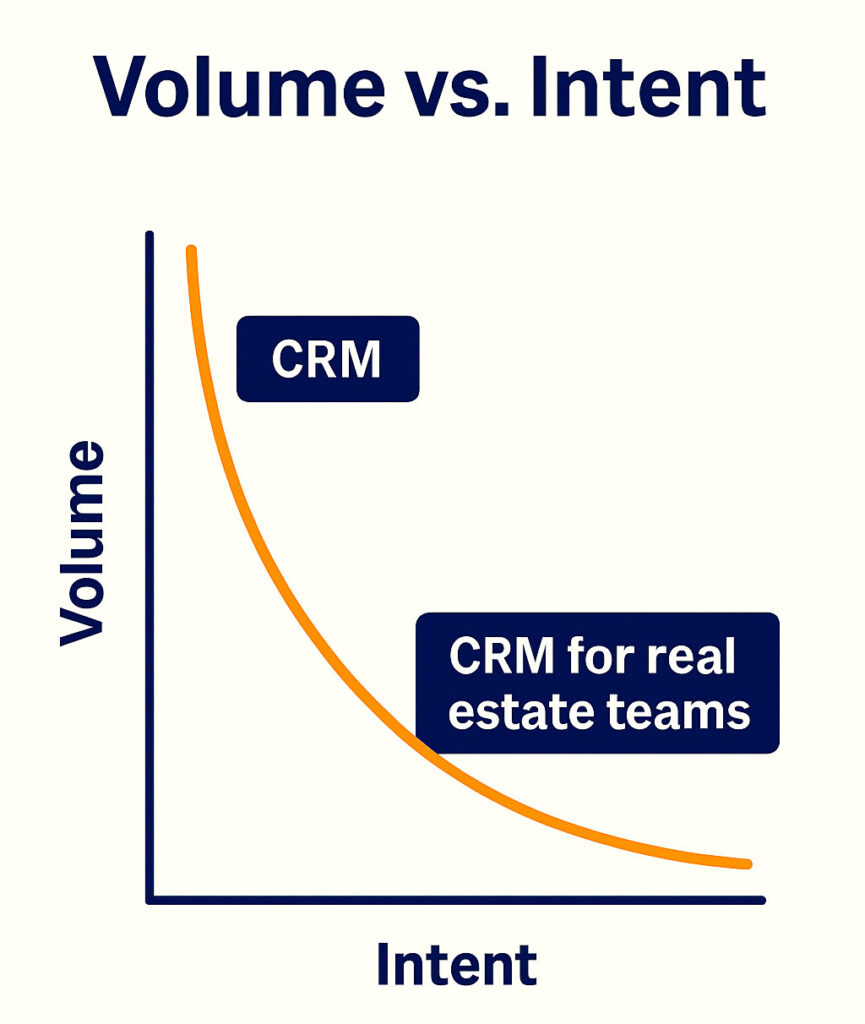
Here’s how that trade-off looks in practice: the higher the search volume, the lower the specificity and conversion intent and vice versa.
Long-Tail Isn’t Optional — It’s Where Conversion Lives
The internet has matured. Users don’t search in one or two words. They use full questions, comparisons, and context:
- “Best CRM for logistics startups”
- “Cloud backup that works with Synology”
If your strategy only targets short-tail head terms, you’re ignoring the majority of commercial intent.
The best-performing pages we manage often rank for dozens of long-tail phrases — not a single fat-head keyword.
Keyword Alignment Table: Good Query vs. Bad Query (And Why It Matters)
| Bad Query | Good Query | Why It Matters |
|---|---|---|
| crm | crm for real estate teams | Generic vs. niche. The second targets a defined vertical with clear purchase intent. |
| website builder | website builder for multilingual stores | Adds commercial specificity and use-case clarity. |
| analytics | GDPR-compliant analytics for EU businesses | Matches legal requirement — higher intent, lower bounce. |
| email platform | email platform with API for developers | Feature-level intent is more likely to convert. |
| free vpn | secure vpn for remote employees | “Free” attracts non-buyers. Second shows use case and commercial interest. |
| ai chatbot | ai chatbot for B2B customer support | Adds audience and purpose — better ad match and conversion likelihood. |
| crm reviews | compare crm tools for logistics startups | From browsing to comparison — signals decision-making behavior. |

Don’t Let Tools Make Your Decisions for You
Keyword tools are useful. But they’re not strategic thinking.
They give estimates, trends, suggestions — not direction. They don’t know your product, your funnel, or your audience nuances.
Every good keyword strategy requires:
- Reviewing actual SERPs to understand Google’s interpretation
- Mapping keywords to buyer stages
- Validating terms against real-world conversion data from Google Ads, Search Console and your CRM
Grouping, Structure and Page Purpose
One of the most common failures is shoving too many keywords onto a single page — or worse, trying to make one ad speak to four types of searchers.
Google rewards focus and clarity.
That means:
- A landing page should match one type of query
- Informational content should live separately from commercial intent
- Paid campaigns should use tight keyword groups (ideally one intent per ad group)
The more specific the experience, the better the performance.
The Negative Side of Keyword Research
In paid campaigns, what you exclude is just as important as what you include.
Businesses often waste thousands on irrelevant clicks from:
- Job seekers
- DIY queries
- Misaligned audiences (e.g., someone searching “open-source” when you’re selling enterprise)
A real keyword strategy includes a live negative keyword list that evolves with your campaign.
It also includes a deliberate choice of keyword match types. Match type decides how loosely Google is allowed to read each term you buy — and a broad setting quietly reintroduces the same irrelevant traffic your exclusions were meant to stop.
Keyword Strategy Is a Process, Not a One-Time Task
Most companies treat keyword research like a static deliverable. Do it once. Check the box. Move on.
But markets shift. Search behavior evolves. Google’s SERPs change — introducing new elements (maps, snippets, video, etc.).
What worked 12 months ago may now miss the mark.
That’s why at 3MY we treat keyword strategy as ongoing market intelligence.
We revisit queries, test new angles, and update targeting quarterly — or faster in fast-moving niches.
How We Approach Keyword Research at 3MY
We don’t just ask “what’s being searched.” We ask:
- Who’s searching this?
- What stage of the funnel are they in?
- What kind of content or offer best matches their intent?
- Are we earning or buying this click — and how much is it worth?
We combine:
- SEO keyword mapping
- Paid campaign targeting
- SERP analysis
- Real-time performance data
Put together, those four inputs build keyword strategies that connect your offer to actual demand — not just to abstract queries.
Need a Second Set of Eyes?
If your ads attract clicks but not clients — or your content ranks but doesn’t convert — it may be your keywords that are misaligned.
Book a Strategic Keyword Review
We’ll dig into your targeting, surface the critical gaps, and map a keyword strategy that actually moves the numbers.