


If you searched “Google Guaranteed” to figure out how to get the badge for your business, some of what you read probably doesn’t match what’s actually on Google’s site right now. That’s not you missing something — it’s the articles. Google renamed the badge, folded three separate programs into one, and quietly ended the guarantee that used to be the whole pitch.
Here’s what the pages say today, not what they said a year ago.
One Badge Instead of Three
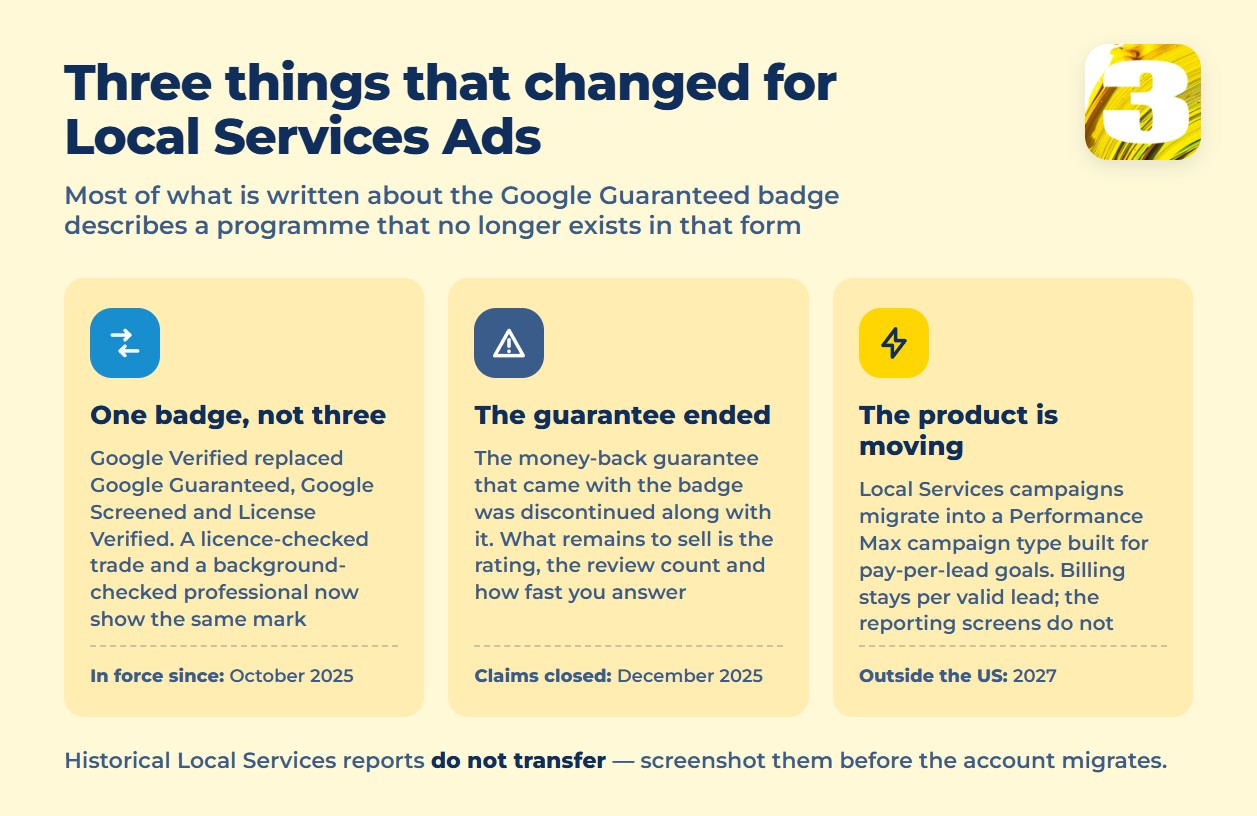
As of October 2025, there’s no more separate Google Guaranteed, Google Screened, or License Verified badge to earn. Google merged all three into a single badge called Google Verified. Google’s own announcement puts it in one sentence: “Google Verified will replace other LSA badges and programs, like Google Guaranteed, Google Screened, License Verified by Google and the Money Back Guarantee.”
The support page that now governs the program describes what’s left: “The Google Verified badge helps inspire confidence by signaling to consumers that your business has passed Google’s proprietary screening process.”
Practically, that means a plumber who passed a license and background check now shows the identical badge as a lawyer who only passed a background check. The distinction shoppers used to see between “guaranteed” trades work and “screened” professional credentials is gone. One badge, one meaning, whatever the underlying check actually covered.

The Guarantee Is Gone Too
The badge used to come with a promise: if a job went wrong, Google would refund the customer. That guarantee no longer exists. Google’s support page states it plainly: “Google will be discontinuing the Money Back Guarantee associated with the Google Guarantee badge.”
There’s no coverage figure anywhere on the current pages, and the reimbursement window for services booked through Local Services Ads closed in December 2025. If your sales pitch still includes “book through Google Guaranteed and your money’s protected,” that line is no longer true — and a customer who checks will find you wrong. What’s left to sell is what was always underneath the badge: your rating, your review count, and how fast you answer. That part didn’t disappear. It’s just the only part left.
The Bigger Change: Local Services Ads Are Moving Into Performance Max
This is the part most competitor content hasn’t caught up to, and it’s worth acting on this month if you run ads in the US. Google is migrating Local Services Ads into a specialized campaign type built for pay-per-lead goals inside Performance Max. The support page describing the transition is direct about it: “existing Local Services Ads campaigns will be automatically migrated to a specialized Performance Max campaign type optimized specifically for pay-per-lead goals.”
Billing doesn’t change — you still pay for a valid lead, not a click — but the campaign structure and reporting screens do. Google’s stated timeline: the first wave started in August 2026, covering a set of US home-service categories (plumbing, HVAC, electrical, appliance repair, cleaning, lawn care, roofing, pest control, moving). Broader groups of advertisers follow by the end of 2026. Everyone outside the US — Canada included — moves in 2027.
One detail worth acting on now: historical performance data does not carry over into the new campaign. Screenshot the current Local Services reporting before your account migrates — Google’s notices land 14 and 7 days ahead, easy to miss in a busy inbox.
Who Can Actually Get the Badge
Before chasing Google Verified, check whether your category qualifies — the list is shorter than most people assume, especially in Canada. Canadian eligibility covers 16 categories, and every one is a home service: appliance repair, carpet cleaning, house cleaning, electricians, HVAC, junk removal, lawn care, locksmiths, movers, pest control, plumbers, roofers, tree care, water damage, and window cleaning or repair.
Lawyers, dentists, and financial planners aren’t on the Canadian list at all — those categories only exist on the US list. Auto services, beauty, and restaurants don’t appear on the list Google publishes today. If someone is offering you the badge in one of those categories, that offer doesn’t match what Google’s own eligibility page currently allows.
How Local Services Actually Charges You
The billing logic is worth knowing before the Performance Max migration changes the screens you’re looking at, because the logic itself isn’t changing. Google’s support page is direct about what you pay for: “You’re charged for each valid lead you receive through your Local Services ad.”
A valid lead is a message, a voicemail or completed exchange with the automated system, an answered call with an actual conversation, a missed call the business returned, or a booking request. Anything short of that shouldn’t be billed.
Budget runs on a weekly average, not a daily cap: Google explains that “your average weekly budget determines the number of leads you’d like to receive in any given week.” Figuring out what a whole month of advertising should cost — not just this one channel — takes different math. There’s a separate piece on what a month of Google Ads actually costs.
Bad leads get handled automatically now, not through a support ticket. Google’s lead-credit page says its machine learning models review flagged leads and, “in most cases, credits will be applied to your account balance within 30 days.” That automatic system doesn’t cover everyone — it’s unavailable for medical categories, tax professionals, and advertisers in EMEA.
A Different Auction: Reviews Outweigh the Bid
Local Services Ads don’t run on the same auction logic as Search. Google says so directly: “The auction is the process Local Services Ads uses to order profiles for a given search, taking into account bid and overall profile quality.”
Profile quality means “your rating, number of reviews, average response time, use of high-quality images, the verification checks” — weighed alongside the bid, not after it. So a business that answers the phone faster and keeps its photos current can outrank a higher bidder, and thin reviews with a stock photo can’t be bought past with budget alone.
What This Means for Your Account
None of this makes Local Services Ads useless — it makes the pitch honest. The refund guarantee that used to close the sale is gone; what’s left to sell is the review count and the response time, and those only work if someone is actually watching them.
The gap between a “lead” logged as an answered call in your dashboard and a customer who never actually spoke to anyone is common — and it’s exactly what dynamic call tracking by channel is built to catch, so you dispute the right ones instead of quietly paying for dead air.
Local Services Ads also don’t replace a Search campaign — they sit next to it, showing above the map pack for a narrow set of categories, while Search still covers everything else you sell and every market where Google Verified isn’t offered. We run both types in the same account rather than treating them as competing budgets, the same way we handle paid placement inside Maps for clients whose category qualifies. how paid pins on Google Maps actually work If your category was never eligible for the badge, building a proper search campaign is still the whole game.